Redfish Lifespan Calculator
Estimate red drum age, likely lifespan, maturity, biology-only size class, and confidence from total length, girth or weight, estuary or coastal habitat, salinity zone, growth region, and measurement quality.
📌Redfish presets
⚙Red drum measurements and habitat
Redfish lifespan estimate
Estimated red drum age, lifespan, size class, and confidence will appear here.
Calculation breakdown
📊Redfish growth and habitat comparison grid
Tidal Creek
Open Estuary
Surf Zone
Inlet Pass
Offshore School
📘Reference tables
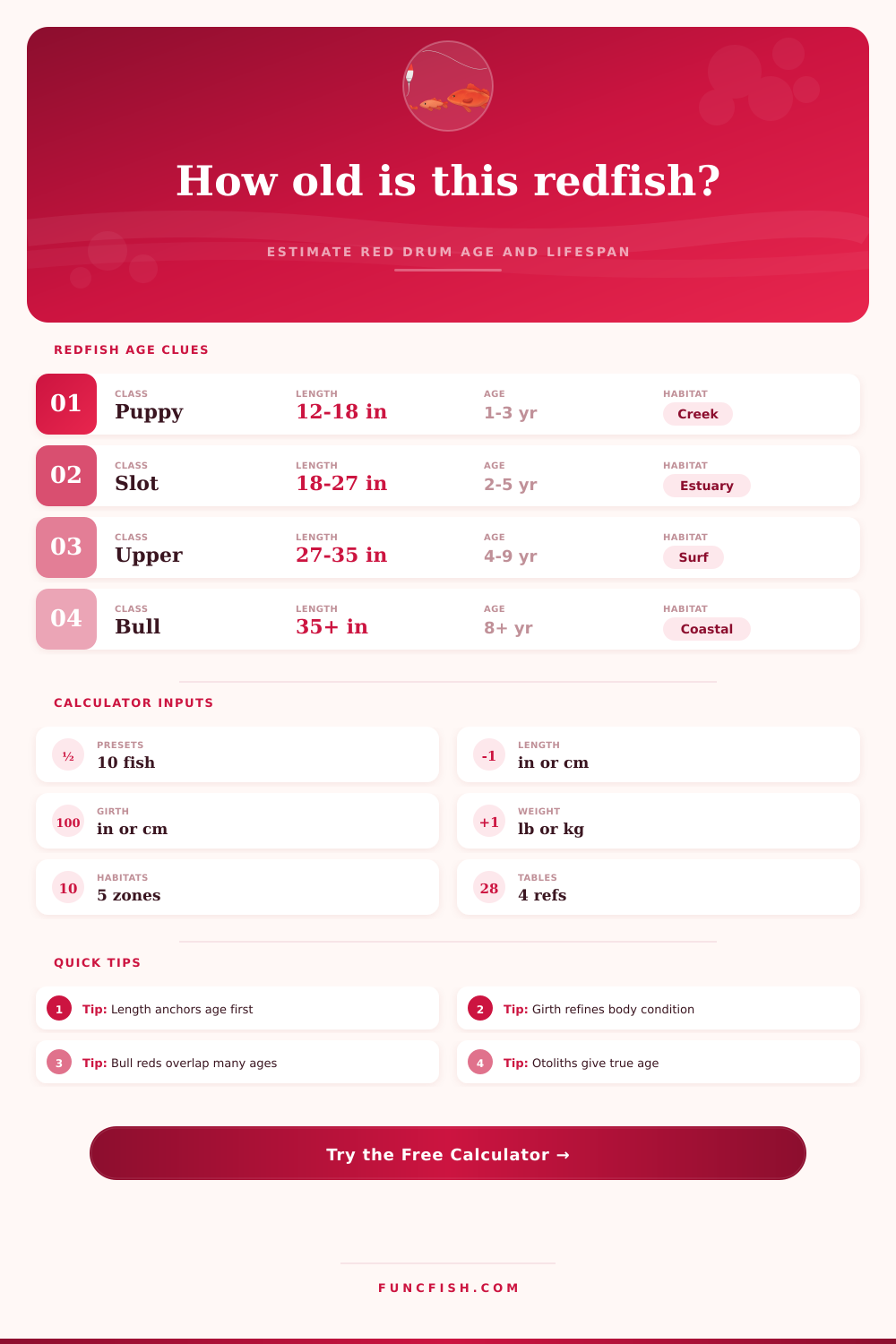
| Biological class | Total length | Common age signal | Maturity signal | Interpretation |
|---|---|---|---|---|
| Puppy drum juvenile | 8-18 in / 20-46 cm | Age 0.5-3 | Immature to subadult | Mostly creek, marsh, and shallow bay growth |
| Slot-class adult, biology band | 18-27 in / 46-69 cm | Age 2-5 | Approaching or reaching maturity | Fast growth years can overlap across several ages |
| Upper adult transition | 27-35 in / 69-89 cm | Age 4-9 | Mature adult likely | Often moving between estuary, surf, pass, and nearshore zones |
| Bull red adult | 35-45 in / 89-114 cm | Age 8-25 | Spawning-capable adult | Large redfish overlap widely because growth slows after maturity |
| Elder bull red | 45+ in / 114+ cm | Age 18+ | Older adult | Size alone becomes less precise; confidence band widens |
| Habitat class | Age modifier | Typical size class | Salinity fit | Model effect |
|---|---|---|---|---|
| Tidal creek or marsh pond | Younger at length | Puppy to slot-class | Low to brackish | Favors faster juvenile growth and lower lifespan signal |
| Open estuary or bay | Baseline | Slot-class to upper adult | Brackish to marine | Uses the central age curve for most field estimates |
| Surf zone or beach trough | Slightly older | Upper adult to bull | Marine | Raises age estimate for larger mobile fish |
| Inlet, pass, or channel mouth | Older adult signal | Bull adult | Marine to oceanic | Adds maturity and movement confidence for large fish |
| Nearshore or offshore school | Oldest signal | Bull to elder bull | Oceanic | Same length can represent a wider older age band |
| Salinity zone | Range | Best fit | Age effect | Confidence note |
|---|---|---|---|---|
| Low brackish | 5-12 ppt | Nursery creeks | Usually younger | Best paired with small to mid-size redfish |
| Brackish mix | 12-22 ppt | Marsh edge and bay | Near baseline | Good fit for estuary fish and slot-class adults |
| Marine mix | 22-35 ppt | Open bay and surf | Baseline to older | Strong fit for mature adults and pass fish |
| Oceanic | 35+ ppt | Coastal schools | Older adult signal | Supports bull red or elder bull interpretation |
| Hypersaline lagoon | 40+ ppt | Shallow lagoon | More variable | Widens band because growth can be unusual |
| Input quality | Best measurement | Secondary clue | Age band | Why it matters |
|---|---|---|---|---|
| Rough visual estimate | Approximate length | Habitat class | Wide | Small length errors can move a red drum by several age years |
| Tape plus one body metric | Total length | Weight or girth | Medium | Body condition helps separate heavy fish from older fish |
| Measured length, girth, and weight | Total length and whole weight | Girth | Narrower | Agreement between body metrics improves confidence |
| Otolith or tag age context | Known age clue | Current length | Tightest | Hard-part or tag evidence anchors the biological estimate |
💡Calculator notes
After maturity, red drum often add length slowly. A 40 inch fish can represent a broad adult age band, so habitat and confidence inputs matter more for bull-class fish.
When scale weight and girth agree with the length-weight curve, the calculator narrows the confidence band. When they disagree, it treats condition as uncertain.
Redfish are a type of fish that are often studied along the Gulf and Atlantic coasts. Many individuals want to know the age of a redfish and to understand the age of a redfish allows an individual to understand the life cycles of that particular fish. Understanding the life cycle of the redfish is important in that the life cycle will tell an individual whether or not a redfish has many year of spawning left to contribute to it’s species, or whether the redfish has already spent the majority of its life spawning.
The length of a redfish is often used as an indicator of the age of the fish. Redfish, when young, tend to exhibit a growth pattern in relation to the length of the species. For instance, a redfish that is twenty inches in length is usually a few years old.
How to Tell the Age of a Redfish
However, a redfish that is forty inches in length is more difficultly to age based off length alone. Redfish tend to slow in their rate of growth after they reach the maturity stage, meaning that they may take many years to grow only a few inches in length. In these cases, people use the weight and girth of the redfish to age the fish.
Another factor that can impact the age of a redfish is the habitat in which the redfish is spotted. Redfish tend to move to different environments as they age. For instance, younger redfish tend to live in marshes and creeks, while the older the redfish, the more likely that it will be spotted in open bay and inlets.
Additionally, a redfish that is spotted in a surf zone will be of an older age than a redfish of the same length spotted in a back creek. The salinity of the water in which the redfish is spotted can have an impact upon the age of the redfish as well. Should the salinity of the water be either very high or very low, the age of the redfish may change as a result of such conditions.
The maturity stage of a redfish is another factor that can impact the age of that fish. After a redfish reaches the maturity stage, its energy shifts to tasks besides gaining in length of the fish. The fish now spends the energy that would otherwise be used to gain in length on the production of egg.
Because of this, the redfish may not grow in length as quickly as a younger redfish. An individual can use a calculator to estimate the age of the redfish by inputting information about the length, girth, weight, habitat, and salinity of the redfish. The calculator will provide the age of the redfish within a band, the upper lifespan of the redfish, and a confidence score regarding the accuracy of the estimated age.
The confidence score will indicate whether the length, girth, and weight measurements agrees with one another. Within the document are reference tables that reveal how different habitats and levels of salinity can impact the growth of the redfish. The tables also reveal that the larger the redfish, the greater the age band for that redfish.
This is due to the slow growth rate of redfish after they reach the maturity stage. Thus, two redfish of the same length may have an age difference of ten years. Such an age difference is expected for redfish of similar sizes because, again, their growth is slow after reaching the maturity stage of the life cycle.
Another factor in the age of the redfish is the region in which the redfish was spotted. For instance, redfish in Texas grow to larger sizes and reach maturity at younger ages than redfish spotted in the Carolinas. In order to provide an accurate estimate of the age of the redfish, the user can adjust the calculator for age according to the region in which the redfish was spotted.
By selecting the coast in which the redfish was caught, the calculator can adjust for regional difference in growth rates. The quality of the measurements of the redfish is another factor that can impact the accuracy of the estimated age. Should an individual make a mistake with the measuring tape when measuring the length, the girth, or the weight of the redfish, the age of the redfish will be estimated incorrectly.
A careful measurement will result in a narrow age band for the redfish. In contrast, measuring the length and age visually will result in a wide age band for the redfish. Additional to the factors discussed above are additional factors that may impact the growth of the redfish within its environment.
Factors like cold weather exposure or red tide can impact the redfish for that specific year. Additionally, redfish that live within a lagoon will grow differently from redfish that live in an estuary. Though these factors can impact the redfish population, the age estimation calculator will not provide a useless estimate for the age of the redfish.
Instead, these factors will contribute to the age of the redfish being a range of ages rather than a specific age. In order to utilize the redfish age estimation calculator, an individual should use the length and body measurements of the redfish. The estimation should also include the habitat and salinity of the redfish.
The result of the estimation should not be treated as the birthday of the redfish. Instead, the age band provided by the calculator will provide an individual with the information necessary to understand the age of the redfish spotted in its local waters.