🐟 Spanish Mackerel Weight Calculator
Estimate fish weight from length & girth — imperial & metric supported
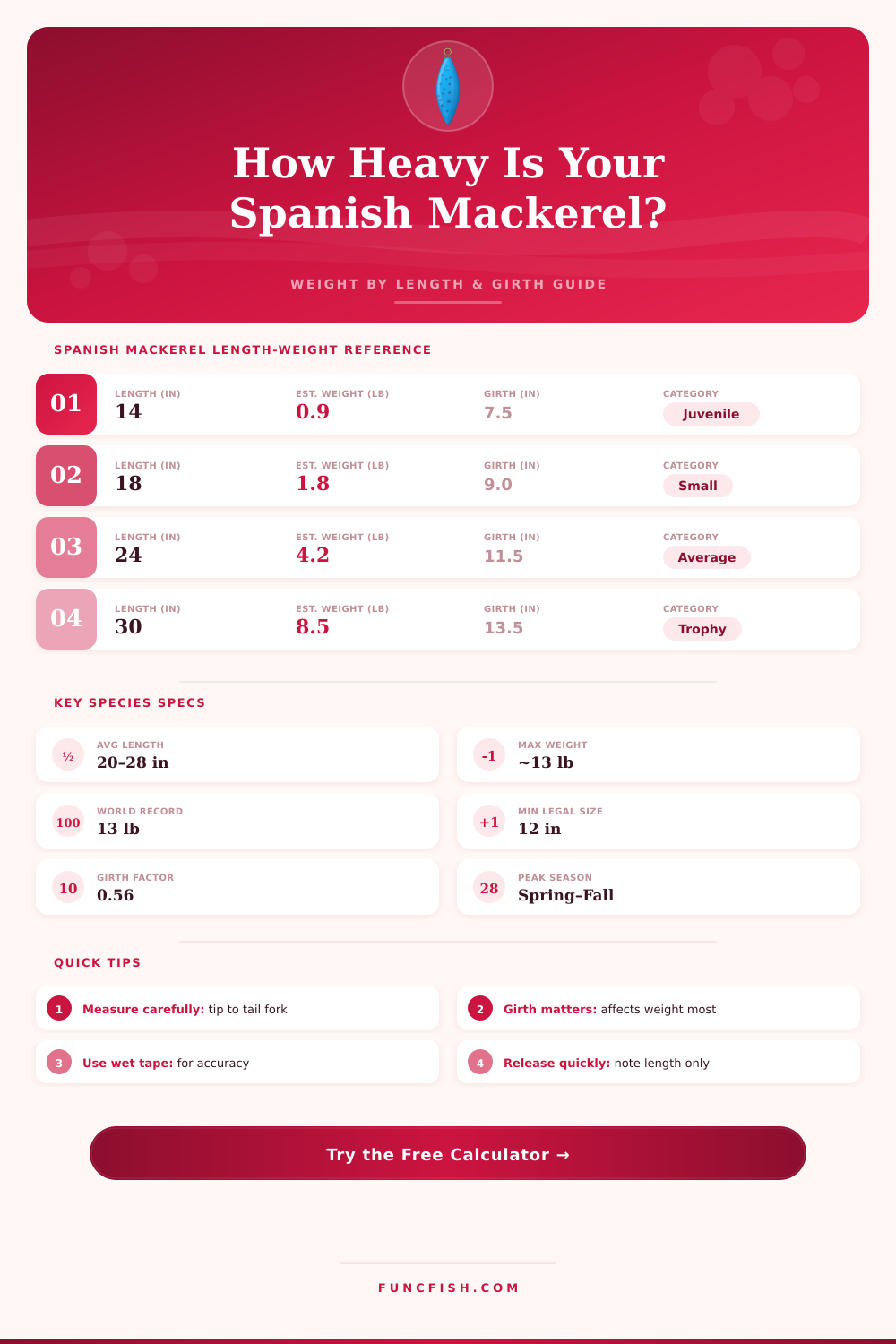
| Fork Length (in) | Fork Length (cm) | Est. Weight (lb) | Est. Weight (kg) | Typical Girth (in) | Category |
|---|---|---|---|---|---|
| 12 | 30.5 | 0.6 | 0.27 | 6.5 | Juvenile |
| 14 | 35.6 | 0.9 | 0.41 | 7.5 | Juvenile |
| 16 | 40.6 | 1.3 | 0.59 | 8.2 | Small |
| 18 | 45.7 | 1.8 | 0.82 | 9.0 | Small |
| 20 | 50.8 | 2.8 | 1.27 | 9.8 | Medium |
| 22 | 55.9 | 3.6 | 1.63 | 10.5 | Medium |
| 24 | 60.9 | 4.2 | 1.91 | 11.5 | Average |
| 26 | 66.0 | 5.8 | 2.63 | 12.0 | Above Avg |
| 28 | 71.1 | 7.2 | 3.27 | 12.8 | Large |
| 30 | 76.2 | 8.5 | 3.86 | 13.5 | Trophy |
| 32 | 81.3 | 10.3 | 4.67 | 14.0 | Trophy |
| 34 | 86.4 | 12.1 | 5.49 | 14.5 | Record Class |
| Condition | Factor | Weight Adjustment | When to Use | Girth Adj. (in) |
|---|---|---|---|---|
| Standard | 1.00 | None | Typical healthy fish | 0 |
| Lean / Slender | 0.88 | -12% | Active schooling fish | -1.0 |
| Heavy / Robust | 1.10 | +10% | Well-fed coastal fish | +1.0 |
| Post-Spawn | 0.85 | -15% | After spawning season | -1.5 |
| Pre-Spawn | 1.12 | +12% | Spring pre-spawn run | +1.5 |
| Juvenile | 0.92 | -8% | Young-of-year fish | -0.5 |
| Species | Avg Length (in) | Avg Weight (lb) | Girth Factor | Formula Divisor |
|---|---|---|---|---|
| Spanish Mackerel | 20–28 | 3–6 | 0.56 | 800 |
| King Mackerel | 30–50 | 10–30 | 0.58 | 800 |
| Cero Mackerel | 18–30 | 3–8 | 0.55 | 800 |
| Atlantic Bonito | 18–24 | 3–6 | 0.53 | 800 |
| Little Tunny | 20–28 | 5–12 | 0.60 | 800 |
| Wahoo | 40–60 | 20–60 | 0.45 | 800 |
In order to accurately estimate the weight of an Spanish mackerel, you will need to use both the length and the girth of the Spanish mackerel. These two measurement is different from one another, yet both must be utilize in order to account for the different possible body shape of Spanish mackerel throughout the year and based off there diet. For instance, a Spanish mackerel may have a relatively long body but a very thin body, or it may have a shorter body but a very thick body.
By only measuring the length of the Spanish mackerel, the estimated weight will be inaccurate due to these different body type. The fisherman should measure the length of the Spanish mackerel by measuring its fork length, the distance from the snout of the fish to the center of the V-notch located in the tail of the fish. The total length of the Spanish mackerel should not be measured with a curved tape measure, as this may stretch the tail of the fish and lead to an incorrect measurement.
How to Estimate the Weight of a Spanish Mackerel
Additionally, the girth of the mackerel should also be measured. You should measure the girth at the thickest part of the body of the Spanish mackerel. Which is typically just in front of the dorsal fin.
This measurement should be taken while the Spanish mackerel is fresh; once the Spanish mackerel is place on ice, its body may have lost some of its weight, or its body may have changed in relation to how the Spanish mackerel while place on ice. The time of year that the Spanish mackerel is caught can also impact the weight of the fish. For instance, during the spring, most Spanish mackerel will be lean and thin in their bodies.
During the fall, however, Spanish mackerel tend to have consumed many small fish, contributing to their increased weight. Thus, the season in which the mackerel was caught must also be considered when estimating the weight of the fish. Additionally, the method by which the Spanish mackerel were caught may impact the weight of the fish, as well.
For instance, if the Spanish mackerel were caught during a surface blitz, they may be lean. However, if trolling spoons caught the Spanish mackerel, they may be thicker in their bodies due to eating more bait while on the trolling lines. To reduce the margin of error in estimating the weight of the Spanish mackerel, it is possible to utilize certain tool.
For instance, a dock ruler may provide more accurate measurements than a soft tape measure. Additionally, a scale may be used to verify the estimated weight; however, the scale must be appropriate for the size of the Spanish mackerel that is being weighed. If the Spanish mackerel to be weighed is of a large size, you must utilize a heavy duty scale in order to avoid overloading the scale.
Using a scale that is too small for the size of the mackerel may result in inaccuracies with that scale. Some of the most common mistake in estimating the weight of a Spanish mackerel may be relying only upon its length. If you rely upon the length as the main measurement of the Spanish mackerel, the girth of the fish is ignored, which can lead to inaccuracies in the estimation of the weight of the mackerel.
Another potential mistake is in the estimation of the length of the mackerel by only looking at the fish with the eyes rather than using a measuring board. Estimating length by eye will lead to more inaccuracy then using a measuring board. Finally, one must remember that the Spanish mackerel caught in the Gulf of Mexico may be broader in their bodies than those Spanish mackerel that are caught in the Atlantic Ocean.
Thus, the estimation of the weight of the fish may also need to be adjusted according to the location of the Spanish mackerel caught.