Sputnik Sinker Wire Length Calculator
Estimate exposed anchor arm length, cut wire stock, arm spread, and breakout pull for surf sputnik sinkers, spider weights, long-tail grapnels, and homemade breakaway-style leads.
📌Surf sinker presets
⚙Wire and sinker settings
Use a higher target for big baits and sweep; lower it for lighter surf rods.
Typical deployed arm angles run about 28 to 48 degrees from the sinker centerline.
Include the hook bend, loop eye, folded latch, or crimped return.
Sputnik sinker wire forecast
Calculation breakdown
🛠Wire gauge reference grid
.031 in spring wire
.035 in spring wire
.041 in spring wire
.047 in spring wire
📏Wire gauge and arm length table
| Wire gauge | Metric diameter | Common sinker range | Typical exposed arm | Build note |
|---|---|---|---|---|
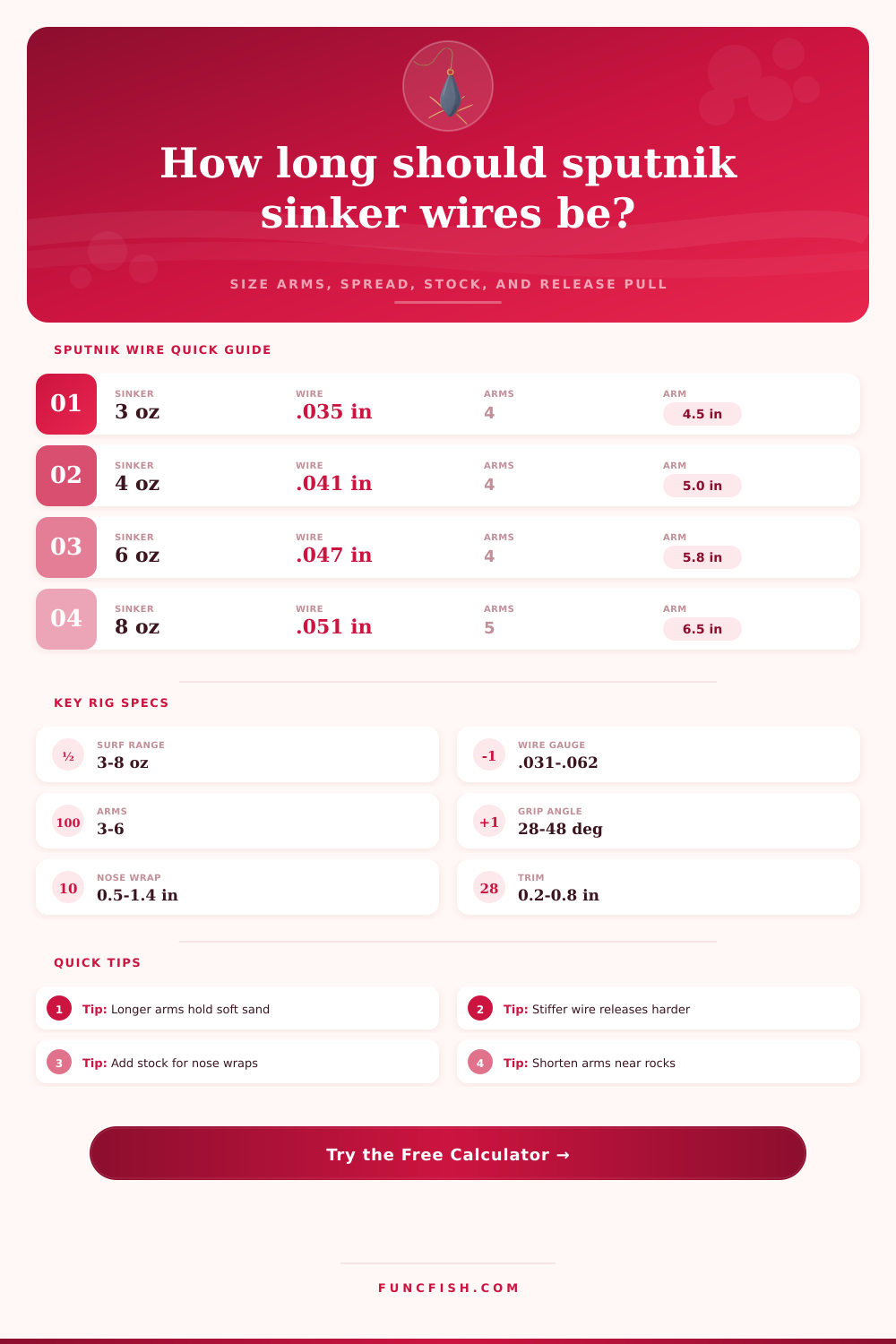
| .031 in stainless | 0.79 mm | 2-3 oz / 55-85 g | 3.5-4.5 in / 90-115 mm | Light grip and easy release |
| .035 in stainless | 0.89 mm | 3-4 oz / 85-115 g | 4.2-5.0 in / 105-127 mm | Balanced for small baits |
| .041 in stainless | 1.04 mm | 4-5 oz / 115-140 g | 4.8-5.6 in / 122-142 mm | Most common surf starting point |
| .047 in stainless | 1.19 mm | 5-7 oz / 140-200 g | 5.3-6.3 in / 135-160 mm | Firm release in sweep |
| .051 in stainless | 1.30 mm | 6-8 oz / 170-225 g | 5.8-6.8 in / 147-173 mm | Heavy bait and softer bottoms |
| .062 in stainless | 1.57 mm | 8-10 oz / 225-285 g | 6.4-7.6 in / 163-193 mm | Very hard release; test rod load |
🌊Bottom and surf correction table
| Condition | Length change | Hold effect | Wire choice | Release caution |
|---|---|---|---|---|
| Clean packed sand | Baseline | Predictable grip | .035-.047 in stainless | Use target pull normally |
| Soft sand trough | Add 8-14% | More bury needed | .041-.051 in stainless | Check spread after casting |
| Mixed shell | Shorten 3-8% | Tips can skate | .041-.047 in stainless | Round off sharp hooks |
| Weed or grass | Add 4-10% | Hold varies by debris | .047-.051 in stainless | Expect false heavy pull |
| Rocky patches | Shorten 15-25% | Snag risk dominates | .031-.041 in stainless | Keep arms soft and short |
| Strong sweep | Add 10-18% | Higher lateral load | .047-.062 in stainless | Avoid overpowering rod tip |
🎣Gear and species comparison grid
| Target or rig | Typical bait load | Sinker weight | Suggested arms | Wire length tendency |
|---|---|---|---|---|
| Pompano double drop | Small strip or sand flea | 2-4 oz / 55-115 g | 4 arms, .031-.035 in | Short to medium for easy release |
| Red drum cut bait | Finger mullet or crab | 4-6 oz / 115-170 g | 4 arms, .041-.047 in | Medium-long for troughs |
| Striped bass bunker | Chunk bait and fish finder | 5-7 oz / 140-200 g | 4 or 5 arms, .047 in | Longer if sweep is steady |
| Small shark bait | Large cut bait | 6-8 oz / 170-225 g | 5 arms, .051-.062 in | Long with firm breakout |
| River catfish rig | Cut bait in current | 3-6 oz / 85-170 g | 3 or 4 arms, .041-.047 in | Medium arms, flatter angle |
| Pier bottom rig | Shrimp, squid, or crab | 4-6 oz / 115-170 g | 4 arms, .041-.047 in | Shorter to clear pilings |
🔧Sinker body allowance table
| Body style | Hub allowance | Arm behavior | Best use | Calculation note |
|---|---|---|---|---|
| Breakaway long-tail | 0.75-1.25 in / 19-32 mm | Clean wire path | Long casting surf rigs | Moderate nose stock |
| Round nose sputnik | 0.65-1.10 in / 17-28 mm | Compact spread | General beach fishing | Use standard spread factor |
| Spider weight hub | 0.45-0.90 in / 11-23 mm | Wide open arms | Soft sand and rivers | Less embedded wire needed |
| Storm pyramid cradle | 0.80-1.35 in / 20-34 mm | Strong side hold | Rough surf and sweep | Add a small body friction credit |
| Torpedo tail loop | 0.90-1.40 in / 23-36 mm | Long trailing arms | Distance casting | Longer nose path |
💡Build notes
Wire stock check: Cut one test arm first, bend it, load it against packed sand, and measure the finished exposed length after springback. Add that difference to the remaining arms before batch cutting.
Breakout check: If the calculated release pull is above the rod tip load you comfortably use, shorten the exposed arms or step down one wire gauge before increasing sinker weight.
So you’re standing on a windy beach holding a light rod and a heavy sinker. When the fish bites, you hope the lead will let go. Surf fishing boils down to that: You need a big enough sinker to cast far and keep position in the current, yet not one that grips so hard you’ll break your line or wear yourself out trying to wrestle a dead anchor.
The sputnik sinker is positioned just at that sweet spot between too tight and too loose, where the spring steel wires bites like tiny anchors. And while brute strength matter somewhat, the real trick is to make sure the spring steel wires are just the right length. Too long and they’ll drag rather than dig in; too short and they won’t grab the bottom at all. The math for that complicated geometry is done for you by our calculator; now you can focus on what’s going on in the water.
How Sputnik Sinker Wire Works
That brings us to what everyone ignores, the key variable: Wire gauge compared to the weight of the sinker. Just because it’s thicker doesn’t necessarily mean it hold better in the softer stuff. It means more difficult break out pull. That makes all the difference when using lighter gear or if the fish is picky, such as pompano. Sure, an eight-ounce lead made from stiff sixty-two thousandth-inch wire will stay put even under gale force wave action, but you’d have to really load the rod tip before it lets go. This is why you may snap your leader off trying to pry him loose. If you use thin thirty-first-inch wire on that same big sinker, it bend too much and never gets a firm grip against a strong side current.
That’s where the science comes into play with the balance of the two forces: How stiff the wire is vs. The leverage created at the end of the long arm helps predict how hard I or the fish has to pull to get this thing loosened. We all know that bottom type determine the geometry but not many will admit it.
If you have clean packed sand, it is going to be forgiving and predictable with typical setups. Soft trough bottoms, however…well that’s another story altogether. Those arms should of had some added length to find firm enough substrate to grab hold as the sinker sinks further into the hole. Otherwise, the wire tips will just bend out of the way when the time comes instead of poking through. This is why hub allowances and nose wrap stock are important on something like this in deep sand. It’s because there’s that much more distance from the actual digging point to where the body sits on the sinker.
For rocky bottoms, do it different. In rocky bottom situations, you will save yourself some frustration (and gear) by keeping the arms short to avoid snags in any hidden structure. The calculator changes its estimates for both pull and spread to match these environmental conditions.
It considers whether or not multiple arm are being used, as a four arm configuration has different loading characteristics compared to a six arm configuration. This can be great when fishing uneven surfaces and helps maintain stability; however more arms mean more friction on the bottom. Always there’s a give-and-take between release sensitivity and holding power.
Add the current and you have one more wrinkle on this problem. Lateral pressure from a brisk offshore sweep or a strong tidal channel is going to pull the sinker sideways instead of simply lifting it vertically. The vector changes. Longer arms is needed to keep the same depth hold. To address those surf conditions, the tool will recommend adjustments that make sense for your desired target species.
Observe how replacing the galvanized music wire with titanium increases the bend radius and thus holding power while not increasing the overall size of the sinker body. There is no exact cut to build these rigs at first. They are refined over time. The best thing to do initially is cut one test arm first, bend it to form, then lay it down on some packed sand, and measure the final exposed length when you let go to account for springback. Then add this variance to all the rest of your arms so you can cut through the lot. That way you don’t get frustrated by creating the perfect theoretical rig only to find out the steel reacts different under real world stress than on paper.
The end result is a sinker that stays put where it should and lets go at the start of the strike. It is a fine line between sensitive and secure. You can consider all the variables like tackle limitations, target species and beach conditions and tweak them to your liking; this eliminates the guessing game for one of the more annoying aspects of surf fishing. And then it’s invisible until it counts, leaving you free to focus on the bite, not the bottom.