🎣 Stick Float Shot Pattern Calculator
Calculate the exact shot weight, placement, and pattern for perfect stick float presentation on any river or canal
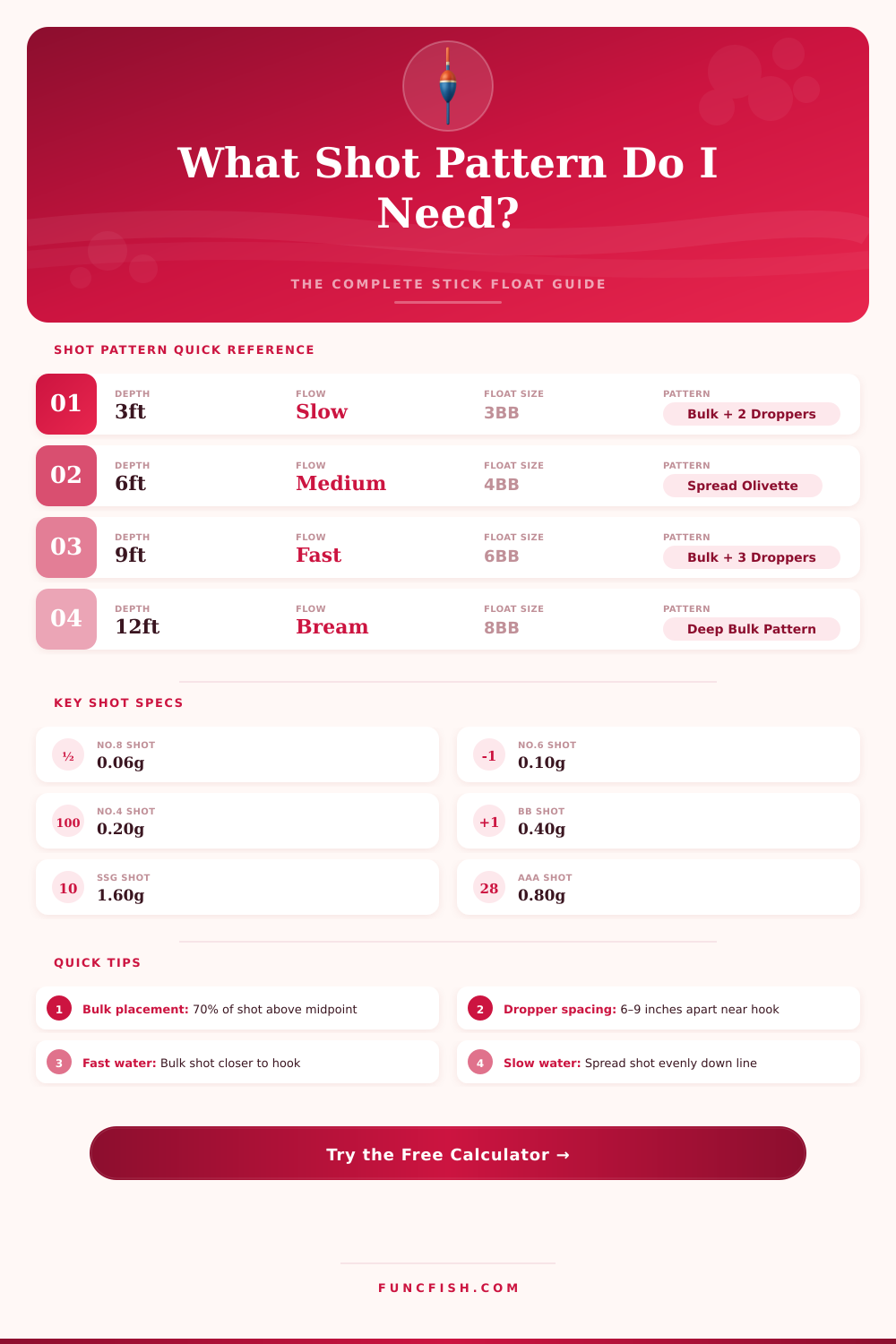
| Shot Size | Weight (g) | Weight (oz) | Diameter (mm) | BB Equivalent | Best Use |
|---|---|---|---|---|---|
| No.12 | 0.03g | 0.001oz | 1.4mm | 0.075 BB | Ultralight dropper |
| No.10 | 0.04g | 0.001oz | 1.6mm | 0.10 BB | Fine dropper |
| No.8 | 0.06g | 0.002oz | 1.9mm | 0.15 BB | Light dropper |
| No.6 | 0.10g | 0.004oz | 2.2mm | 0.25 BB | Dropper / spread |
| No.4 | 0.20g | 0.007oz | 2.6mm | 0.50 BB | Mid-bulk / spread |
| No.1 | 0.30g | 0.011oz | 3.0mm | 0.75 BB | Bulk / spread |
| BB | 0.40g | 0.014oz | 3.3mm | 1.0 BB | Standard bulk |
| AAA | 0.80g | 0.028oz | 3.8mm | 2.0 BB | Deep bulk / fast flow |
| SSG | 1.60g | 0.056oz | 4.6mm | 4.0 BB | Heavy bulk / floods |
| Swan | 2.20g | 0.078oz | 5.2mm | 5.5 BB | Heaviest bulk |
| Species | Typical Weight | Preferred Depth | Recommended Float | Pattern Style | Dropper Shot |
|---|---|---|---|---|---|
| Roach | 2oz–2lb | 4–8ft | 3BB–4BB | Spread / Bulk+Drop | No.8–No.6 |
| Dace | 1oz–12oz | 3–6ft | 2BB–4BB | Spread | No.8–No.6 |
| Chub | 8oz–6lb | 4–12ft | 4BB–8BB | Bulk + Droppers | No.6–No.4 |
| Bream | 1lb–12lb | 6–14ft | 4BB–10BB | Deep Bulk | No.10–No.8 |
| Tench | 1lb–10lb | 6–12ft | 4BB–8BB | Deep Bulk | No.8–No.6 |
| Grayling | 4oz–3lb | 3–8ft | 3BB–6BB | Bulk + Droppers | No.6–No.4 |
| Perch | 4oz–4lb | 4–10ft | 3BB–5BB | Bulk + Droppers | No.6–No.4 |
| Barbel | 2lb–15lb | 4–12ft | 6BB–10BB | Olivette | No.4–No.1 |
| Bleak | 0.5oz–3oz | 1–4ft | 1BB–2BB | Shirt Button | No.10–No.8 |
| Carp | 2lb–30lb+ | 5–15ft | 6BB–10BB+ | Olivette | No.4–BB |
| Pattern | Description | Best Conditions | Bulk Position | Droppers |
|---|---|---|---|---|
| Even Spread | Shot equally spaced down line | Slow, shallow, wary fish | N/A — all spread | None distinct |
| Bulk + Droppers | Grouped bulk with 2–3 small shot below | Medium flow, most species | 60–70% up from hook | 2–3 No.6–No.8 |
| Olivette + Droppers | Olivette weight + fine droppers | Fast / deep water | Midpoint or higher | 2–4 No.8–No.10 |
| Shirt Button | Small evenly spaced shot, no bulk | Canal / slow / ultra-shy fish | N/A — uniform | All same size |
| Deep Bulk | Bulk placed low, near hook | Deep, still/slow, bream/tench | 30–40% up from hook | 1–2 No.10–No.8 |
A stick float are used to indicate when a fish is biting at teh bait. In order to attract fishes to the bait, the stick float must be positioned in such a way that the bait will reach the desired depth in the water colum. In order to do this, fishermen use weights on the fishing line that are referred to as shot.
The process of placing these weights on the fishing line is referred to as shotting. Shotting are necessary to ensure that the bait will sink at the appropriate rate. If the shotting is not performed correctly, the bait may either sink to the bottom of the catch area too fast or too slow, both of which will prevent the fish from eating the bait.
How to Put Weights on a Stick Float
One of the main weight that is used in shotting is the bulk shot. The bulk shot is a large weight that is used to anchor the fishing line to the movement of the river’s current. If the river’s current is steady, then the angler can place the bulk shot in middle of the fishing line.
However, if the river’s current is fast, then the bulk shot should be placed deeper into the fishing line. A deeper bulk shot is used to fight the drag that the river’s current creates upon the fishing line. Additionally, there are different types of shot that can be used in the fishing line.
For instance, wire shot can be used in areas of the river that experience choppy water, while carbon shot can be used in areas of the water that have a steady current. Droppers are weight that are smaller than the bulk shot, and droppers are used to control the fall of the bait. Multiple droppers can be used to create a ladder pattern for the bait.
For instance, if the bait is maggots or worms, the droppers will control the rate at which the bait will fall to the bottom of the river. The speed of the river will dictate the use of droppers. For instance, if the speed of the river is slow, then the droppers will have smaller weights than if the river has a fast current.
The type of bait that is used will change the way in which the shot is used. For instance, if bread is the bait that is being used, the final dropper will have to be slow in its sinking to avoid startling the fish. Hemp is another type of bait that is used when the fishing location being used has mid-water areas, since hemp will travel faster through the water than bread will.
Holdback is the tension that the shot creates on the fishing line. Holdback will change the depth to which the shot sinks. If the shot has a firm holdback, the shot will sink deeper into the water, resulting in a straighter fishing line.
The diameter of the fishing line will also impact the shot that is used. A thick fishing line will present more resistance to the shot entering the water, requiring more shot than if using a thinner fishing line. In addition to the diameter of the fishing line, the length of the hooklength should also be considered.
A longer hooklength is useful for targeting fish near the bottom of the river, such as chub fish. One way to organize the shotting is to use a certain percentage of the total weight of the shot for the bulk shot. For instance, half of the total weight of the shot can be placed into the bulk shot, and the remaining weight can be used for the droppers.
If barbel fish are targeted in deep water areas, the angler should place the bulk of the shot on the bottom of the fishing line in olivette rigs to target the barbel fish. Additionally, only use droppers to fine-tune the position of the worm bait. The target lane in which the fishing is to occur should also be considered.
If targeting fish in the top third of the fishing area, deeper droppers will allow the bait to catch the fish that are rising to the water’s surface. Another factor to consider when shotting is the length of the swim area in which the bait should fall. If the swim area in which the bait will fall is short, the angler should place the bulk shot higher on the fishing line with droppers of decreasing weight.
However, if the swim area is longer, the droppers can be spaced out evenly along the fishing line. Since the water currents in the river have different speeds, it is important to consider the surface speed of the water to determine how the droppers should be compressed to that specific section of the fishing line. Errors in fishing can occur if the angler is only considering the tip of the stick float.
For instance, if the fishing line is hanging high in the water, the angler should drop the bulk shot deeper into the line. Additionally, if the fishing line is high in the water, a light telltale should be added to the line. Bread sinks more slow than maggots, thus a different type of dropper pattern is used when bread is the bait compared to when maggots are the bait.
Preset shot patterns can be used to determine the weights of the shot and the droppers that should be used when fishing for various types of bait. Thus, by using these pre-established patterns, guessing which weights of shot should be used will be eliminated. Youll avoid making mistakes if you follow these tips.
Its important to remember that the weight of the shot matter alot. You should of checked the current before you start. The fishing line’s tension is vital.
If you’re looking for larg fish, you can absorbs the current better with heavier weights. Their is many ways to setup the line. Use a armchair to sit comfortabley while you wait.
The river currents is strong. The water is different than the lake. The fishing gear is expensive.
One should of known that. The fishing area is vast. There is alot of fish.
You can sees them. The weather is bad. You should brings gear.
The boat is small. Its a good day. A armchair sits near the river.
The rod is long. The line is thin. Its a big fish.
The fishs is biting. The bait is tasty. You should of used more shot.
The current is fast. The water is deep. The river is wide.
The fish is there. The bait sinks. The float moves.
The angler waits. The line is tight. The fish bites.
The angler pulls. The fish is caught. The end.