
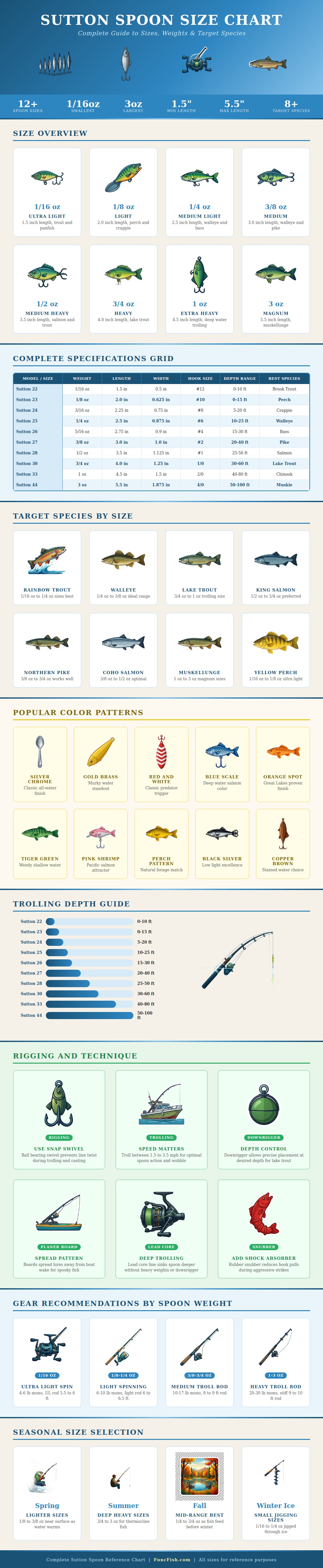
The size of the spoon are one of the most critical factors to consider when fishing. The size of the spoon will determine how the spoon interact with the depth, the speed at which you move the spoon in the water, and the behavior of the fish. If the spoon that you use is of a wrong size, then the fish may not notice it or may reject the bait altogether.
The conditions of the water will play a critical role in selecting the proper size of spoon. In water that is exceptionally clear and exposed to alot of sunlight, the fish will tend to move to deeper depths in the water column. In this case, an heavier spoon that can reach these depths will be necesary.
Pick the Right Spoon Size for Fishing
However, in water that stains and has less light penetration, the fish will remain in shallow depths. For these situations, a lighter spoon will allow it to stay in the strike zone for an extended period. The chart provided in this article demonstrates the relationship between the length of the spoon and the weight of the spoon.
With this information, anglers can easily select the appropriate spoon for there specific water conditions. Spoons that are small in size tend to mimic the movements of small baitfish and insects. Because of their smaller size, these spoons are ideal for targeting trout and perch population.
These fish feed on small prey in shallow waters. Additionally, the small spoons tend to cast good on light fishing tackle. However, they can be challenging to use in the presence of the wind and when anglers must reach deep water.
For these reasons, small spoons is categorized under the shallowest depth ranges. Medium sized spoons have more mass than small spoons. Medium spoons are useful for trolling behind a boat or for casting in moderate wind.
These spoons are ideal for catching walleye and bass populations as these fish lives in the middle portion of the water column. As the spoon’s weight increases, the length of the spoon increase. The longer spoon will trigger larger fish to strike at the spoon.
Large spoons are used to fish deep waters where salmon and lake trout lives during the summer months. Additionally, anglers cast large spoons to attract muskies as these fish will chase at large spoons. The large spoons will have more length and larger hooks to enable them to catch larger fish that weigh many pound.
If an angler uses a small spoon to catch a large fish, it may not mimic the food that the fish are used to eating. Another critical factor that determines the color of the spoon is the size of the spoon. If a spoon has a silver finish, it will mimic a small minnow in clear water.
However, a large spoon with a silver finish will mimic a larger baitfish to a muskie. Additionally, fish with gold finishes or darker patterns is visible in stained water so there are many different spoon sizes with these finishes. The speed at which you move the spoon in the water will also change with the weight of the spoon.
For light spoons, the best speed for trolling is steady and moderate. However, heavier spoons can be retrieved at a faster rate because the heavier spoon does not plane up as much as the light spoon. Additionally, you should combine the use of a swivel or a short fishing leader with the fishing spoon to avoid the fishing line get twisted up.
Fish behavior will change with the season of the year. In the early part of the year when the water is cold, the fish will tend to stay in shallow waters. In this case, anglers will use light spoons.
In the middle of summer, the depth where the fish live ranges between thirty and forty feet deep. In such situations, anglers will use heavier spoons. During the fall season when fish are feeding very aggressive, medium sized spoons will work best for the angler.
Anglers dont necessarily need to own every size of spoon. However, it is essential to have three or four size of spoons in your fishing collection. Depending on your location, you can have a light spoon to use in shallow waters, a medium weight spoon to troll behind your boat, and a heavy spoon for deep waters.
Based off the information in the chart above, anglers can easily select the best spoon size for their current environment.