Swordfish Lifespan Calculator
Estimate swordfish age, life stage, body condition, and confidence from lower jaw fork length, girth, weight, sex estimate, ocean basin, depth and temperature band, maturity, and measurement quality.
📌Swordfish presets
⚙Length, sex, basin, and condition inputs
Swordfish lifespan estimate
Estimated age, life stage, condition, and confidence range will appear here.
Age and lifespan breakdown
🧬Billfish and swordfish comparison grid
📊Swordfish reference tables
| LJFL band | Typical age signal | Maturity cue | Condition note |
|---|---|---|---|
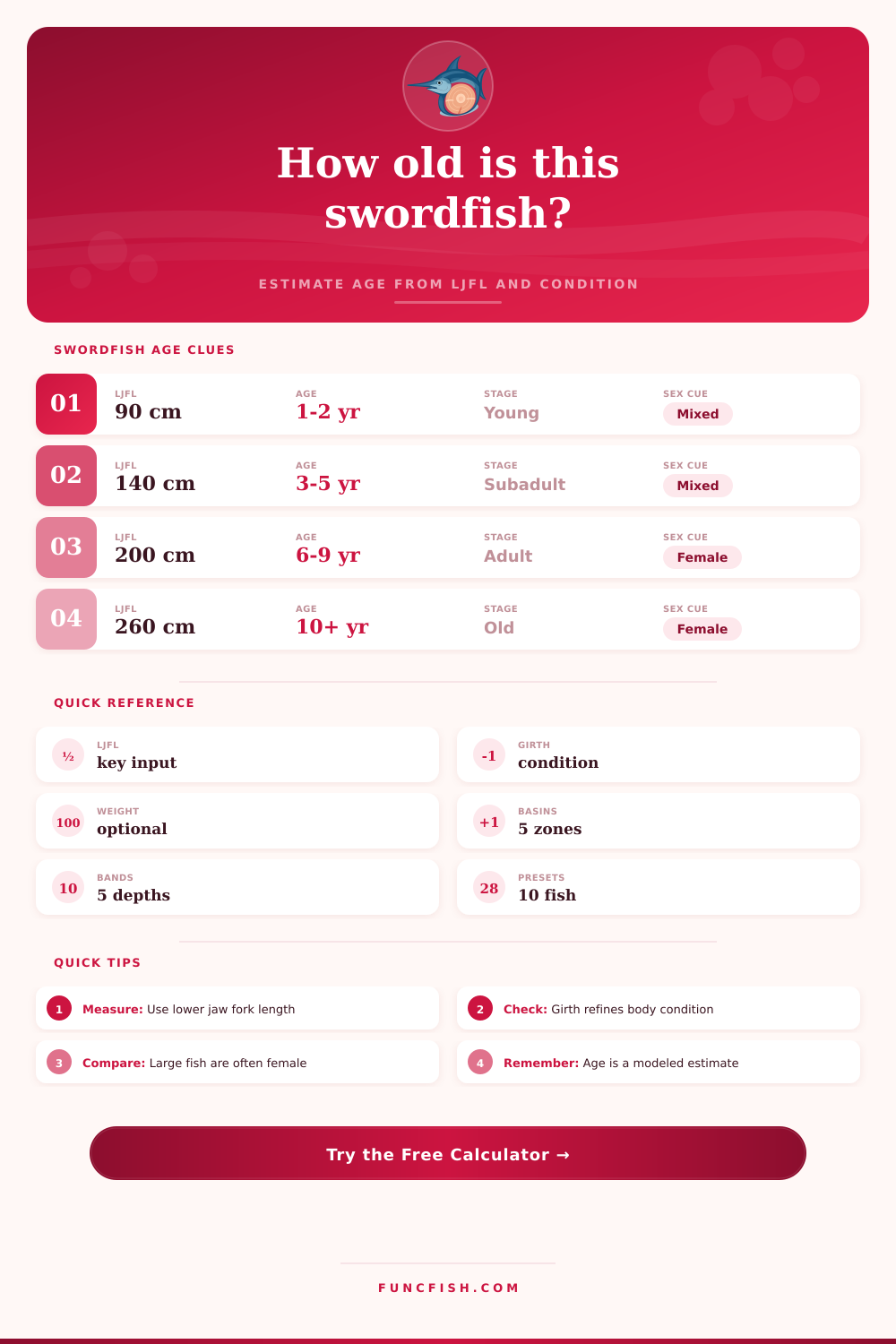
| 50-90 cm / 20-35 in | Young-of-year to about 2 years | Juvenile | Weight is highly variable, so length drives the estimate. |
| 90-150 cm / 35-59 in | Roughly 2 to 5 years | Subadult to early adult | Girth helps separate fast growers from lean fish. |
| 150-220 cm / 59-87 in | Roughly 5 to 9 years | Mature adult likely | Females become more likely in the upper part of the band. |
| 220-300 cm / 87-118 in | Roughly 8 to 14+ years | Large older adult | Very large swordfish are commonly treated as likely female. |
| Ocean basin | Growth adjustment | Use in model | Confidence caution |
|---|---|---|---|
| North Atlantic | Baseline | Balanced adult growth curve | Good general fit for canyon and Gulf Stream fish. |
| Mediterranean | Slightly older for length | Raises age for the same LJFL | Juveniles and local stocks need wider ranges. |
| North Pacific | Near baseline | Useful for Hawaii and California samples | Temperature band matters strongly for depth sets. |
| South Pacific | Slightly faster growth | Lowers age modestly at the same LJFL | Large females still need a broad upper range. |
| Indian Ocean | Moderate baseline | Works as a mixed tropical basin input | Regional study data can shift the curve. |
| Depth-temperature band | Typical context | Age effect | Condition clue |
|---|---|---|---|
| Warm surface night bite | Night feeding near warmer upper water | Neutral to slightly faster | Check recent feeding weight before aging older. |
| Mixed layer or thermocline | Transition-zone sets and current breaks | Baseline | Often the cleanest all-around field input. |
| Deep cool daytime set | Deep scattering layer or daytime drops | Slightly older for length | Cool water can slow apparent growth. |
| Temperate current edge | Productive fronts and canyon edges | Older if growth appears slow | Robust girth can offset the slow-growth signal. |
| Cold productive water | Cool, food-rich edge water | Wider band | Condition may be high even when length growth is slow. |
| Species | Bill shape | Common aging input | Lifespan pattern |
|---|---|---|---|
| Swordfish | Flat, sword-like upper jaw | Lower jaw fork length and fin-spine aging | Females may reach older and much larger classes. |
| Blue marlin | Rounded spear-like bill | Lower jaw fork length, sex, basin | Longer-lived large billfish with strong sex-size split. |
| White marlin | Shorter rounded bill | LJFL and regional growth data | Generally shorter maximum age than blue or black marlin. |
| Sailfish | Long bill with tall dorsal sail | LJFL, rapid early growth class | Fast growth, shorter large-adult window. |
💡Field estimate tips
Swordfish age estimates are much steadier when lower jaw fork length is measured directly instead of using total length or dockside memory.
A heavy swordfish of the same LJFL is not always older; girth and weight mostly tell the calculator whether the fish is lean, average, or robust.
Swordfish are mobile creature that travel entire ocean basin. Swordfish often dive through the different temperature layer of the oceans. Because swordfish travel through different environments, many people wants to know the age of a swordfish.
The age of a swordfish is important in that the age of a swordfish can tell you about the growth rate of that swordfish, as well as the reproductive contribution of that swordfish. Because swordfish dont have rings on their bodies like some other freshwater fish species, you cannot determine the age of a swordfish by simply look at the swordfish. To determine the age of a swordfish, a scientist must examine the spines or otoliths of the swordfish in an laboratory.
How to Find the Age of a Swordfish
In the field, you can only determine the length, girth, weight, and location of the swordfish. Each of these measurements can be used to calculate the age of a swordfish through a mathematical model. The mathematical model accounts for the sex of the swordfish, the ocean basin in which the swordfish was observed, the depth of the swordfish in the ocean, and the body condition of the swordfish.
This calculator use the length, girth, and weight of the swordfish to calculate the age of that individual swordfish. The length of the lower jaw fork of a swordfish is the first measurement that should be taken. This measurement is the most consistent with other measurements because even if the tail of the swordfish is damage, the length of the lower jaw will remain the same.
Furthermore, the girth and weight of the swordfish should also be measured. The weight of a swordfish is not always correlated with its age. For example, a heavy swordfish may be the result of the swordfish having a better body condition then other swordfish of the same length, or because the swordfish ate a meal recently.
Therefore, the weight and girth can help to determine if the swordfish is growing at the same rate as other swordfish of its length. The sex of the swordfish is another important measurement. Female swordfish tend to grow to be larger individuals, as well as live longer than male swordfish.
Therefore, if the length of the swordfish is towards the longer end of the growth range, it is likely that the swordfish is a female, and its age will reflect that. Conversely, if the swordfish is a male of the same length, its age will be younger than that of a female swordfish of the same length. If the sex of the swordfish is unknown, the calculator will use a mixed curve to calculate the age of the swordfish.
However, by inputting the sex of the swordfish, you will make the age of the swordfish more accurately. The ocean basin in which the swordfish lived and its depth will also impact the age of the swordfish. Swordfish located in the Mediterranean Sea grow at different rates than swordfish in the South Pacific Ocean.
Furthermore, swordfish in the Mediterranean Sea tend to be older for a given length of swordfish than swordfish in the South Pacific. Swordfish that live at certain depths in the ocean will exhibit different growth rates than swordfish that live in different depth range. For instance, swordfish that live in deeper waters with lower water temperatures will exhibit slower rates of growth in length than swordfish that live in warmer waters.
These factors is accounted for in the calculation of the age of the swordfish. Additionally, the maturity of the swordfish and its body condition can also be used to calculate its age. Swordfish that are already in the adult stage will add girth to their bodies rather than length.
The maturity of the swordfish will also be compared to its length to determine if the swordfish is of an age that would exhibit such maturity. Furthermore, the body condition of the swordfish can also help to reveal its age. For example, a lean swordfish of the same length may be of an older age than the length of its body suggests because of the slow growth rate of the swordfish.
The reference tables located on this calculator indicate the relationship between each of these measurements. Each of these tables can be referenced to determine whether the calculated age of the swordfish is within the normal range of ages for that type of swordfish, or whether the age may be outside of the expected range for that species. It is often assumed that the longer the swordfish is, the more year of age it is.
However, the growth of swordfish slows down after the swordfish reaches maturity. Furthermore, because female swordfish continue to grow in length after male swordfish have cease growing, two swordfish of the same length may differ in age by several years. These differences are accounted for in the calculation of the age of the swordfish through this calculator.
The quality of the measurements of the swordfish is another important factor. For example, visually estimating the length of the swordfish will not provide the same accuracy as measuring the length of the swordfish with a tape measure and measuring its girth. The age estimate will also provide a confidence score to reflect the accuracy of the measurements of the swordfish.
The further the measurements are from those that are perfectly taken, or if the swordfish length is at an extreme range for the swordfish species, the more the age spread will reflect the potential age of the swordfish. Thus, while the calculator will still indicate an age for the swordfish, that age will only be precise within a certain age range for that swordfish. The age of swordfish is important for different reason than others.
For instance, because older female swordfish produce more eggs than the males of the same species, fishing communities make management decisions regarding the age of swordfish for the benefit of fishing communities. Additionally, because the swordfish of large lengths represent the growth of that species over many year, the age of swordfish is factored into the management of the species. When recording the measurements of a swordfish in the field, those measurements contain different information regarding the life of that swordfish.
The information is made more accessible through this calculator.