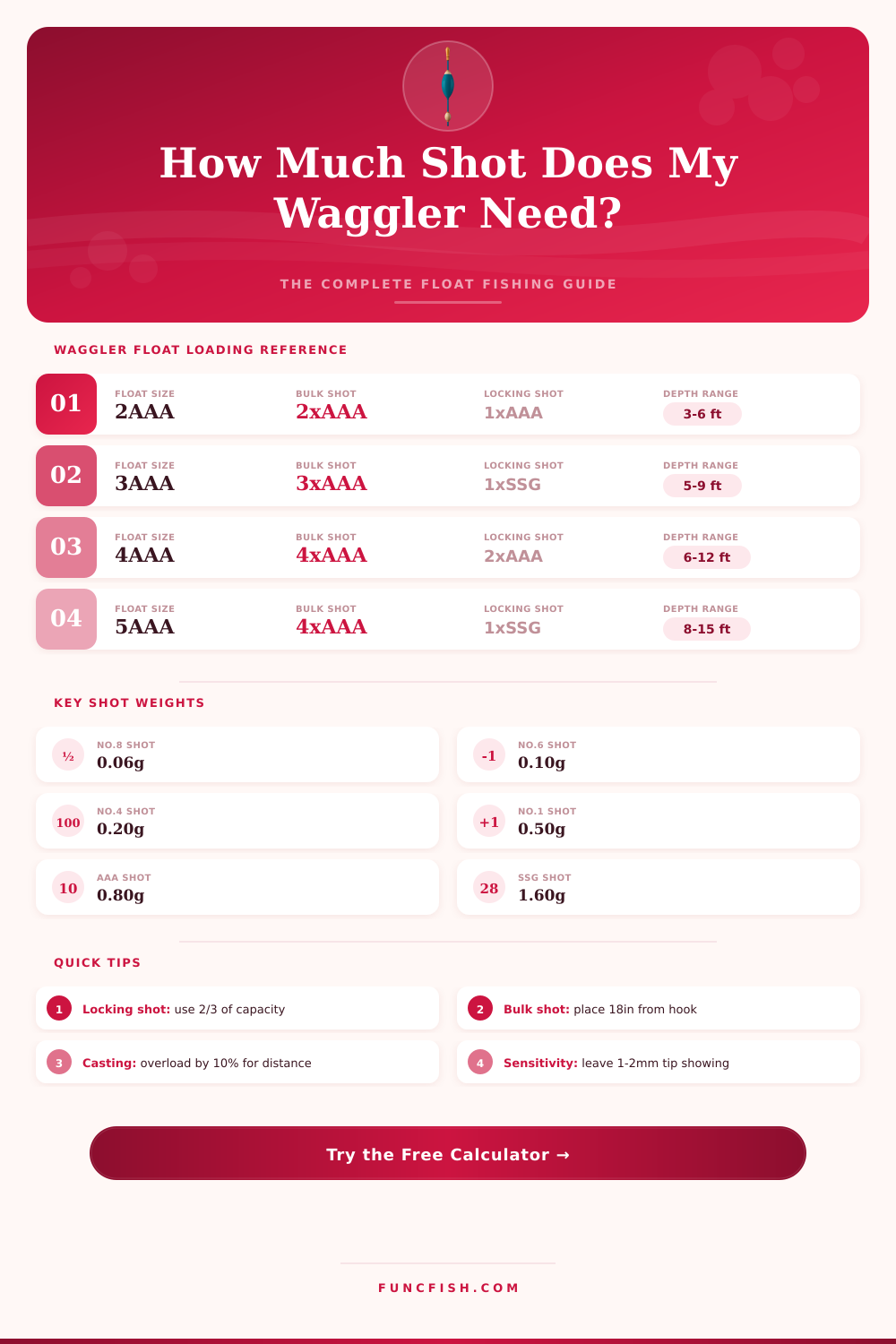
🎣 Waggler Float Loading Calculator
Calculate the exact shot weight and loading for your waggler float rig
| Float Type | Best Scenario | Locking % | Tip Showing |
|---|---|---|---|
| Straight Waggler | Stillwater, calm conditions | 60–75% | 1–2 cm |
| Insert Waggler | Shy biting, ultra sensitive | 65–80% | 0.5–1 cm |
| Bodied Waggler | Reservoir, long distance | 55–65% | 1.5–3 cm |
| Crystal Waggler | Clear water, wary fish | 60–75% | 1–2 cm |
| Loaded Waggler | Windy, self-cocking | 30–50% | 1–2 cm |
| Slider Waggler | Deep water over 10 ft | 60–70% | 1.5–2.5 cm |
| Dart Waggler | Canals, short range | 70–85% | 0.5–1 cm |
| Pole Float (conv.) | Light lines, margin fishing | 50–65% | 1–1.5 cm |
| Species | Typical Weight | Float Capacity | Recommended Setup |
|---|---|---|---|
| Roach | 2–16 oz (50–450g) | 1.5–3 AAA | Insert waggler, No.8–No.4 droppers |
| Bream | 1–6 lb (0.5–2.7 kg) | 3–5 AAA | Bodied waggler, bulk + dropper |
| Tench | 2–8 lb (0.9–3.6 kg) | 4–6 AAA | Bodied waggler, heavy locking |
| Chub | 1–5 lb (0.45–2.3 kg) | 2–4 AAA | Straight waggler, drifting bait |
| Rudd | 2–12 oz (50–340g) | 1–2.5 AAA | Insert waggler, surface rig |
| Dace | 1–6 oz (25–170g) | 1.5–3 AAA | Straight waggler, trotting |
| Perch | 4 oz–4 lb (110g–1.8 kg) | 2–4 AAA | Insert waggler, drop shot style |
| Carp (surface) | 2–30 lb (0.9–13.6 kg) | 4–8 AAA | Bodied/crystal waggler, freelined |
| Scenario | Locking Shot | Bulk Shot Position | Dropper Shot |
|---|---|---|---|
| Slow sinking bait | 2/3 of total | Mid-depth (bulk) | 2 x No.8 at 12 in |
| Fast sinking, deep | 60% of total | Upper third | 1 x BB at 18 in |
| Surface/mid-water | 70% of total | N/A (all locking) | 1 x No.8 only |
| On-the-drop | 50% of total | Evenly spaced | 3 x No.8 spread |
| Laying on bottom | 65% of total | 60 cm from hook | 1 x No.6 at 6 in |
| Distance casting | 75% of total | Top third | 1 x AAA at 24 in |
A waggler is a type of float that is used in fishing. In order for the waggler to correctly perform it’s function of showing whether the bait are touching the bottom or not, it must be properly loaded. If a waggler isnt loaded proper, it may drag sideways or the bait on the hook may flutter above the bottom of the water without touch it.
To properly load a waggler, it is first necesary to understand the marked rating of the waggler. The rating of the waggler, such as a 3AAA waggler, indicate the total carrying capacity of that waggler. The total carrying capacity is the weight of the weight that can be added to the waggler after subtracting the weight that is already built into the waggler.
How to Load a Waggler Float
If too many weight is added to the waggler, there will be negative shot on the line. If too little weight are added to the waggler, it will float more high in the water. The weights that must be accounted for include the weight of the bait that will be used, the amount of bristle on the waggler that should remain above the water, and the drag that the wind or the current may create.
The weight of the shot on the line must also be balanced against the weight of the droppers. Bulk shot is shot that is placed close to the waggler. Bulk shot is often used to help the waggler drive through the wind.
Droppers are weight that are placed further from the waggler than the bulk shot. Droppers are used to control how the bait falls through the water. For instance, if you are to perform fishing in a canal, lighter shot will be used and droppers will be placed every eight to twelve centimeter from one another since fish in the canals can be more wary of fishing rigs.
Open pits with strong wind can be fished with a waggler that has more bulk shot added to the line to fight against the wind. Deep reservoir may use a slider to help control the waggler to the fish at great depths. The type of fishing line that is used can also impact the function of the waggler.
If the fishing line that is used is of a thicker monofilament line, there will be more drag on the line. Therefore, more reserve shot will be needed for such lines. Fluorocarbon fishing lines will sink faster then monofilament lines so there will be less shot needed for fluorocarbon lines.
Braid lines can be cast further distances but may tangle in the water with a current so softer droppers will be used. The length of the hook will also affect the waggler since longer hooks will cause the droppers to spread further from one another. One of the mistakes to avoid with wagglers is adding too much weight to the waggler for the sake of caution.
If you load the waggler to its full rating and the weight of the built in weight is not accounted for, the tip of the waggler will not cock correct. Avoid adding too much weight to the bulk shot since this will kill the finesse of the waggler. The bait trim that is weighed should reflect this fact that a single bait weigh less than a double pellet bait.
If the water is likely to be choppy, more of the bristle on the waggler should extend above the water so that the incoming wave will not bury the waggler. Certain types of fish requires different setups of waggler lines. For instance, if the fish that are targeted are roach, a crystal shirt-button waggler with small hooks can be used.
Carp may require a pellet waggler with light weight stacked near the fishing hook. Chub can be caught with a glide with a slider that contains a high percentage of bulk shot. Tench require a peacock insert with a specific amount of bulk shot and dropper.
Each of these fish species require the specific type of waggler for their catch to be successful. To even further fine tune the waggler to ensure it is properly loaded, the angler can trim the waggler. If there is too many bristle on the waggler, one small dropper can be removed.
If the waggler is too flat, additional weight can be added to the smallest dropper. By performing this final trim to balance the waggler according to the conditions in which the fishing will occur, the fishing session will go more smooth.