
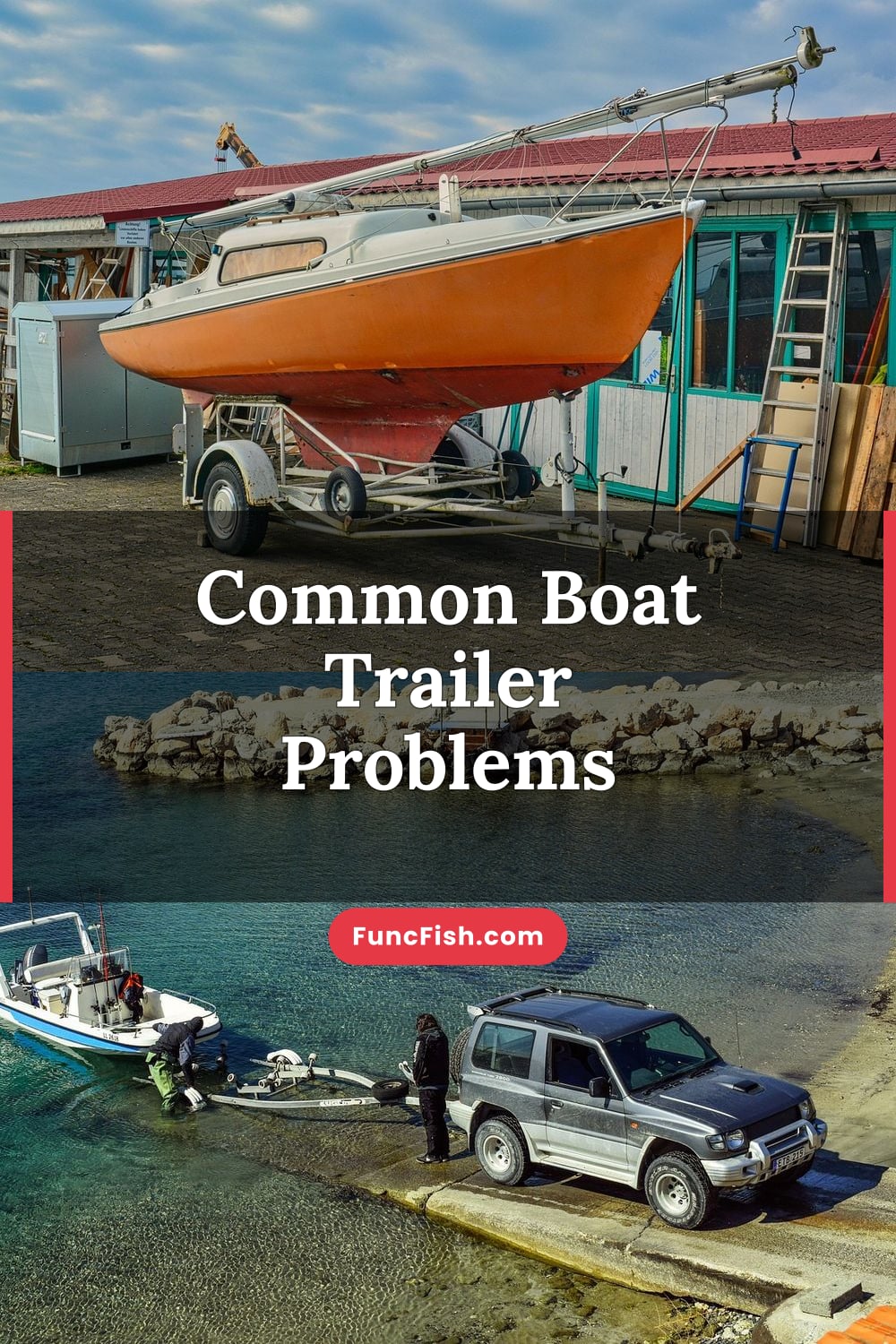
Boat owners experiences a weekend on the water full of sun on their face and fishes in the cooler. However, soon, the trailer has to be backed down the ramp to load the boat and head home. Yet, problems can arise when the trailer begin to make grinding noises and one of the tires appear low on air.
Boat trailers are subjected to salt, the sun, and the submersion of the boat that is towed behind the trailer. However, many boat trailer owners treats their trailer in an afterthought. However, the majority of problems with trailers can be prevented.
There are only a few common problem that can occur with boat trailers. By knowing these problems, their causes, and the actions that can be taken to avoid these problems, boat trailer owners can save themselves money, time, and frustration. One of the most common problems with boat trailers is the formation of rust and corrosion.
Common Boat Trailer Problems To Watch For
1. Rust and Corrosion

This occurs because the trailer is subjected to submersion of the boat, as well as the sun exposure of the trailer while the boat is on the trailer. Thus, the metal component of the trailer wear down due to these elements. This problem is most noticeable on the trailer when the trailer is subjected to submersion but can be seen the most in areas where the trailer’s paint begins to chip.
The rust begins to spread under the trailer’s surface and can be missed when the trailer begins to experience a malfunction of any of it metal components. The fix to the rust and corrosion problem is to submerge the trailer in fresh water after each use of the trailer. This is especially true if the trailer will be driven on locations that contain saltwater.
Additionally, after the trailer has been rinsed with fresh water, the owner should inspect the trailer for rust twice a year. The areas that should be inspected include the inside of the frame rails that can become a corrosion factory if not clean with a wire brush and treated with a rust-inhibiting product. Another common problem with boat trailers is with the tires.
2. Tire Maintenance and Inflation
Due to the additional weight of the boat that is towed by the trailer, trailer tires are subjected to more weight than truck tires. Additionally, trailer tires receives less maintenance than truck tires. Under-inflation of trailer tires is the most common cause of tire problems.
Trailer tires can lose air due to the additional heat that the trailer tires create. This can cause the sidewall of the tire to fail. To avoid problems with trailer tires, owners should check the trailer tires for proper inflation when the trailer is stationary.
The inflation should be set to the maximum psi of the tire. Many trailer owners choose to inflate their tires to 30 psi because this is the psi for their truck tires. However, trailer tires should be inflated to between 50 and 65 psi.
Additionally, owners should rotate the trailer’s tires every season. The outside edges of the tires wear down more fast than the inside tires due to the trailer moving in its path. Additionally, each trailer owner should carry a spare tire that is the same as the trailer’s current tires.
The jacks for the trailer should also be inspected to ensure that they can lift the trailer with the boat on the trailer. Another problem with trailers is the failure of the trailer’s components that allow the trailer to turn. These components, known as trailer bearings, often make howling or grinding noises, especially at higher speed of the trailer.
3. Trailer Bearings
These trailer bearings are located within the trailer’s wheel hub near the trailer brake components. These trailer bearings are exposed to submersion due to the trailer being subjected to water and the temperature differences between the trailer’s hot wheels and the cold water that is used to cool the trailer components. To prevent these trailer bearing problems, bearing protectors can be installed on each trailer wheel hub.
These bearing protectors contain grease that can protect the bearing from water damage. They are relatively inexpensive, and they pay for themselves the first time they are used to prevent water damage to the trailer bearings. Additionally, trailer owners should listen for changes in the sound made by the trailer’s wheels.
Any change in sound with the change of the trailer’s speed or when the trailer’s brakes are applied indicate that these trailer bearings are the problem. Brake problems on trailers usually occur with the trailers fishtailing on wet roads or when one tire is wearing unevenly relative to the other. These trailer brakes wear with use.
4. Trailer Brake Systems
Due to the exposure of trailer brakes to water, the wires that connect the trailer brakes to the trailer’s brakes can corrode with time. This causes one side of the trailer to lock while the other trailer wheel remain unactuated. To prevent trailer brake problems, trailer owners should test their trailer’s brakes before every long trip.
The owner should move the trailer at a slow speed in an empty parking lot. Additionally, the manual brake controller should be applied to the trailer. Each trailer tire should lock with equal force.
Additionally, the trailer’s brake wiring should be inspected to ensure that the connectors are dry to avoid the connection of corroded wires. If the trailer is stored outdoors, a waterproof cover can be placed over the trailer’s brakes during the off-season to protect the trailer’s brake components from moisture. Lights on trailers can flicker or fail on the road.
5. Trailer Light Failures
However, the most common cause of trailer light failure is submersion of the trailer. Due to submersion, water gets into the trailer lights’ sockets and the trailer light ground connection corrodes. This causes trailer lights to blink on the road.
While LED lights resist submersion to a certain degree, LED lights are still exposed to moisture. To fix the problem with trailer lights, a dedicated ground wire should be attached to each light fixture on the trailer and allowed to connect to the trailer tongue. Additionally, any light that is replaced on the trailer should contain dielectric grease in the light fixture.
This will prevent moisture from entering the light fixture. The addition of dielectric grease to the trailer lights is a five-minute task that will save hours of frustration should any of the trailer lights ever fail on the road. Winch and strap problems on trailers are common problems for trailer owners.
6. Winch and Strap Care
Due to the winch and strap on the trailer taking the additional effort of loading the boat onto the trailer, the strap can fray over time. Additionally, the winch strap can be exposed to ultraviolet light from the sun, causing the strap to weaken over time. Additionally, the winch can experience problems due to the additional effort of moving the boat on the trailer.
To avoid winch and winch strap problems, the owner should inspect the winch and strap before every use of the trailer. The winch strap should be visually inspected for any fraying of the fibers of the strap. Additionally, the winch strap should be replaced every two years, even if it appears to be in good condition.
The reason for this maintenance task is to compensate for the weakness of the winch strap caused by exposure to ultraviolet light. Additionally, the winch gears should be lubricated with a light lubricant. The trailer winch ratchet should be inspected to ensure that it engages properly.
A backup safety chain can also be placed around the boat’s bow eye. This would prevent the boat from moving backward if the winch strap were to fail while loading the boat onto the trailer. Finally, problems related to the loading of the trailer can cause the trailer to create problems on the road.
7. Proper Tongue Weight
Most trailer owners load the trailer by sliding the boat as far forward on the trailer as possible. However, few people consider tongue weight. Tongue weight is the weight of the boat that is placed on the trailer’s tongue.
This tongue weight should be between 10 and 15% of the total weight of the trailer with the boat. If the tongue weight is too low, the trailer will experience problems that are felt as sway while traveling on the road. If the tongue weight is too high, the trailer’s rear axle will squat when going over hills or inclines, and the trailer’s headlights will point towards the trailer’s sky.
Additionally, the control of the trailer can experience issues when the tongue weight is too high. To avoid trailer problems related to tongue weight, trailer owners can use a bathroom scale or tongue weight scale to even out the weight of the trailer. If the trailer tongue is underweighted, it is possible to move the boat on the trailer or move the trailer’s axle to even out tongue weight.
Once the even weight is located, it is a good idea to mark the winch strap so that the boat is loaded on the trailer in the same manner each time the trailer is used. This is a small modification to the trailer’s loading of the boat, but it can make a big difference in the comfort of the trailer owner during every journey. While trailer maintenance may not be the most glamorous of tasks to perform, trailers are the component of the boat that turns a boat into a vehicle for adventure.
Thus, if owners take the same care for the trailer as they do for the boat’s outboard motors, trailers will serve the trailer owner for many years. The next time that owners hear a strange noise from their trailer or see some visual problem with the trailer, they should not ignore the problem. These signs are the trailer communicating with their owner that something is wrong before the trailer begins to fail.
It is better to invest a few minutes to fix a potential problem than to spend hours on the side of the road when the trailer finally fails. Thus, trailer owners will be glad that they took the few minutes to prevent a potential problem on the road.