Water Density by Temp and Salinity Calculator
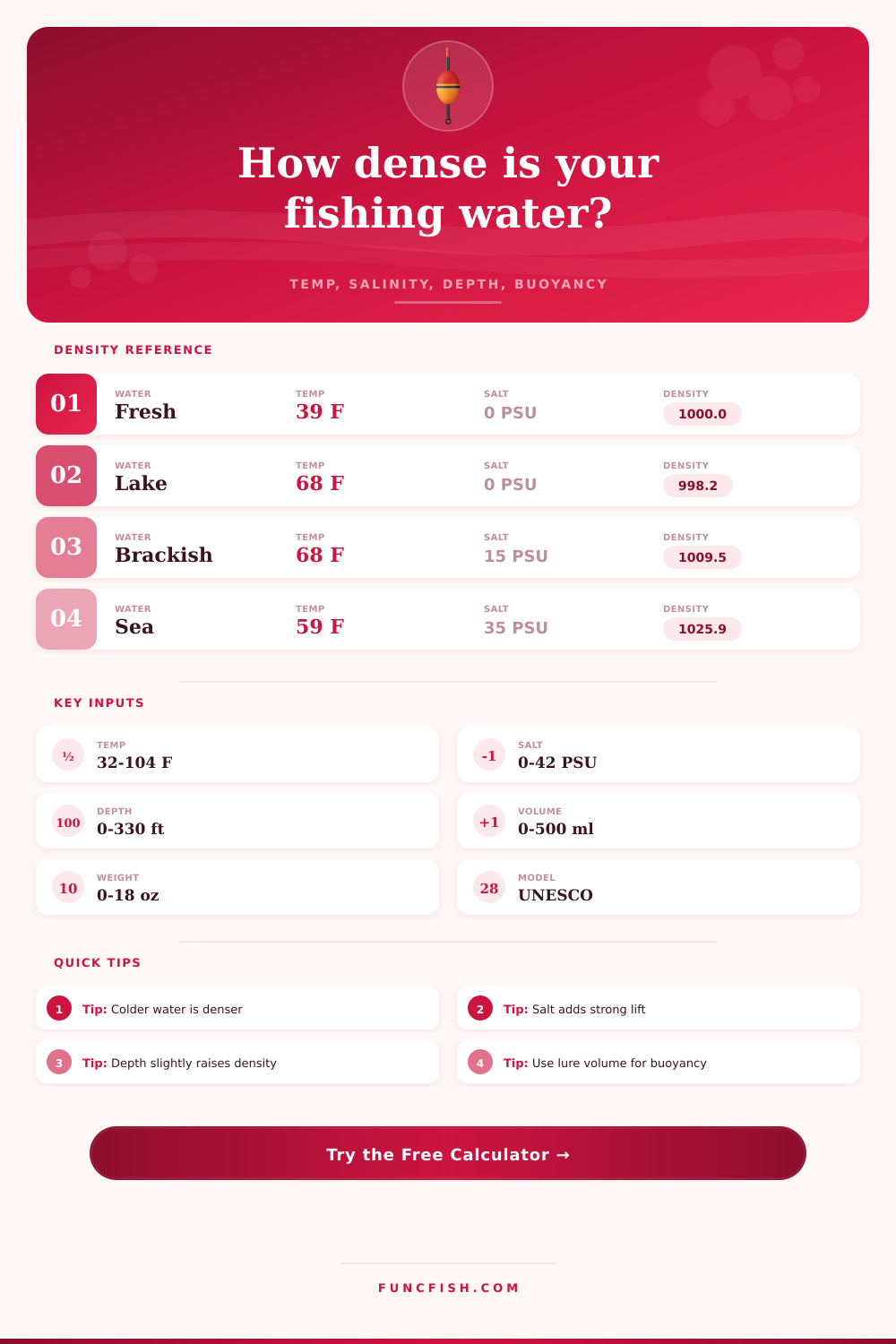
Estimate water density from temperature, salinity, and fishing depth, then translate it into specific gravity and lure or float buoyancy.
📌Fishing water presets
⚙Water and rig settings
Water density and buoyancy forecast
Calculation breakdown
📊Common fishing water density cards
Cold Freshwater
Warm Bass Lake
Brackish Estuary
Coastal Seawater
📐Density reference table
| Fishing situation | Temp | Salinity | Approx density | Rig effect |
|---|---|---|---|---|
| Ice fishing lake near maximum freshwater density | 39 F / 4 C | 0 PSU | 1000.0 kg/m3 | Highest freshwater lift |
| Warm shallow largemouth pond | 86 F / 30 C | 0 PSU | 995.7 kg/m3 | Slightly less float lift |
| Cold spring trout creek | 45 F / 7 C | 0 PSU | 999.9 kg/m3 | Nearly maximum freshwater lift |
| Light brackish tidal river | 68 F / 20 C | 5 PSU | 1002.0 kg/m3 | Noticeable lift gain |
| Estuary or back bay | 72 F / 22 C | 18 PSU | 1011.4 kg/m3 | Suspending baits ride higher |
| Typical open ocean surface | 59 F / 15 C | 35 PSU | 1025.9 kg/m3 | More buoyant than freshwater |
| Warm tropical reef water | 82 F / 28 C | 35 PSU | 1022.7 kg/m3 | Salt lift offsets warm water |
| Hypersaline flat or lagoon | 90 F / 32 C | 42 PSU | 1026.4 kg/m3 | Strongest shallow lift here |
🧰Material density comparison
| Material or tackle item | Typical density | Compared with freshwater | Compared with seawater | Common use |
|---|---|---|---|---|
| Balsa lure body | 120 to 180 kg/m3 | Strong float | Strong float | Crankbaits and topwater |
| Cedar or basswood body | 350 to 500 kg/m3 | Floats before hardware | Floats before hardware | Plugs and jerkbaits |
| Hollow hard plastic lure | 600 to 950 kg/m3 | Often floats or suspends | More likely to rise | Minnow baits and divers |
| Soft plastic bait | 1000 to 1200 kg/m3 | Slow sink to sink | Can suspend if salted lightly | Worms, swimbaits, trailers |
| Fluorocarbon leader | 1750 to 1780 kg/m3 | Sinks | Sinks | Leaders and finesse rigs |
| Steel hook or wire | 7800 kg/m3 | Sinks hard | Sinks hard | Hooks, snaps, wire leader |
| Lead sinker | 11340 kg/m3 | Sinks hard | Sinks hard | Weights and jig heads |
| Tungsten jig | 19300 kg/m3 | Sinks hardest | Sinks hardest | Compact heavy jigs |
🚩Practical notes
Density model: The calculator uses the UNESCO 1983 surface seawater polynomial for 0 to 40 C and 0 to 42 PSU, then adds a compact depth compression estimate for fishing depths.
Buoyancy tuning: A suspending lure that is neutral in freshwater usually floats a little more in saltwater because the same volume displaces denser water.
The densities of the water affects the behavior of the lure or the bait. The density of the water change the amount of lift that the lure or bait experiences. For instance, a lure may suspend in the warmest water in a lake or river, but if the temperature or the salt content of the water change, the same lure could experience a change in how fast it sinks or how fast it rise.
Three factor that alter the behavior of the lure in the water affect the density of the water. These three factors are the temperature of the water, the amount of salt in the water, and the depth of the water. The temperature of the water have the greatest effect on the density of the water.
How Water Density Affects Lures
The density of the water changes based on the temperature of the water. The density of the water is the greatest at approximately four degree Celsius. As the temperature of the water increase above four degrees Celsius, the density of the water decreases.
When the temperature of the water falls below four degrees Celsius, the water molecules in the water expand and the density of the water also changes. For instance, a lure may behave in a specific way in the water in September in your lake. However, the lure will behave differently in January when the temperature of the water changes.
The amount of salt that the water contains also changes the density of the water. The salt in the water increase the density of the water. When the salt is mixed with the water, the salt increases the mass of the water in each cubic meter of water without increasing the volume of the water.
The increased mass of the water increases the amount of weight that the lure must displace when the lure sit in the water. Therefore, a lure will displace more weight in saltwater than it will in freshwater. Additionally, the salinity of the water can also impact the way that the lure sit in the water.
For instance, a lure made of soft plastic will slowly sink in freshwater. However, the same lure will sit higher in water that contains more salinity. Depth also have an impact on the density of the water.
However, the effect of depth on the density of the water is more lessened than the effect of water temperature and the amount of salt in the water. As the depth of the water increases, the pressure on the water increases. The increased pressure of the water at depth force the water molecules to come closer together.
The closer proximity of the water molecules increases the density of the water at depth. While the effect of depth on the density of the water is small, the effect is enough to impact the movement of some fishing lures. The calculator allow you to enter the temperature of the water, the salinity of the water, the depth of the water, the volume of the lure or the float, and the weight of that lure or float.
Using the volume and the weight of the lure, you can calculate whether or not the lure will rise, sink, or remain in a neutral position in the water. Additionally, the calculator allow you to determine how much foam or ballast you will have to add to the lure to ensure that it remains in the desired position in the water. The calculator also contains presets for the most common water conditions.
These presets allow you to quickly compare the effect that different water conditions can have on the behavior of your lure. Another factor that impacts the way that a lure behaves in the water is the material out of which the lure is made. For instance, balsa and cedar are two woods that are very light in weight when dried.
Therefore, lures that are made of these woods will naturally float before the addition of hardware to the lure. Hollow hard plastic lures are likely to be in a neutral position when the lure is allowed to float on the water’s surface. Soft plastics has a density that is similar to the density of the water; therefore, only a small amount of either salt or weight will impact the position of the lure.
Fluorocarbon and lead will naturally sink in the water regardless of the conditions of the water. For these materials, people use them when they want the lure to naturally sink in the water. The calculator presents this information in the material reference portion.
Another factor that will impact the density of the water is the minerals and the tannins that is dissolved in the water. However, the impact of minerals and tannins on the density of the water is more lessened than the impact of the temperature and the salinity of the water. Lakes whose waters contains a lot of dissolved minerals are heavier than lakes with soft water.
Likewise, rivers whose water contains a lot of tannins will have a higher density than rivers whose water does not contain tannins. The density of the water will change the behavior of a lure that is light in weight. This influence can be tested with the extra-load setting on the calculator.
It is a habit that you should of develop to calculate the numbers for the type of water in which you plan to fish. You can always test the lure in a bucket of water, or the first few casts of the lure will allow you to determine if it is behaving in the way in which you design it. If the lure does not have the correct trim in relation to the water, you can always add a small amount of foam or a single split shot to the lure.
You will need to adjust the trim for your lure more often when fishing in a tidal river than in an offshore location. This is due to the change in salinity in the tidal river. However, you will need to adjust your lure for your favorite lakes and ponds less often.
A high mountain lake with a consistent temperature will exhibit different behavior than a pond with a changing water temperature. Overall, the buoyancy of a lure is a relationship between the lure and the water.