Chum Cost Per Trip Calculator
Estimate chum quantity, reserve, leftover credit, and cost split for a fishing trip based on mix type, current, water temperature, trip length, and number of spots.
📌Trip presets
⚙Chum trip settings
Chum trip estimate
Full breakdown
📋Chum type cost grid
Frozen Block
Menhaden Oil
Bunker Chunks
Sardine Mash
Pellet Mix
Oats Binder
Shrimp Shell
Corn Groundbait
📊Rate and split references
| Scenario | Base feed | Startup per spot | Typical planning note |
|---|---|---|---|
| Pier / dock basket | 1.1 lb/hr / 0.5 kg/hr | 1.5 lb / 0.7 kg | Basket feed is steady but compact |
| Surf soak | 2.2 lb/hr / 1.0 kg/hr | 3.0 lb / 1.4 kg | Wave wash needs more reserve |
| Inshore boat | 3.0 lb/hr / 1.4 kg/hr | 4.0 lb / 1.8 kg | Good baseline for reef or channel edges |
| Kayak / skiff | 1.4 lb/hr / 0.6 kg/hr | 2.0 lb / 0.9 kg | Small slick, short reset window |
| Bridge current line | 2.8 lb/hr / 1.3 kg/hr | 3.5 lb / 1.6 kg | Current multiplier matters most |
| Offshore reef | 5.2 lb/hr / 2.4 kg/hr | 8.0 lb / 3.6 kg | Longer soak and more startup chum |
| Freshwater groundbait | 1.0 lb/hr / 0.5 kg/hr | 2.2 lb / 1.0 kg | Lower steady feed, larger first ball |
| Catfish bait station | 1.7 lb/hr / 0.8 kg/hr | 3.0 lb / 1.4 kg | Front-load scent around the station |
| Condition | Multiplier | Budget effect | When to use it |
|---|---|---|---|
| Slack or pond | 0.82x | Lower steady feed | Low drift, groundbait, small water |
| Light current | 1.00x | Baseline | Most protected inshore plans |
| Moderate current | 1.22x | Extra hourly chum | Tide moving but line still holds |
| Strong current | 1.48x | Larger reserve | Bridge, inlet, channel edges |
| Ripping tide | 1.78x | High burn rate | Short prime windows or heavy flow |
| Chum type | Default unit cost | Feed factor | Best budgeting use |
|---|---|---|---|
| Frozen chum block | $4.50/lb / $9.92/kg | 1.00x | General saltwater trip planning |
| Menhaden oil plus carrier | $7.25/lb / $15.98/kg | 0.62x | Concentrated slick with low weight |
| Bunker / menhaden chunks | $2.80/lb / $6.17/kg | 1.35x | Visible chunk line and bigger baits |
| Sardine mash | $3.60/lb / $7.94/kg | 1.18x | Fast scent release in warm water |
| Fish pellet mix | $1.70/lb / $3.75/kg | 0.82x | Freshwater or slow saltwater feed |
| Oats and cereal binder | $0.95/lb / $2.09/kg | 1.10x | Bulk carrier for homemade mixes |
| Shrimp shell mash | $1.35/lb / $2.98/kg | 1.28x | Channel, pier, and crustacean scent |
| Corn groundbait | $0.85/lb / $1.87/kg | 0.95x | Carp, catfish, and freshwater stations |
💡Planning checks
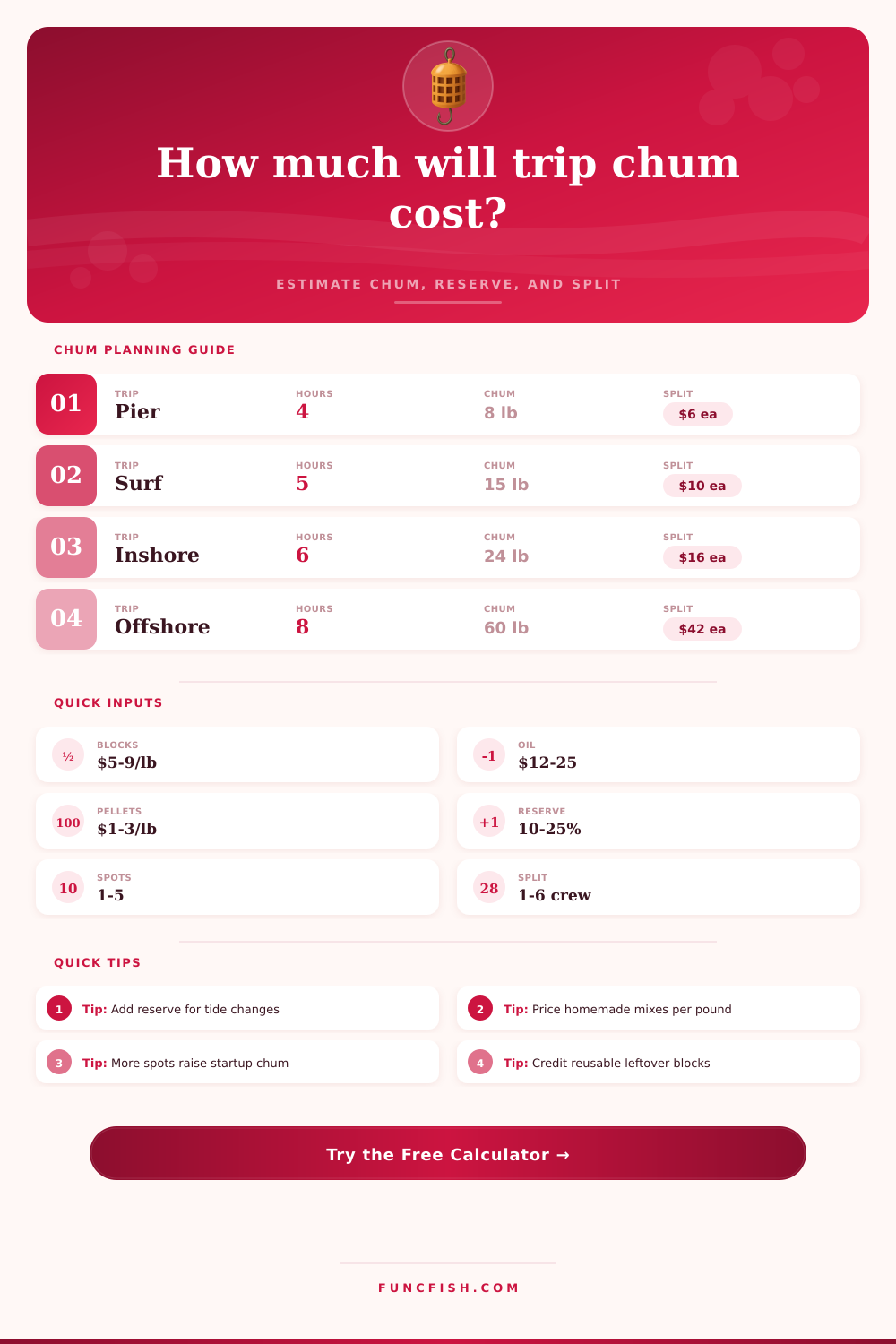
Reserve: A 10% to 25% reserve is usually enough for a normal tide change. Use more when you plan several resets or expect a fast current.
Leftover credit: Credit only unopened or reusable chum. Soft mash, thawed scraps, and loose groundbait often have little real value after the trip.
Planning a fishing trips requires answering several questions, such as how much chum is needed, how much this will cost, and how an number of anglers who will participate in the fishing trip will split this cost. Chum is used to attract the fish to the area and to keep them at the area. Chum can be used up quickly depending upon the strength of the current, the temperature of the water, and the number of spots in which the fish will be fished.
The amount of chum needed for the fishing spots will change depending upon the conditions of the water. For instance, a small amount of chum will remain in a slick in a small area for many hours if the angler are fishing near the shoreline. However, the same amount of chum will dissipate in a few minutes if the fishing spots are in an inlet with a strong current.
Plan chum amounts and cost for a fishing trip
If the water is warm, fish will be more actively in the area and the chum will break down faster. Thus, there will be a greater need for chum if the water is warm. The calculator allows the angler to set these variables, and the calculator will provide the angler with an idea of how each of these variables will change the total amount of chum that will be required for the trip.
Depending upon the type of chum used for the fishing trip, there will be different tradeoffs in relation to the cost and the performance of the chum. For instance, dense frozen blocks of chum will release their scent slow and can withstand strong currents. Oil-based chum spreads over a wider area but costs more per pound and leaves less chum at the end of the day that can be of any use.
Pellet and groundbait are cost effective and easy to store but require a larger volume of chum to be effective as the other types. The calculator can help determine the specifics of each of these chum types and how each will affect the total amount of chum that must be purchase and the total cost of the fishing trip. A third variable that should be considered is the purchase of a reserve allowance of chum.
This allowance ensures that the chum runs out when it should be depleted. For instance, ten or fifteen percent more chum than the amount calculated will allow for instances where the tide changes or where additional spots are fished where the chum will be depleted. The purchase of extra chum will ensure that the slick of chum continues to exist, and it will prevent the need for rationing of the chum supply.
The leftover credit is the opposite of a reserve allowance. Any credit that is left over from one fishing trip is only purchased if the angler plans on using the chum on another trip. For instance, soft mash or thawed scraps of chum are rarely found in usable form so any credit that is gained from chum in this category should not be counted upon.
Each spot where fish will be fished will require an initial dose of chum to be cast before the angler can begin the feed of chum. Thus, if there are any number of spots that will be fished, the amount of chum will increase according. The calculator multiplies the amount of chum needed for each spot and the number of spots that will be fished to make sure that there is no underestimation of the total amount of chum that will be required for each fishing trip.
Other variables that should be considered include the travel distance to the spots where the fish will be fished. If the travel distance includes a long drive to the fishing spots, or if the trips include travel to offshore locations, fuel and the cost of the chum ice that will be used to keep the chum fresh will factor into the total cost of the fishing trip. The cost of additives, like oil that will be used to assist in the dispersion of the chum, or the cost of disposable bags used to contain the chum will be included in the total cost of the fishing trip.
There are three specific numbers that should be watched for the fishing trip. The total amount of chum that will be purchased will tell the angler the total amount of chum that will need to be loaded onto the boat or onto the fishing spot prior to fishing begins. The trip spend after leftover credit will allow the angler to understand the total cost of the trip after the value of the remaining chum is subtracted.
The cost per angler will make it clear the cost split between each of the anglers in the trip; no angler should know the total cost of the chum purchase. If these three numbers match the angler’s expectation for the trip, then the chum purchase plan is a solid one. Many anglers focus on the feed rate of the chum that will be used during the fishing trip.
However, many anglers tend to miss what the cost per angler will reveal about the trip. A heavy use of chum may be the best idea for those who plan to fish offshore when the fish are biting; however, it may be a wasteful idea for those who plan to fish in a short session on a pier. The chum calculator for these variables allows the angler to see these differences between the cost of the chum and the cost per angler.
An essential habit for anglers is to use the chum calculator before the fishing trip begins; not after. The current can be adjusted, the reserve amount can be increased in the case of a fast incoming tide, or the angler can change the chum type to a cheaper mix for the same effect. The ability to make these changes before the trip allows for chum to become a more deliberate part of the fishing plan.
Planning a fishing trips requires answering several questions, such as how much chum is needed, how much this will cost, and how an number of anglers who will participate in the fishing trip will split this cost. Chum is used to attract the fish to the area and to keep them at the area. Chum can be used up quickly depending upon the strength of the current, the temperature of the water, and the number of spots in which the fish will be fished.
The amount of chum needed for the fishing spots will change depending upon the conditions of the water. For instance, a small amount of chum will remain in a slick in a small area for many hours if the angler are fishing near the shoreline. However, the same amount of chum will dissipate in a few minutes if the fishing spots are in an inlet with a strong current.
If the water is warm, fish will be more actively in the area and the chum will break down faster. Thus, there will be a greater need for chum if the water is warm. The calculator allows the angler to set these variables, and the calculator will provide the angler with an idea of how each of these variables will change the total amount of chum that will be required for the trip.
Depending upon the type of chum used for the fishing trip, there will be different tradeoffs in relation to the cost and the performance of the chum. For instance, dense frozen blocks of chum will release their scent slow and can withstand strong currents. Oil-based chum spreads over a wider area but costs more per pound and leaves less chum at the end of the day that can be of any use.
Pellet and groundbait are cost effective and easy to store but require a larger volume of chum to be effective as the other types. The calculator can help determine the specifics of each of these chum types and how each will affect the total amount of chum that must be purchase and the total cost of the fishing trip. A third variable that should be considered is the purchase of a reserve allowance of chum.
This allowance ensures that the chum runs out when it should be depleted. For instance, ten or fifteen percent more chum than the amount calculated will allow for instances where the tide changes or where additional spots are fished where the chum will be depleted. The purchase of extra chum will ensure that the slick of chum continues to exist, and it will prevent the need for rationing of the chum supply.
The leftover credit is the opposite of a reserve allowance. Any credit that is left over from one fishing trip is only purchased if the angler plans on using the chum on another trip. For instance, soft mash or thawed scraps of chum are rarely found in usable form so any credit that is gained from chum in this category should not be counted upon.
Each spot where fish will be fished will require an initial dose of chum to be cast before the angler can begin the feed of chum. Thus, if there are any number of spots that will be fished, the amount of chum will increase according. The calculator multiplies the amount of chum needed for each spot and the number of spots that will be fished to make sure that there is no underestimation of the total amount of chum that will be required for each fishing trip.
Other variables that should be considered include the travel distance to the spots where the fish will be fished. If the travel distance includes a long drive to the fishing spots, or if the trips include travel to offshore locations, fuel and the cost of the chum ice that will be used to keep the chum fresh will factor into the total cost of the fishing trip. The cost of additives, like oil that will be used to assist in the dispersion of the chum, or the cost of disposable bags used to contain the chum will be included in the total cost of the fishing trip.
There are three specific numbers that should be watched for the fishing trip. The total amount of chum that will be purchased will tell the angler the total amount of chum that will need to be loaded onto the boat or onto the fishing spot prior to fishing begins. The trip spend after leftover credit will allow the angler to understand the total cost of the trip after the value of the remaining chum is subtracted.
The cost per angler will make it clear the cost split between each of the anglers in the trip; no angler should know the total cost of the chum purchase. If these three numbers match the angler’s expectation for the trip, then the chum purchase plan is a solid one. Many anglers focus on the feed rate of the chum that will be used during the fishing trip.
However, many anglers tend to miss what the cost per angler will reveal about the trip. A heavy use of chum may be the best idea for those who plan to fish offshore when the fish are biting; however, it may be a wasteful idea for those who plan to fish in a short session on a pier. The chum calculator for these variables allows the angler to see these differences between the cost of the chum and the cost per angler.
An essential habit for anglers is to use the chum calculator before the fishing trip begins; not after. The current can be adjusted, the reserve amount can be increased in the case of a fast incoming tide, or the angler can change the chum type to a cheaper mix for the same effect. The ability to make these changes before the trip allows for chum to become a more deliberate part of the fishing plan.
Planning a fishing trips requires answering several questions, such as how much chum is needed, how much this will cost, and how an number of anglers who will participate in the fishing trip will split this cost. Chum is used to attract the fish to the area and to keep them at the area. Chum can be used up quickly depending upon the strength of the current, the temperature of the water, and the number of spots in which the fish will be fished.
The amount of chum needed for the fishing spots will change depending upon the conditions of the water. For instance, a small amount of chum will remain in a slick in a small area for many hours if the angler are fishing near the shoreline. However, the same amount of chum will dissipate in a few minutes if the fishing spots are in an inlet with a strong current.
If the water is warm, fish will be more actively in the area and the chum will break down faster. Thus, there will be a greater need for chum if the water is warm. The calculator allows the angler to set these variables, and the calculator will provide the angler with an idea of how each of these variables will change the total amount of chum that will be required for the trip.
Depending upon the type of chum used for the fishing trip, there will be different tradeoffs in relation to the cost and the performance of the chum. For instance, dense frozen blocks of chum will release their scent slow and can withstand strong currents. Oil-based chum spreads over a wider area but costs more per pound and leaves less chum at the end of the day that can be of any use.
Pellet and groundbait are cost effective and easy to store but require a larger volume of chum to be effective as the other types. The calculator can help determine the specifics of each of these chum types and how each will affect the total amount of chum that must be purchase and the total cost of the fishing trip. A third variable that should be considered is the purchase of a reserve allowance of chum.
This allowance ensures that the chum runs out when it should be depleted. For instance, ten or fifteen percent more chum than the amount calculated will allow for instances where the tide changes or where additional spots are fished where the chum will be depleted. The purchase of extra chum will ensure that the slick of chum continues to exist, and it will prevent the need for rationing of the chum supply.
The leftover credit is the opposite of a reserve allowance. Any credit that is left over from one fishing trip is only purchased if the angler plans on using the chum on another trip. For instance, soft mash or thawed scraps of chum are rarely found in usable form so any credit that is gained from chum in this category should not be counted upon.
Each spot where fish will be fished will require an initial dose of chum to be cast before the angler can begin the feed of chum. Thus, if there are any number of spots that will be fished, the amount of chum will increase according. The calculator multiplies the amount of chum needed for each spot and the number of spots that will be fished to make sure that there is no underestimation of the total amount of chum that will be required for each fishing trip.
Other variables that should be considered include the travel distance to the spots where the fish will be fished. If the travel distance includes a long drive to the fishing spots, or if the trips include travel to offshore locations, fuel and the cost of the chum ice that will be used to keep the chum fresh will factor into the total cost of the fishing trip. The cost of additives, like oil that will be used to assist in the dispersion of the chum, or the cost of disposable bags used to contain the chum will be included in the total cost of the fishing trip.
There are three specific numbers that should be watched for the fishing trip. The total amount of chum that will be purchased will tell the angler the total amount of chum that will need to be loaded onto the boat or onto the fishing spot prior to fishing begins. The trip spend after leftover credit will allow the angler to understand the total cost of the trip after the value of the remaining chum is subtracted.
The cost per angler will make it clear the cost split between each of the anglers in the trip; no angler should know the total cost of the chum purchase. If these three numbers match the angler’s expectation for the trip, then the chum purchase plan is a solid one. Many anglers focus on the feed rate of the chum that will be used during the fishing trip.
However, many anglers tend to miss what the cost per angler will reveal about the trip. A heavy use of chum may be the best idea for those who plan to fish offshore when the fish are biting; however, it may be a wasteful idea for those who plan to fish in a short session on a pier. The chum calculator for these variables allows the angler to see these differences between the cost of the chum and the cost per angler.
An essential habit for anglers is to use the chum calculator before the fishing trip begins; not after. The current can be adjusted, the reserve amount can be increased in the case of a fast incoming tide, or the angler can change the chum type to a cheaper mix for the same effect. The ability to make these changes before the trip allows for chum to become a more deliberate part of the fishing plan.
Planning a fishing trips requires answering several questions, such as how much chum is needed, how much this will cost, and how an number of anglers who will participate in the fishing trip will split this cost. Chum is used to attract the fish to the area and to keep them at the area. Chum can be used up quickly depending upon the strength of the current, the temperature of the water, and the number of spots in which the fish will be fished.
The amount of chum needed for the fishing spots will change depending upon the conditions of the water. For instance, a small amount of chum will remain in a slick in a small area for many hours if the angler are fishing near the shoreline. However, the same amount of chum will dissipate in a few minutes if the fishing spots are in an inlet with a strong current.
If the water is warm, fish will be more actively in the area and the chum will break down faster. Thus, there will be a greater need for chum if the water is warm. The calculator allows the angler to set these variables, and the calculator will provide the angler with an idea of how each of these variables will change the total amount of chum that will be required for the trip.
Depending upon the type of chum used for the fishing trip, there will be different tradeoffs in relation to the cost and the performance of the chum. For instance, dense frozen blocks of chum will release their scent slow and can withstand strong currents. Oil-based chum spreads over a wider area but costs more per pound and leaves less chum at the end of the day that can be of any use.
Pellet and groundbait are cost effective and easy to store but require a larger volume of chum to be effective as the other types. The calculator can help determine the specifics of each of these chum types and how each will affect the total amount of chum that must be purchase and the total cost of the fishing trip. A third variable that should be considered is the purchase of a reserve allowance of chum.
This allowance ensures that the chum runs out when it should be depleted. For instance, ten or fifteen percent more chum than the amount calculated will allow for instances where the tide changes or where additional spots are fished where the chum will be depleted. The purchase of extra chum will ensure that the slick of chum continues to exist, and it will prevent the need for rationing of the chum supply.
The leftover credit is the opposite of a reserve allowance. Any credit that is left over from one fishing trip is only purchased if the angler plans on using the chum on another trip. For instance, soft mash or thawed scraps of chum are rarely found in usable form so any credit that is gained from chum in this category should not be counted upon.
Each spot where fish will be fished will require an initial dose of chum to be cast before the angler can begin the feed of chum. Thus, if there are any number of spots that will be fished, the amount of chum will increase according. The calculator multiplies the amount of chum needed for each spot and the number of spots that will be fished to make sure that there is no underestimation of the total amount of chum that will be required for each fishing trip.
Other variables that should be considered include the travel distance to the spots where the fish will be fished. If the travel distance includes a long drive to the fishing spots, or if the trips include travel to offshore locations, fuel and the cost of the chum ice that will be used to keep the chum fresh will factor into the total cost of the fishing trip. The cost of additives, like oil that will be used to assist in the dispersion of the chum, or the cost of disposable bags used to contain the chum will be included in the total cost of the fishing trip.
There are three specific numbers that should be watched for the fishing trip. The total amount of chum that will be purchased will tell the angler the total amount of chum that will need to be loaded onto the boat or onto the fishing spot prior to fishing begins. The trip spend after leftover credit will allow the angler to understand the total cost of the trip after the value of the remaining chum is subtracted.
The cost per angler will make it clear the cost split between each of the anglers in the trip; no angler should know the total cost of the chum purchase. If these three numbers match the angler’s expectation for the trip, then the chum purchase plan is a solid one. Many anglers focus on the feed rate of the chum that will be used during the fishing trip.
However, many anglers tend to miss what the cost per angler will reveal about the trip. A heavy use of chum may be the best idea for those who plan to fish offshore when the fish are biting; however, it may be a wasteful idea for those who plan to fish in a short session on a pier. The chum calculator for these variables allows the angler to see these differences between the cost of the chum and the cost per angler.
An essential habit for anglers is to use the chum calculator before the fishing trip begins; not after. The current can be adjusted, the reserve amount can be increased in the case of a fast incoming tide, or the angler can change the chum type to a cheaper mix for the same effect. The ability to make these changes before the trip allows for chum to become a more deliberate part of the fishing plan.
Planning a fishing trips requires answering several questions, such as how much chum is needed, how much this will cost, and how an number of anglers who will participate in the fishing trip will split this cost. Chum is used to attract the fish to the area and to keep them at the area. Chum can be used up quickly depending upon the strength of the current, the temperature of the water, and the number of spots in which the fish will be fished.
The amount of chum needed for the fishing spots will change depending upon the conditions of the water. For instance, a small amount of chum will remain in a slick in a small area for many hours if the angler are fishing near the shoreline. However, the same amount of chum will dissipate in a few minutes if the fishing spots are in an inlet with a strong current.
If the water is warm, fish will be more actively in the area and the chum will break down faster. Thus, there will be a greater need for chum if the water is warm. The calculator allows the angler to set these variables, and the calculator will provide the angler with an idea of how each of these variables will change the total amount of chum that will be required for the trip.
Depending upon the type of chum used for the fishing trip, there will be different tradeoffs in relation to the cost and the performance of the chum. For instance, dense frozen blocks of chum will release their scent slow and can withstand strong currents. Oil-based chum spreads over a wider area but costs more per pound and leaves less chum at the end of the day that can be of any use.
Pellet and groundbait are cost effective and easy to store but require a larger volume of chum to be effective as the other types. The calculator can help determine the specifics of each of these chum types and how each will affect the total amount of chum that must be purchase and the total cost of the fishing trip. A third variable that should be considered is the purchase of a reserve allowance of chum.
This allowance ensures that the chum runs out when it should be depleted. For instance, ten or fifteen percent more chum than the amount calculated will allow for instances where the tide changes or where additional spots are fished where the chum will be depleted. The purchase of extra chum will ensure that the slick of chum continues to exist, and it will prevent the need for rationing of the chum supply.
The leftover credit is the opposite of a reserve allowance. Any credit that is left over from one fishing trip is only purchased if the angler plans on using the chum on another trip. For instance, soft mash or thawed scraps of chum are rarely found in usable form so any credit that is gained from chum in this category should not be counted upon.
Each spot where fish will be fished will require an initial dose of chum to be cast before the angler can begin the feed of chum. Thus, if there are any number of spots that will be fished, the amount of chum will increase according. The calculator multiplies the amount of chum needed for each spot and the number of spots that will be fished to make sure that there is no underestimation of the total amount of chum that will be required for each fishing trip.
Other variables that should be considered include the travel distance to the spots where the fish will be fished. If the travel distance includes a long drive to the fishing spots, or if the trips include travel to offshore locations, fuel and the cost of the chum ice that will be used to keep the chum fresh will factor into the total cost of the fishing trip. The cost of additives, like oil that will be used to assist in the dispersion of the chum, or the cost of disposable bags used to contain the chum will be included in the total cost of the fishing trip.
There are three specific numbers that should be watched for the fishing trip. The total amount of chum that will be purchased will tell the angler the total amount of chum that will need to be loaded onto the boat or onto the fishing spot prior to fishing begins. The trip spend after leftover credit will allow the angler to understand the total cost of the trip after the value of the remaining chum is subtracted.
The cost per angler will make it clear the cost split between each of the anglers in the trip; no angler should know the total cost of the chum purchase. If these three numbers match the angler’s expectation for the trip, then the chum purchase plan is a solid one. Many anglers focus on the feed rate of the chum that will be used during the fishing trip.
However, many anglers tend to miss what the cost per angler will reveal about the trip. A heavy use of chum may be the best idea for those who plan to fish offshore when the fish are biting; however, it may be a wasteful idea for those who plan to fish in a short session on a pier. The chum calculator for these variables allows the angler to see these differences between the cost of the chum and the cost per angler.
An essential habit for anglers is to use the chum calculator before the fishing trip begins; not after. The current can be adjusted, the reserve amount can be increased in the case of a fast incoming tide, or the angler can change the chum type to a cheaper mix for the same effect. The ability to make these changes before the trip allows for chum to become a more deliberate part of the fishing plan.
Planning a fishing trips requires answering several questions, such as how much chum is needed, how much this will cost, and how an number of anglers who will participate in the fishing trip will split this cost. Chum is used to attract the fish to the area and to keep them at the area. Chum can be used up quickly depending upon the strength of the current, the temperature of the water, and the number of spots in which the fish will be fished.
The amount of chum needed for the fishing spots will change depending upon the conditions of the water. For instance, a small amount of chum will remain in a slick in a small area for many hours if the angler are fishing near the shoreline. However, the same amount of chum will dissipate in a few minutes if the fishing spots are in an inlet with a strong current.
If the water is warm, fish will be more actively in the area and the chum will break down faster. Thus, there will be a greater need for chum if the water is warm. The calculator allows the angler to set these variables, and the calculator will provide the angler with an idea of how each of these variables will change the total amount of chum that will be required for the trip.
Depending upon the type of chum used for the fishing trip, there will be different tradeoffs in relation to the cost and the performance of the chum. For instance, dense frozen blocks of chum will release their scent slow and can withstand strong currents. Oil-based chum spreads over a wider area but costs more per pound and leaves less chum at the end of the day that can be of any use.
Pellet and groundbait are cost effective and easy to store but require a larger volume of chum to be effective as the other types. The calculator can help determine the specifics of each of these chum types and how each will affect the total amount of chum that must be purchase and the total cost of the fishing trip. A third variable that should be considered is the purchase of a reserve allowance of chum.
This allowance ensures that the chum runs out when it should be depleted. For instance, ten or fifteen percent more chum than the amount calculated will allow for instances where the tide changes or where additional spots are fished where the chum will be depleted. The purchase of extra chum will ensure that the slick of chum continues to exist, and it will prevent the need for rationing of the chum supply.
The leftover credit is the opposite of a reserve allowance. Any credit that is left over from one fishing trip is only purchased if the angler plans on using the chum on another trip. For instance, soft mash or thawed scraps of chum are rarely found in usable form so any credit that is gained from chum in this category should not be counted upon.
Each spot where fish will be fished will require an initial dose of chum to be cast before the angler can begin the feed of chum. Thus, if there are any number of spots that will be fished, the amount of chum will increase according. The calculator multiplies the amount of chum needed for each spot and the number of spots that will be fished to make sure that there is no underestimation of the total amount of chum that will be required for each fishing trip.
Other variables that should be considered include the travel distance to the spots where the fish will be fished. If the travel distance includes a long drive to the fishing spots, or if the trips include travel to offshore locations, fuel and the cost of the chum ice that will be used to keep the chum fresh will factor into the total cost of the fishing trip. The cost of additives, like oil that will be used to assist in the dispersion of the chum, or the cost of disposable bags used to contain the chum will be included in the total cost of the fishing trip.
There are three specific numbers that should be watched for the fishing trip. The total amount of chum that will be purchased will tell the angler the total amount of chum that will need to be loaded onto the boat or onto the fishing spot prior to fishing begins. The trip spend after leftover credit will allow the angler to understand the total cost of the trip after the value of the remaining chum is subtracted.
The cost per angler will make it clear the cost split between each of the anglers in the trip; no angler should know the total cost of the chum purchase. If these three numbers match the angler’s expectation for the trip, then the chum purchase plan is a solid one. Many anglers focus on the feed rate of the chum that will be used during the fishing trip.
However, many anglers tend to miss what the cost per angler will reveal about the trip. A heavy use of chum may be the best idea for those who plan to fish offshore when the fish are biting; however, it may be a wasteful idea for those who plan to fish in a short session on a pier. The chum calculator for these variables allows the angler to see these differences between the cost of the chum and the cost per angler.
An essential habit for anglers is to use the chum calculator before the fishing trip begins; not after. The current can be adjusted, the reserve amount can be increased in the case of a fast incoming tide, or the angler can change the chum type to a cheaper mix for the same effect. The ability to make these changes before the trip allows for chum to become a more deliberate part of the fishing plan.
Planning a fishing trips requires answering several questions, such as how much chum is needed, how much this will cost, and how an number of anglers who will participate in the fishing trip will split this cost. Chum is used to attract the fish to the area and to keep them at the area. Chum can be used up quickly depending upon the strength of the current, the temperature of the water, and the number of spots in which the fish will be fished.
The amount of chum needed for the fishing spots will change depending upon the conditions of the water. For instance, a small amount of chum will remain in a slick in a small area for many hours if the angler are fishing near the shoreline. However, the same amount of chum will dissipate in a few minutes if the fishing spots are in an inlet with a strong current.
If the water is warm, fish will be more actively in the area and the chum will break down faster. Thus, there will be a greater need for chum if the water is warm. The calculator allows the angler to set these variables, and the calculator will provide the angler with an idea of how each of these variables will change the total amount of chum that will be required for the trip.
Depending upon the type of chum used for the fishing trip, there will be different tradeoffs in relation to the cost and the performance of the chum. For instance, dense frozen blocks of chum will release their scent slow and can withstand strong currents. Oil-based chum spreads over a wider area but costs more per pound and leaves less chum at the end of the day that can be of any use.
Pellet and groundbait are cost effective and easy to store but require a larger volume of chum to be effective as the other types. The calculator can help determine the specifics of each of these chum types and how each will affect the total amount of chum that must be purchase and the total cost of the fishing trip. A third variable that should be considered is the purchase of a reserve allowance of chum.
This allowance ensures that the chum runs out when it should be depleted. For instance, ten or fifteen percent more chum than the amount calculated will allow for instances where the tide changes or where additional spots are fished where the chum will be depleted. The purchase of extra chum will ensure that the slick of chum continues to exist, and it will prevent the need for rationing of the chum supply.
The leftover credit is the opposite of a reserve allowance. Any credit that is left over from one fishing trip is only purchased if the angler plans on using the chum on another trip. For instance, soft mash or thawed scraps of chum are rarely found in usable form so any credit that is gained from chum in this category should not be counted upon.
Each spot where fish will be fished will require an initial dose of chum to be cast before the angler can begin the feed of chum. Thus, if there are any number of spots that will be fished, the amount of chum will increase according. The calculator multiplies the amount of chum needed for each spot and the number of spots that will be fished to make sure that there is no underestimation of the total amount of chum that will be required for each fishing trip.
Other variables that should be considered include the travel distance to the spots where the fish will be fished. If the travel distance includes a long drive to the fishing spots, or if the trips include travel to offshore locations, fuel and the cost of the chum ice that will be used to keep the chum fresh will factor into the total cost of the fishing trip. The cost of additives, like oil that will be used to assist in the dispersion of the chum, or the cost of disposable bags used to contain the chum will be included in the total cost of the fishing trip.
There are three specific numbers that should be watched for the fishing trip. The total amount of chum that will be purchased will tell the angler the total amount of chum that will need to be loaded onto the boat or onto the fishing spot prior to fishing begins. The trip spend after leftover credit will allow the angler to understand the total cost of the trip after the value of the remaining chum is subtracted.
The cost per angler will make it clear the cost split between each of the anglers in the trip; no angler should know the total cost of the chum purchase. If these three numbers match the angler’s expectation for the trip, then the chum purchase plan is a solid one. Many anglers focus on the feed rate of the chum that will be used during the fishing trip.
However, many anglers tend to miss what the cost per angler will reveal about the trip. A heavy use of chum may be the best idea for those who plan to fish offshore when the fish are biting; however, it may be a wasteful idea for those who plan to fish in a short session on a pier. The chum calculator for these variables allows the angler to see these differences between the cost of the chum and the cost per angler.
An essential habit for anglers is to use the chum calculator before the fishing trip begins; not after. The current can be adjusted, the reserve amount can be increased in the case of a fast incoming tide, or the angler can change the chum type to a cheaper mix for the same effect. The ability to make these changes before the trip allows for chum to become a more deliberate part of the fishing plan.
Planning a fishing trips requires answering several questions, such as how much chum is needed, how much this will cost, and how an number of anglers who will participate in the fishing trip will split this cost. Chum is used to attract the fish to the area and to keep them at the area. Chum can be used up quickly depending upon the strength of the current, the temperature of the water, and the number of spots in which the fish will be fished.
The amount of chum needed for the fishing spots will change depending upon the conditions of the water. For instance, a small amount of chum will remain in a slick in a small area for many hours if the angler are fishing near the shoreline. However, the same amount of chum will dissipate in a few minutes if the fishing spots are in an inlet with a strong current.
If the water is warm, fish will be more actively in the area and the chum will break down faster. Thus, there will be a greater need for chum if the water is warm. The calculator allows the angler to set these variables, and the calculator will provide the angler with an idea of how each of these variables will change the total amount of chum that will be required for the trip.
Depending upon the type of chum used for the fishing trip, there will be different tradeoffs in relation to the cost and the performance of the chum. For instance, dense frozen blocks of chum will release their scent slow and can withstand strong currents. Oil-based chum spreads over a wider area but costs more per pound and leaves less chum at the end of the day that can be of any use.
Pellet and groundbait are cost effective and easy to store but require a larger volume of chum to be effective as the other types. The calculator can help determine the specifics of each of these chum types and how each will affect the total amount of chum that must be purchase and the total cost of the fishing trip. A third variable that should be considered is the purchase of a reserve allowance of chum.
This allowance ensures that the chum runs out when it should be depleted. For instance, ten or fifteen percent more chum than the amount calculated will allow for instances where the tide changes or where additional spots are fished where the chum will be depleted. The purchase of extra chum will ensure that the slick of chum continues to exist, and it will prevent the need for rationing of the chum supply.
The leftover credit is the opposite of a reserve allowance. Any credit that is left over from one fishing trip is only purchased if the angler plans on using the chum on another trip. For instance, soft mash or thawed scraps of chum are rarely found in usable form so any credit that is gained from chum in this category should not be counted upon.
Each spot where fish will be fished will require an initial dose of chum to be cast before the angler can begin the feed of chum. Thus, if there are any number of spots that will be fished, the amount of chum will increase according. The calculator multiplies the amount of chum needed for each spot and the number of spots that will be fished to make sure that there is no underestimation of the total amount of chum that will be required for each fishing trip.
Other variables that should be considered include the travel distance to the spots where the fish will be fished. If the travel distance includes a long drive to the fishing spots, or if the trips include travel to offshore locations, fuel and the cost of the chum ice that will be used to keep the chum fresh will factor into the total cost of the fishing trip. The cost of additives, like oil that will be used to assist in the dispersion of the chum, or the cost of disposable bags used to contain the chum will be included in the total cost of the fishing trip.
There are three specific numbers that should be watched for the fishing trip. The total amount of chum that will be purchased will tell the angler the total amount of chum that will need to be loaded onto the boat or onto the fishing spot prior to fishing begins. The trip spend after leftover credit will allow the angler to understand the total cost of the trip after the value of the remaining chum is subtracted.
The cost per angler will make it clear the cost split between each of the anglers in the trip; no angler should know the total cost of the chum purchase. If these three numbers match the angler’s expectation for the trip, then the chum purchase plan is a solid one. Many anglers focus on the feed rate of the chum that will be used during the fishing trip.
However, many anglers tend to miss what the cost per angler will reveal about the trip. A heavy use of chum may be the best idea for those who plan to fish offshore when the fish are biting; however, it may be a wasteful idea for those who plan to fish in a short session on a pier. The chum calculator for these variables allows the angler to see these differences between the cost of the chum and the cost per angler.
An essential habit for anglers is to use the chum calculator before the fishing trip begins; not after. The current can be adjusted, the reserve amount can be increased in the case of a fast incoming tide, or the angler can change the chum type to a cheaper mix for the same effect. The ability to make these changes before the trip allows for chum to become a more deliberate part of the fishing plan.