Kokanee Salmon Weight Calculator
Estimate kokanee salmon weight from fork length, girth, body depth, kokanee run phase, lake productivity, forage condition, spawning phase, measurement confidence, and units.
📌Kokanee presets
⚙Kokanee measurements and phase
Model: kokanee weight starts with a salmonid fork length x girth squared estimate, then adjusts for body depth, run phase, lake productivity, forage condition, spawning phase, and measurement confidence.
Kokanee salmon weight estimate
Enter measurements and calculate to see the kokanee estimate.
Calculation breakdown
📊Kokanee profile cards
Bright Silver Adult
Pre-Run Stager
Red Spawner
Fertile Lake Fish
🔀Kokanee / sockeye comparison grid
Kokanee resident
Landlocked sockeye form with shorter growth window and lake forage dependence.
Kokanee trophy
Fertile lakes and low competition can produce unusually heavy adults.
Sockeye adult
Anadromous sockeye normally carry more ocean-fed mass at a given mature length.
Spawn phase clue
Both forms lose feeding mass as spawning color, hump, and body changes advance.
📋Kokanee reference tables
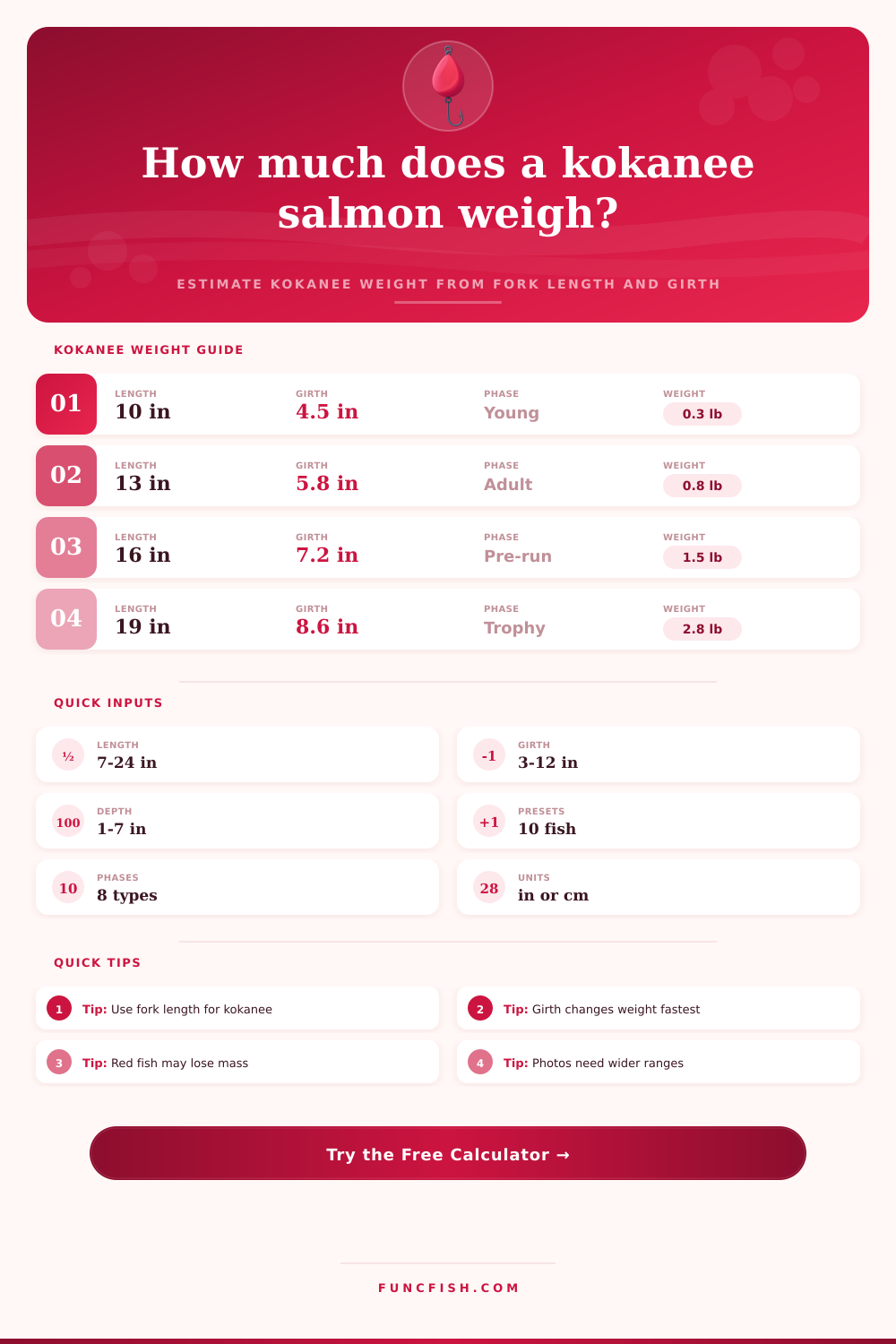
| Fork length | Average girth | Likely weight | Kokanee class |
|---|---|---|---|
| 8 in / 20 cm | 3.4-3.8 in / 8.6-9.7 cm | 0.13-0.20 lb / 59-91 g | Juvenile or small adult |
| 11 in / 28 cm | 4.6-5.2 in / 11.7-13.2 cm | 0.35-0.55 lb / 159-249 g | Common adult |
| 14 in / 36 cm | 5.9-6.7 in / 15.0-17.0 cm | 0.80-1.20 lb / 363-544 g | Quality kokanee |
| 17 in / 43 cm | 7.2-8.2 in / 18.3-20.8 cm | 1.55-2.35 lb / 0.70-1.07 kg | Large lake fish |
| 20 in / 51 cm | 8.5-9.8 in / 21.6-24.9 cm | 2.70-4.10 lb / 1.22-1.86 kg | Trophy kokanee |
| Kokanee run / phase | Body profile | Weight factor | Best measurement clue |
|---|---|---|---|
| Open-water silver feeder | Firm silver body, steady girth | 1.00 | Fork length and widest girth |
| Summer deep-water school | Longer pelagic body | 0.98 | Depth prevents over-estimate |
| Pre-run staging fish | Full body before color changes | 1.08 | Girth often peaks here |
| Tributary runner | Longer body, color change begins | 0.96 | Watch belly loss |
| Shoreline spawning fish | Red body, shape changes | 0.90 | Use phase and depth check |
| Post-spawn spent fish | Thin body and depleted mass | 0.78 | Use widest confidence range |
| Lake productivity | Forage signal | Expected body | Calculator effect |
|---|---|---|---|
| Cold clear low-food lake | Sparse zooplankton | Lean, slower growth | Lowers weight factor |
| Moderate plankton lake | Steady plankton bands | Average kokanee shape | Neutral baseline |
| Productive reservoir | Strong summer feed | Fuller girth and depth | Raises estimate |
| Fertile plankton bloom lake | Dense seasonal bloom | Heavy shoulders and belly | Highest profile factor |
| Crowded low-growth lake | Many small schools | Shorter, thinner adults | Reduces mass and class |
| Confidence setting | Use when | Base range | What widens it |
|---|---|---|---|
| Scale checked plus tape | Scale or very careful tape used | About +/- 5 percent | Unusual spawning shape |
| Good fork length and girth | Normal field measurement | About +/- 9 percent | Depth far from profile |
| Quick field tape | Fast release or moving fish | About +/- 15 percent | Loose girth reading |
| Rough net or cooler estimate | Partial dimensions only | About +/- 22 percent | Length-heavy estimate |
| Photo-only estimate | Measurements reconstructed later | About +/- 30 percent | Perspective and body angle |
Kokanee estimates are field calculations. A calibrated scale is the only exact weight, especially for spawning-phase fish with unusual body shape.
💡Kokanee measuring tips
Kokanee are usually compared by fork length. If you only have total length, reduce it slightly before entering the calculator or choose a wider confidence setting.
A bright silver kokanee and a red runner can share the same fork length while carrying different girth, depth, and reserve weight.
Kokanee salmon weight are an important metric in that the weight of kokanee salmon provide information regarding the health of the lake in which the kokanee salmon are living. For instance, a kokanee salmon that is 16 inches in length may weigh either one pound or it may weigh three pounds, the difference in weight due to the source of the water in which the kokanee salmon live, the time of year when the kokanee salmon is weigh, and the available food sources for those kokanee salmon. Because it is difficult to determine the weight of a kokanee salmon without using a scale, it is possible to use a calculator to estimate the weight of that individual kokanee salmon.
The calculator utilize three different measurements of the kokanee salmon to calculate the geometry of the fish. For instance, the calculator may utilize one of the measurements is the length of the fishs fork length, which is a measurement that can easily be take from the fish. Additionally, the girth of the fish can provide information regarding the weight of the kokanee salmon, and the depth of the body of the kokanee salmon can reveal the differences between fish with broad bodies versus those with thin bodies and narrow feature.
How to Estimate the Weight of a Kokanee Salmon
Each of these three measurements provide the calculator with information regarding the geometry of the kokanee salmon. In addition to using these geometry measurements to calculate the weight of a kokanee salmon, the calculator also incorporate information regarding biological factors that may impact the weight of those salmon. For instance, the weight of kokanee salmon can change based off the productivity of the lake in which they lives.
For example, lakes with low levels of plankton will produce kokanee salmon that have little body fat and are thin, while lakes with high levels of zooplankton will produce kokanee salmon that have more body fat and weigh more. By choosing the type of water in which the kokanee salmon live in the calculator, the weight of the fish can be adjusted to account for these different types of lakes. Additionally, the amount of food eaten by the kokanee salmon will impact their body weight, as well; kokanee salmon that eat alot of food will have more body fat and weigh more then those that eat little food.
The same adjustment for food can be made in the calculator. Another factor that will affect the weight of a kokanee salmon is its spawning phase. For instance, silver kokanee salmon and red spawning kokanee salmon can have the same length, but their weights may be different.
In the calculator, the user can choose the spawning phase of the kokanee salmon, which alter the weight calculation accordingly. The color changes of the kokanee salmon in the spawning phase will impact the weight of the salmon; however, the early changes to the color of the salmon will have little impact on the weight of the salmon being measured. However, after the fish have begun to spawn or after the spawning process is complete, the weight of the fish will change significant.
The calculator provides an estimate of the weight of the kokanee salmon, a weight range for that salmon, a condition index for the fish, and the class of the kokanee salmon. A lower confidence setting will account for the difficulty in measuring the weight of a fish that is moving in its natural habitat. The condition index compares the weight of the salmon that is being measured to the average kokanee salmon of the same length and of the same type of lake in which the salmon live.
If the index is close to 100, then the kokanee salmon has an average weight; if it is higher than 100, then the kokanee salmon has a higher reserve of body fat than average kokanee salmon of the same length; if it is lower than 100, then the kokanee salmon has less body fat than average salmon of that length. The calculator provides reference tables that display the factors that impact kokanee salmon. These reference tables are not replacements for the calculator, but they can help to show whether or not the weight of the salmon is within the normal weight for that species.
The reference tables can help to determine if the kokanee salmon from a certain lake are normal in weight, or whether the time of year that the fish are being weighed may be incorrect. Because the weight of a kokanee salmon is not a fixed trait of the fish, the weight of kokanee salmon can vary from lake to lake. For instance, a 17-inch kokanee salmon may be heavy in one lake, but thin in another lake of the same size.
Such differences in weight are create by the food availability in each lake, the length of time that the kokanee salmon had to eat in its native habitat, and its stage of the spawning season. Therefore, using the calculator to provide an estimate of the weight of the kokanee salmon provides a better picture of the kokanee salmon than measuring its length alone. By utilizing this calculator, it is also possible to compare the weight of kokanee salmon within different season of the year.
For instance, if the calculator indicates that the weight of the salmon each season is lower than previous years, that may be an indicator of issues regarding the availability of food for those salmon. However, if the weight estimates are higher, that may indicate that the kokanee salmon living in the lake had a good year for plankton populations. Thus, the weight of the kokanee salmon can become data that can be used to make determination regarding the salmon populations and their habitats.