Trophy Fish Score Calculator
Compare a catch against species benchmarks using measured length, girth, scale weight, condition, scoring method, and release documentation.
📌Trophy presets
⚙Catch measurements
Trophy score summary
Full breakdown
🏆Species benchmark grid
Largemouth
Walleye
Pike
Striped bass
📊Reference tables
| Species | Trophy length | Trophy weight | Legacy mark | Best measure |
|---|---|---|---|---|
| Largemouth bass | 22 in / 56 cm | 8 lb / 3.6 kg | 10 lb / 4.5 kg | Total length |
| Smallmouth bass | 20 in / 51 cm | 5 lb / 2.3 kg | 6 lb / 2.7 kg | Total length |
| Rainbow trout | 26 in / 66 cm | 8 lb / 3.6 kg | 10 lb / 4.5 kg | Total length |
| Walleye | 30 in / 76 cm | 10 lb / 4.5 kg | 12 lb / 5.4 kg | Total length |
| Northern pike | 40 in / 102 cm | 18 lb / 8.2 kg | 25 lb / 11.3 kg | Total length |
| Muskellunge | 50 in / 127 cm | 35 lb / 15.9 kg | 45 lb / 20.4 kg | Total length |
| Bluegill | 10 in / 25 cm | 1 lb / 0.45 kg | 1.5 lb / 0.68 kg | Total length |
| Channel catfish | 32 in / 81 cm | 15 lb / 6.8 kg | 25 lb / 11.3 kg | Total length |
| Striped bass | 42 in / 107 cm | 30 lb / 13.6 kg | 40 lb / 18.1 kg | Fork or total |
| Redfish | 40 in / 102 cm | 25 lb / 11.3 kg | 35 lb / 15.9 kg | Fork or total |
| Score class | Point range | Length status | Weight status | Field meaning |
|---|---|---|---|---|
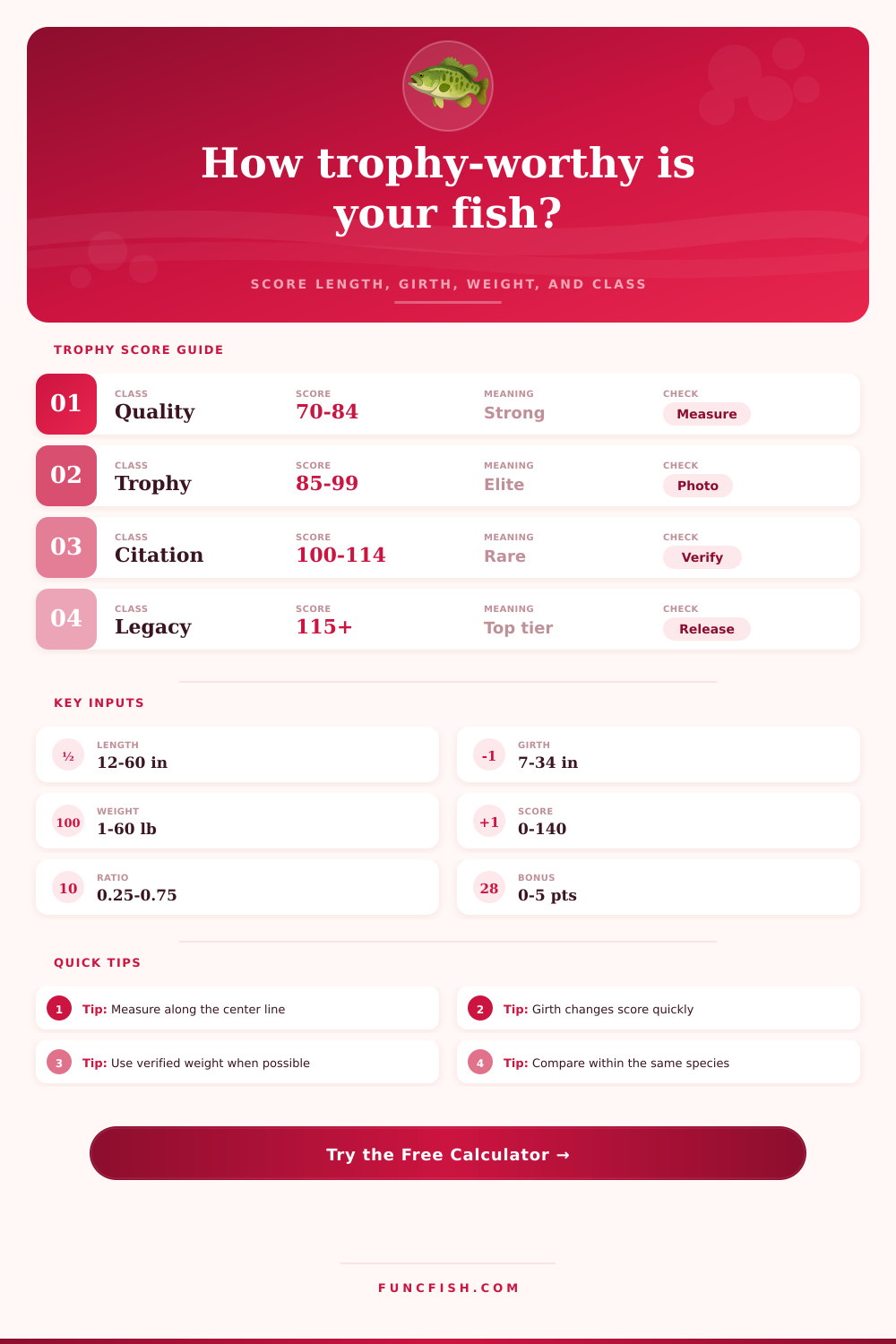
| Nice fish | 55-69 | Above average | Healthy | Worth recording carefully |
| Quality fish | 70-84 | Near trophy | Strong | Excellent local catch |
| Trophy fish | 85-99 | Trophy window | Heavy | Photo and measure twice |
| Citation fish | 100-114 | At benchmark | Benchmark | Rare species-class catch |
| Legacy fish | 115+ | Above benchmark | Exceptional | Top-tier catch by species |
| Measurement factor | Score impact | When it matters | Calculator handling | Best field check |
|---|---|---|---|---|
| Fork length | -1% to +3% | Saltwater species | Converts to total-equivalent | Note method on photo |
| Pinched tail | +1% to +2% | Long-tail fish | Small total length bonus | Keep fish flat |
| Heavy girth | +3 to +10 pts | Pre-spawn fish | Raises condition index | Measure widest point |
| Certified scale | +2 pts | Weight records | Adds documentation credit | Record scale photo |
| Healthy release | +2 to +4 pts | CPR scoring | Adds release credit | Fast wet handling |
| Method | Length weight | Girth weight | Scale weight | Best use |
|---|---|---|---|---|
| Balanced trophy | 42% | 18% | 32% | All-around ranking |
| Length citation | 62% | 15% | 15% | Ruler-based awards |
| Weight trophy | 25% | 15% | 52% | Scale-heavy scoring |
| Catch-photo-release | 56% | 22% | 10% | Release-focused catches |
| Condition factor | 25% | 45% | 22% | Comparing build quality |
| Saltwater fork-length | 54% | 16% | 22% | Fork-length species |
💡Scoring checks
Tip: A length-only trophy can score lower if girth and scale weight are thin for the species. Measure girth at the widest natural point before release.
Tip: Compare fish only against the same species benchmark. A 10 inch bluegill and a 40 inch pike can both be trophy-class catches.
When you catch a fish, you may want to know if your fish is a trophy for that specific species of fish. The fish may feel large in your hands to you, but that does not necessarily mean that the fish will score as a trophy fish. A trophy fish must meet specific measurement for it’s species.
Trophy fish are scored based on its length, weight, and girth. These three measurements provide a score for the fish. This score is useful in that it allow you to compare one fish to another fish, as well as to compare a fish that you catch in one season to a fish that you may catch in a different season.
How to Tell if Your Fish Is a Trophy
The measurements for the fish will determine the score of the fish. Length is a primary scoring measurement for fish. Girth is a primary scoring measurement for fish.
The weight of the fish are a primary scoring measurement. Condition is also a scoring measurement for fish; the condition of the fish relates to the length of the fish. For instance, a fish in a pre-spawn condition will contain more mass than a fish in a post-spawn condition of the same length.
You can use a calculator to input each of these measurements to remove guesswork from scoring the fish. The methods for scoring the fish can change the weight given to each of the measurements of the fish. For instance, the length focused method will give more importance to the length of the fish than a weight heavy method.
A condition based method will give more importance to the girth and the mass of the fish. You can use the calculator to test each of these methods for the fish. Additionally, the documentation for the fish also has some value.
For instance, knowing the length and the weight of the fish with a ruler and scale is more valuable than knowing the length and weight of the fish in memory; the more accurate the documentation of the fish, the more accurate the score. In order to calculate the score correctly, you should compare the fish to the correct species of fish. For instance, a 22-inch largemouth bass is not comparable to a 40-inch pike.
Comparing the fish to the incorrect species will result in an incorrect score. However, the calculator will automatically load the parameter for the specific species that is selected. Additionally, the waterbody in which the fish was caught can affect the score of the fish.
For instance, a fish caught in a small pond may score more higher than a fish caught in a large reservoir. To account for this, the calculator makes modest adjustment based off different waterbody types. The output of the calculator will provide a placement value for the fish within the species of fish that was caught.
The score will not rank the player against other players, but rather the fish within its species. A score within the quality range for the species of fish mean that the fish is a quality fish for that location, while a score that is within the trophy-class range means that the fish is a very large fish for that species. Additionally, if the fish scores beyond the common benchmark for the species of fish, the fish may earn a citation or even a legacy mark for that fish.
This makes visible the distance between a common fish and a trophy fish. Girth is another important measurement for the fish. Although many people may consider girth to be a secondary measurement for fish, the girth is a primary measurement.
The girth will change the condition index of the fish; for instance, a fish with a long length but narrow girth will score differently than a fish with short length but wide girth. A fish with a wide girth will have more mass, which will lead to a higher class for that fish. Therefore, the calculator makes it so that fish players dont have to remember the conversion tables for girth to mass.
Additionally, you can find more value from this calculator if you use it many times. For instance, if you catch many fish from the same waterbody, using the calculator will allow you to see patterns in the scores of the fish. For instance, you can learn which months of the year will yield more weighted fish than other months, or which areas of the waterbody contain more conditioned fish than others.
These patterns would of been difficult to recognize if you only used your opinion of the fish to determine its value. However, using the score allows you to hold in your memory the value of each of your fish, and to recognize whether or not a particular fish was a trophy fish for that waterbody.