Catch Rate By Time Of Day Calculator
Estimate bites per hour, likely landed fish, and the strongest bite window from clock time, light level, species behavior, weather, tide, pressure, and water temperature.
📌Scenario presets
⚙Trip inputs
Time-of-day catch forecast
Full breakdown
📋Activity factor grid
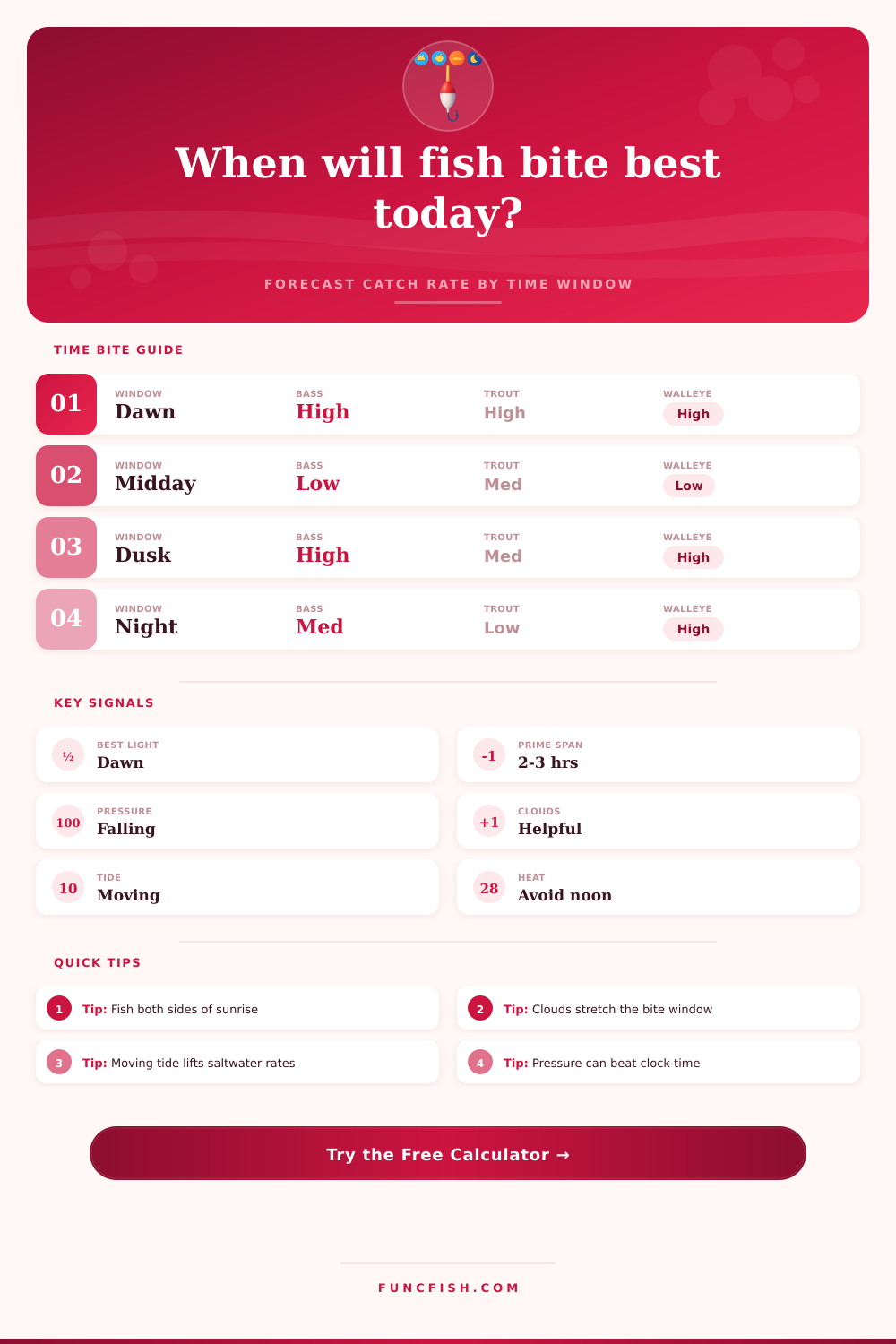
Low-angle light often lifts feeding activity for bass, walleye, redfish, trout, and crappie.
Clear skies and high sun compress the bite unless fish are shaded, deep, or current-fed.
A falling barometer can increase movement before a front, especially with cloud cover.
Saltwater and tidal-river species often feed better when bait is being pushed by water.
📊Species time references
| Species | Peak time | Temp comfort | Notes |
|---|---|---|---|
| Largemouth bass | Dawn / dusk | 60-78°F / 16-26°C | Shade helps midday |
| Smallmouth bass | Dawn / clouds | 58-72°F / 14-22°C | Current extends bite |
| Trout | Morning | 48-64°F / 9-18°C | Heat reduces rate |
| Walleye | Dusk / night | 50-68°F / 10-20°C | Low light matters |
| Catfish | Night | 68-84°F / 20-29°C | Warm nights score high |
| Redfish | Moving tide | 65-82°F / 18-28°C | Water movement is key |
| Condition | Multiplier | Best use | Caution |
|---|---|---|---|
| Overcast dawn | 1.45x | Shallow feeding | Watch storm safety |
| Bright noon | 0.70x | Shade or depth | Clear water drops faster |
| Falling pressure | 1.22x | Pre-front bite | Short-lived window |
| Post-front high | 0.62x | Slow finesse | Lower expectations |
| Peak tide flow | 1.28x | Saltwater edges | Slack water fades |
| Full moon night | 1.15x | Night predators | Day bite may shift |
💡Practical checks
Tip: Enter local sunrise and sunset instead of using generic clock time. A 6:30 AM start can be prime in June and nearly dark in winter.
Tip: If the calculated best window is outside your session, compare its multiplier with your actual start to decide whether moving the trip is worth it.
The fishing activity estimator take into account a variety of different environmental variables. Many angler are interested in determining the best time of day to go fishing. You can use the fishing activity calculator to determine the best time of day to fish by entering information about the time of day, the light levels in the water, the temperature of the water, and the barometric pressure.
Each of these variables can help to indicate how the fish may behave during the fishing trip, so it is important to enter accurate information into the calculator in order to recieve an accurate estimation of fishing activity. Sunrise and sunset time are two of the environmental variables that can be entered into the calculator. Each sunrise and sunset helps to determine the angle of the light that will hit the water.
Find the Best Time to Fish
Anglers may want to start fishing about one hour before the sunrise times, as the fish are often active during this period (known as the dawn surge). However, the fish tend to become less active after the sunrise time. A similar amount of activity occur at sunset times.
The length of these periods, however, may vary with the time of year and the amount of cloud cover in the sky. Water temperature is another of the variables that can help determine fishing activity. Each type of fish has a specific range of temperatures that is comfortable for those fish.
Active periods often occur when the water temperature is within that comfortable range for the type of fish that is to be caught. If the water temperature is outside of that range, the fish will be less active. The fishing activity calculator compare the entered water temperature to the ideal water temperature range for the species of fish that is to be caught.
The activity levels of some species may differ at different times of the year due to the warming of the water. For instance, the activity of largemouth bass may change with the approaching of spring compared to late summer when the water is warm. In addition to each of the mentioned variables, barometric pressure and tide movement are two additional variables in the fishing activity calculator.
Falling barometric pressure often indicates increased activity in the fish. Falling barometric pressure is even more effective at increasing the activity in the fish if there is also cloud cover in the sky. In the case of saltwater or tidal rivers, the movement of the tides is another variable that can be entered into the calculator.
Fish tend to use the seams in the water that are created by the movement of the water to ambush their prey, so the movement of the water can potentially increase the number of bites that an angler will recieve from the fish. This variable is automatically applied to saltwater and tidal rivers, but has a lesser influence on inland lakes. In addition to these environmental variables, it is also important to consider your own fit in fishing and your fishing efficiency.
Your presentation fit will impact the activity of the fish. For instance, if your bait or lure matches the conditions in which you will be fishing, the fish will be more likely to bite. Fishing efficiency is a variable that considers how many of the fish that bite will be successfully land.
If you are using a new fishing pattern, or if there are many other anglers in the water (high fishing pressure), both the number of fish that bite and land will decrease. The fishing activity calculator will provide three main types of information. First, you can estimate the number of fish bites that will occur each hour.
Second, the calculator can indicate the number of landed fish that can be expected. Third, the calculator will also provide information about the single best hour of fishing that can occur that day. In addition to these estimates, a score can also be provided that indicates how well the entered variables agree with each other.
If the score is high, it means that the activity in the fish may be expected to be high. However, a high score is not indicative of the ability of those fish to be caught. If the score is low, it means that at least one of the variables entered may work against the other variables entered.
A low score means that the angler should have realistic expectation for the fishing trip. In order to determine the best time to go fishing, it may be beneficial to run the fishing activity calculator a few different times. For instance, you could run the fishing activity calculator once for the start time of fishing that is planned.
Secondly, you can run the fishing activity calculator to determine the best time of day to fish. If these two times are significantly different, the schedule for fishing may be changed. Additionally, you can use the fishing activity calculator to determine the impact of certain changes to the fishing trip.
For instance, it may be helpful to determine what impact a change in tide will have on fishing activity or what impact a change in the temperature of the water will have on fishing activity. Cloud cover and wind during the time of fishing are two additional variables that may work in the angler’s advantage. In the case of cloudy skies during fishing, there may be more low-light periods in the water that can lead to increased activity in the fish.
Additionally, if there is only a light wind in the area, this may help to hide the fishing line from the fish. However, strong winds can be detrimental to fishing activity; a strong wind may make it difficult to control the boat, and it may move the fish to sheltered areas, reducing the chances of the fish biting on the angler’s bait. There are some variables that the fishing activity calculator cannot account for.
For instance, the traffic in the water, the fishing pressure in the area, or the number of blooms of algae in the water may also affect the activity of the fish. However, the fishing activity calculator does not account for these variables; it cannot measure the traffic in the water, the fishing pressure in the area, or the number of blooms in the water of algae. Thus, the fishing activity calculator should not be used as a way to guarantee the angler will catch fish.
However, by entering the variables of interest to the angler, and by additionally using any knowledge that the angler has of the area, fishing trip, or fish, the angler can make an informed decision about when to go fishing and whether or not a trip to the water is worth the effort. Thus, the fishing activity calculator can help anglers to avoid fishing during times that are likely to be unproductive (such as during the middle of the day), and to recognize that there may be an advantage to fishing during times when the tides are moving.