Dead Fish Penalty Calculator
Convert gross weigh-in weight into an official net score after dead fish deductions, optional live-release credits, and big fish eligibility checks.
📌Tournament presets
⚙Penalty settings
Use the written event rule sheet for final scoring.
Official score estimate
Full breakdown
📋Rule profile data grid
4 oz Club
8 oz Strict
Walleye
Metric
📑Penalty and scoring references
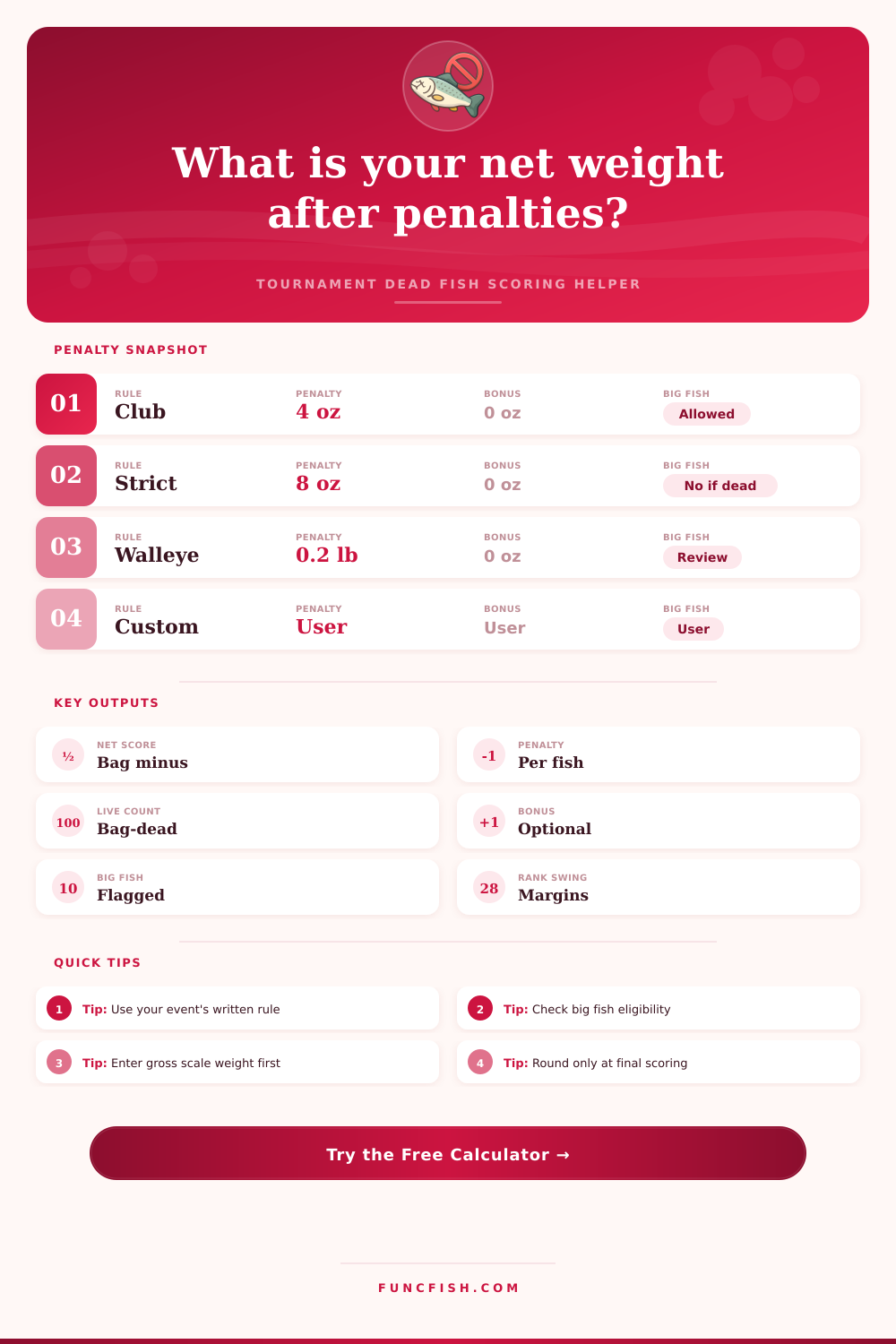
| Rule profile | Dead penalty | Metric equivalent | Big fish handling |
|---|---|---|---|
| Bass club 4 oz | 0.25 lb per fish | 113 g per fish | Often still eligible |
| Strict derby 8 oz | 0.50 lb per fish | 227 g per fish | Often ineligible if dead |
| Walleye 0.20 lb | 0.20 lb per fish | 91 g per fish | Check event sheet |
| Metric 250 g | 0.551 lb per fish | 250 g per fish | Set by event |
| Bonus format | Penalty plus lost bonus | Enter bonus in g | Depends on big fish rule |
| Division | Common bag size | Scoring focus | Penalty sensitivity |
|---|---|---|---|
| Bass | 5 fish | Total bag plus big fish | High when weights are tight |
| Walleye | 5-6 fish | Team bag weight | Medium to high |
| Catfish | 3-5 fish | Bag and big fish pots | Big fish status matters |
| Panfish | 10-25 fish | Stringer weight | Count errors add up |
| Redfish | 2 fish | Small team bag | One fish can decide it |
| Fish care setup | Risk adjustment | Scoring note | Best use in calculator |
|---|---|---|---|
| Recirculating livewell | Baseline | No score change by itself | Standard boat events |
| Aerated livewell | Low | Track long summer waits | Club and jackpot events |
| Supplemental oxygen | Lower risk | Does not remove penalties | Hot weather weigh-ins |
| Short weigh-in line | Low | Fewer fish-care delays | Small field events |
| Long weigh-in line | Higher risk | Check counts before stage | Large field events |
💡Practical scoring checks
Tip: Enter the gross scale weight before any deduction. The calculator subtracts dead fish penalties and then adds any live-fish bonus you specify.
Tip: Some events make a dead big fish ineligible even when the bag weight still counts. Use the big fish rule selector to flag that outcome.
Tournament fishing contests results can change due to the discovery of a dead fish in a contestant’s catch. The discovery of a dead fish can lead to a penalty for that contestants, which can change the fishing contest results. A dead fish cost a contestant more than the weight of the fish.
The weight of the fish that dies can lead to a penalty that is defined within the rules of the fishing tournament. The difference between a small penalty and a large penalty can be more significant than the difference in the weight of the fish between the different boat competing in the contest.
tournament organizers includes a penalty for dead fish to discourage poor care of the fish. A penalty for dead fish allows the fishing tournament to punish contestants for poor fish care without banning any fish that are not healthy.
Dead Fish Penalty and Live Fish Bonus in Fishing Tournaments
The amount of penalty for a dead fish depends on the tournament organizers’ priorities. For example, a small fish tournament could have a smaller penalty for dead fish to ensure that a bad day with one dead fish does not ruin a contestant’s entire day. Conversely, a large penalty for dead fish could be used in a high-stakes fishing tournament.
In this example, the tournament organizers may want all contestants to care for their fish by keeping their livewells filled with water. The calculator can be used to calculate the penalty for a dead fish in a fishing tournament by entering the rule profile, the number of fish that will be weighed, and the penalty per fish. Using the calculator will save the fishing tournament organizers from guessing the impact that a dead fish can have on the fishing contest.
The live-fish bonus works similar to the dead-fish penalty but with an added bonus for fish weighed. Some fishing tournaments gives a contestant a bonus for every fish that they weigh, ensuring that the fish are alive. The bonus encourages contestants to use better aeration devices or to have shorter periods between when they catch the fish and when they weigh them.
The live-fish bonus is given only if the number of live fish is larger than the number of dead fish. The live-fish bonus and the dead-fish penalty must be compared to find the true value of the live-fish bonus. For instance, if a contestant has five fish but one dead fish, the contestant loses the live-fish bonus for this fish and also the dead-fish penalty.
In this scenario, the loss of a single fish costs the contestant more than half a pound of weight. The inclusion of both the live-fish bonus and dead-fish penalty fields in the calculator allows the organizers to include these impacts on the total weight of the tournament contestants. Another factor that the presence of a dead fish impacts is the contestant’s eligibility for prizes for the biggest fish.
Some fishing contests will include the weight of the dead fish in the contestant’s total weight but will disqualify the contestant from prizes for the biggest fish. Other contests will only apply the penalty for a dead fish if that dead fish was the one declared as the biggest fish in the fishing contest. The calculator allows the fishing tournament organizer to include the eligibility for prizes for the biggest fish in the fishing contest.
Using this field, the calculator can show whether a contestant is eligible for the prize or whether they only took weight from the catch due to the dead fish penalty. The prize for the biggest fish can be larger than the prize for the fishing contest winner. A contestant can lower the risk of having a dead fish in their catch by using a recirculating livewell that includes supplemental oxygen for the fish.
However, a dead fish will still cost the contestant a penalty for the fish. The risk-index line in the calculator will show the percentage of a contestant’s weight that came from bad fish care. If that percentage is high, the contestant may need to use ice packs for the fish or shorten the drift of the boat to ensure that they do not have a dead fish in their catch.
The margins for the teams ahead and behind can help a fishing tournament organizer understand the effect of the dead-fish penalty on the contestant’s rank in the fishing contest. The margin will help with the conversion of the dead fish penalty into a question about the rank of the contestant in the fishing tournament. For example, if the penalty for a dead fish is larger than the margin between the contestant and the leader in the fishing contest, then a dead fish cost the contestant the fishing contest win.
However, if the penalty for a dead fish is smaller than the margin between the contestant and the next contestant in the fishing contest, then the penalty for a dead fish will not impact the contestant’s rank in the fishing contest. The calculator will perform this calculation to determine these rankings automatically. The dead fish penalty calculator cannot account for any decisions made during the fishing contest.
For example, if a contestant put their fish into the weighing trough and the fish looked unhealthy but then revived later, or if a contestant had healthy fish but one of them died while in the weighing trough, the calculator cannot account for this. These variables are outside of the parameters of the formula used in the calculator. The value of using the calculator before a fishing contest is that it can allow the fishing tournament organizers to know the cost of each dead fish before arriving at the fishing dock.
They will also be able to know whether the live-fish bonus encourages contestants to take the risks involved in caring for fish until they are weighed and the cost of having a dead fish in the contest.