Big Bass Points Calculator
Score a bass catch from measured weight, length, girth, species benchmark, event format, condition, and verification details.
🎯Big bass presets
⚙Catch scoring inputs
Big bass score summary
Full breakdown
🏆Bass benchmark grid
Largemouth
Smallmouth
Spotted
Peacock
📋Scoring reference tables
| Species | Big weight | Big length | Elite weight | Calculator note |
|---|---|---|---|---|
| Largemouth bass | 7 lb / 3.2 kg | 22 in / 56 cm | 10 lb / 4.5 kg | Heavy girth drives points quickly |
| Smallmouth bass | 5 lb / 2.3 kg | 20 in / 51 cm | 6.5 lb / 2.9 kg | Length and condition stay balanced |
| Spotted bass | 4.5 lb / 2.0 kg | 19 in / 48 cm | 6 lb / 2.7 kg | Benchmark is lower than largemouth |
| Shoal bass | 4.5 lb / 2.0 kg | 20 in / 51 cm | 6 lb / 2.7 kg | Current fish get slight field credit |
| Peacock bass | 7 lb / 3.2 kg | 23 in / 58 cm | 10 lb / 4.5 kg | Long profile with strong fight factor |
| Striped bass | 25 lb / 11.3 kg | 38 in / 97 cm | 40 lb / 18.1 kg | Separate benchmark for larger bass |
| White bass | 2.5 lb / 1.1 kg | 16 in / 41 cm | 4 lb / 1.8 kg | Shorter species with high school rate |
| Guadalupe bass | 2.5 lb / 1.1 kg | 16 in / 41 cm | 3.5 lb / 1.6 kg | Small benchmark, river class scoring |
| Scoring format | Weight share | Length share | Girth share | Best use |
|---|---|---|---|---|
| Tournament big bass | 58% | 22% | 12% | Scale-first event scoring |
| Club points ladder | 45% | 30% | 15% | Repeatable season points |
| Kayak CPR length | 12% | 66% | 12% | Board-photo length contests |
| Derby bonus board | 50% | 25% | 15% | Single-day bonus fish |
| Personal log score | 38% | 34% | 18% | Balanced catch journal |
| Youth pond derby | 35% | 38% | 17% | Rewards solid measured fish |
| Class | Point range | Common meaning | Verify with | Result note |
|---|---|---|---|---|
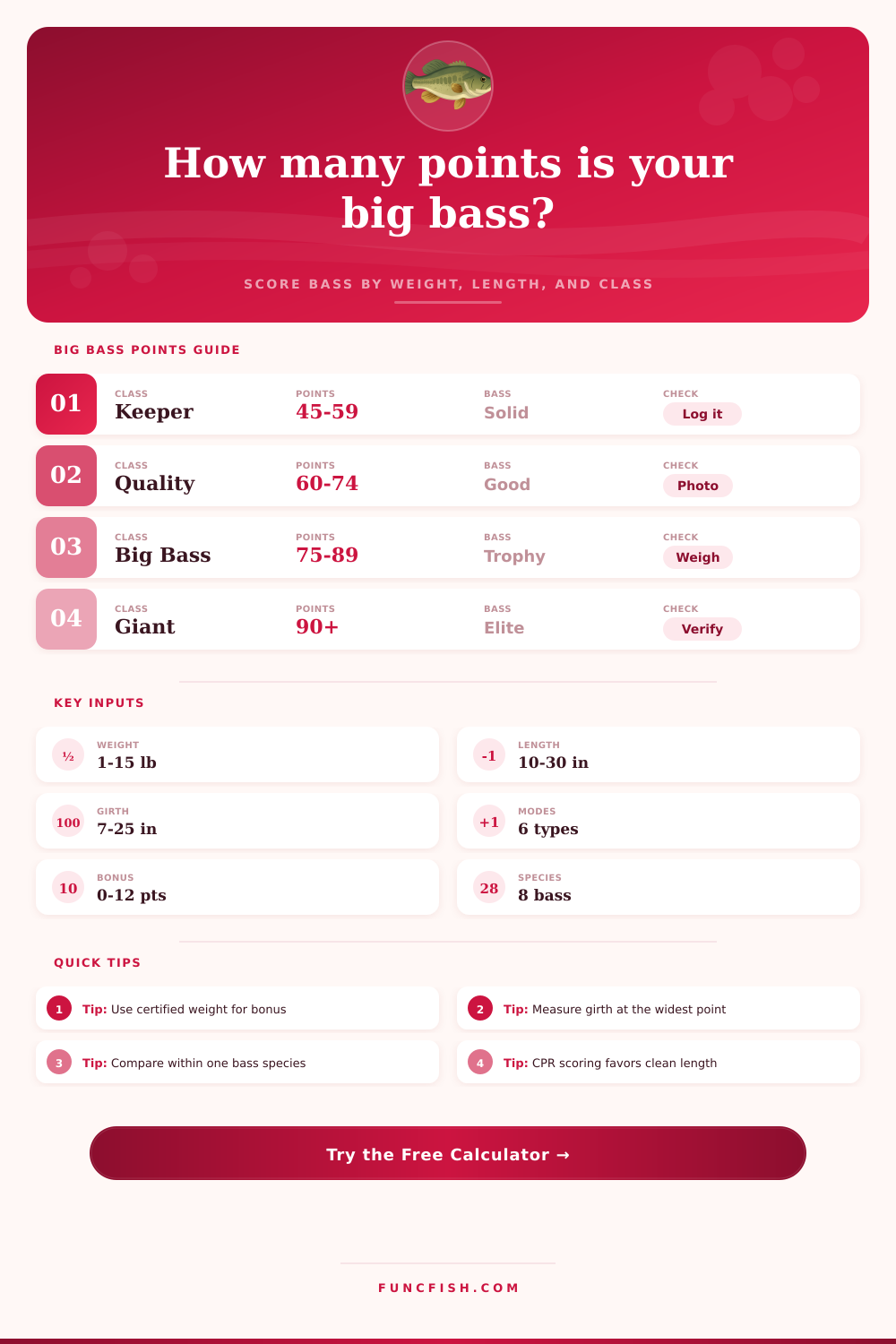
| Keeper bass | 45 to 59 | Solid catch | Length photo | Worth logging, not dominant |
| Quality bass | 60 to 74 | Strong local fish | Photo and ruler | Likely competitive in small fields |
| Big bass | 75 to 89 | Trophy-class catch | Digital scale | Could win many bonus pools |
| Giant bass | 90 to 104 | Rare benchmark fish | Scale and witness | Elite result for the species |
| Legacy bass | 105 plus | Outstanding fish | Certified record | Far beyond normal comparison |
💡Scoring checks
Weight matters most in scale-based formats. For tournament big bass scoring, use the actual scale reading and enter the current leader to calculate the exact gap.
Length-only contests need clean board photos. CPR scoring shifts points toward length, so a verified board measurement can outrank a heavier unverified estimate.
A point system allow a person to compare their catch of a bass fish to the benchmarks establish for the specific species of bass that they catch. A points system is useful in that it provide a number to the bass fish that reflect the bass fish catch, rather than relying upon the feelings of the angler regarding the weight, length, and girth of the bass fish that was caught. Each of these factor is important, but must be compared to the specific species of bass that was caught, as a smallmouth bass fish will differ from a largemouth bass fish in relation to the parameter of size for that species of bass.
In order to calculate an accurate score for the bass fish that was caught, the angler must account for several factors. The species of the bass fish is one of the primary input into calculating the score for the bass fish caught. The weight of the bass fish is one of the input that is required to calculate the score of the bass fish.
How to Score a Bass Fish
In addition to the weight of the bass fish, the length and girth of the bass fish are two additional factor that must be accounted for in calculating the score of the bass fish, as the bass fish may be very thick for its length. The condition of the bass fish is another important input factor, as a pre-spawn bass may have more girth than a post-spawn bass fish. Finally, the waterbody type and the season in which the bass fish were caught are two additional factor that the angler must account for when calculating the score of the bass fish.
Verification level is another important factor in calculating the score of the bass fish that was caught. Verification level determine the trustworthiness of the measurement of the bass fish. For instance, an estimate of the weight of the bass fish from a photo will reflect a lower verification level then the certified weight of the bass fish with the presence of a witness.
Verification level is important in that it can impact whether or not the score of the bass fish will be used in determining a ladder or tournament payout. Finally, field size is another important factor in calculating the score of the bass fish that is caught. For instance, a bass fish that is large in a ten-person bass fish tournament may not be as large as a bass fish that is in the same weight category in a hundred-person tournament.
The final score for the bass fish that was caught will indicate the quality of the fish that was caught. For instance, a score that fall in the mid-sixties may indicate a quality local bass fish, but a score in the seventies or eighties may indicate that the bass fish that was caught may be considered a trophy fish. Scores in such high range are relatively rare for the bass fish that are caught, however.
Each of these factors will impact the score for the bass fish that is caught. For instance, an 8-pound largemouth bass fish may have one score when measured on a certified scale in a tournament with hundreds of other angler, but may have a different score if the largemouth bass fish was measured on a board while on a solo kayak trip. Each of the different scoring format requires a focus upon different factors than others.
For instance, in tournaments in which the goal is to catch the heaviest fish, the focus is on the weight of the bass fish that is caught. Kayak fish tournaments may focus on length to determine the total number of inch of bass fish that were released from the water. Finally, club ladders may feature a scoring system for both weight and length and girth of the bass fish, since such ladders may be used to indicate the success of each player over a fishing season.
Each of these scoring formats can be used in relation to bass fish, but each angler should select the appropriate scoring mode for there situation; selecting the incorrect scoring mode would result in an inaccurate score for the bass fish that was caught. The reference tables will list the weight, length, and girth shares for each of the different scoring formats. In addition to these tables, the list of big-mark targets for each species is also list in these tables.
Each of these targets are important in that bass fish of different species grow at different rates; a 5-pound smallmouth bass fish will grow more differently than a 5-pound largemouth bass fish, for instance. In using a points system for the bass fish that is caught, an angler will be able to gain clarity regarding the bass fish once they have been caught. The use of a points system allow an angler to understand if their bass fish was an average catch, a strong catch, or an exceptional catch.
Additionally, a points system allow for the angler to compare their catches to their previous bass fish catches. Finally, an angler can use a points system to understand their fishing behavior; for instance, if an angler can recognize in which month or types of water they catch the best bass fish. Thus, the points system is a tool that allow for an angler to compare one bass fish catch to another catch.