Weigh-In Deduction Calculator
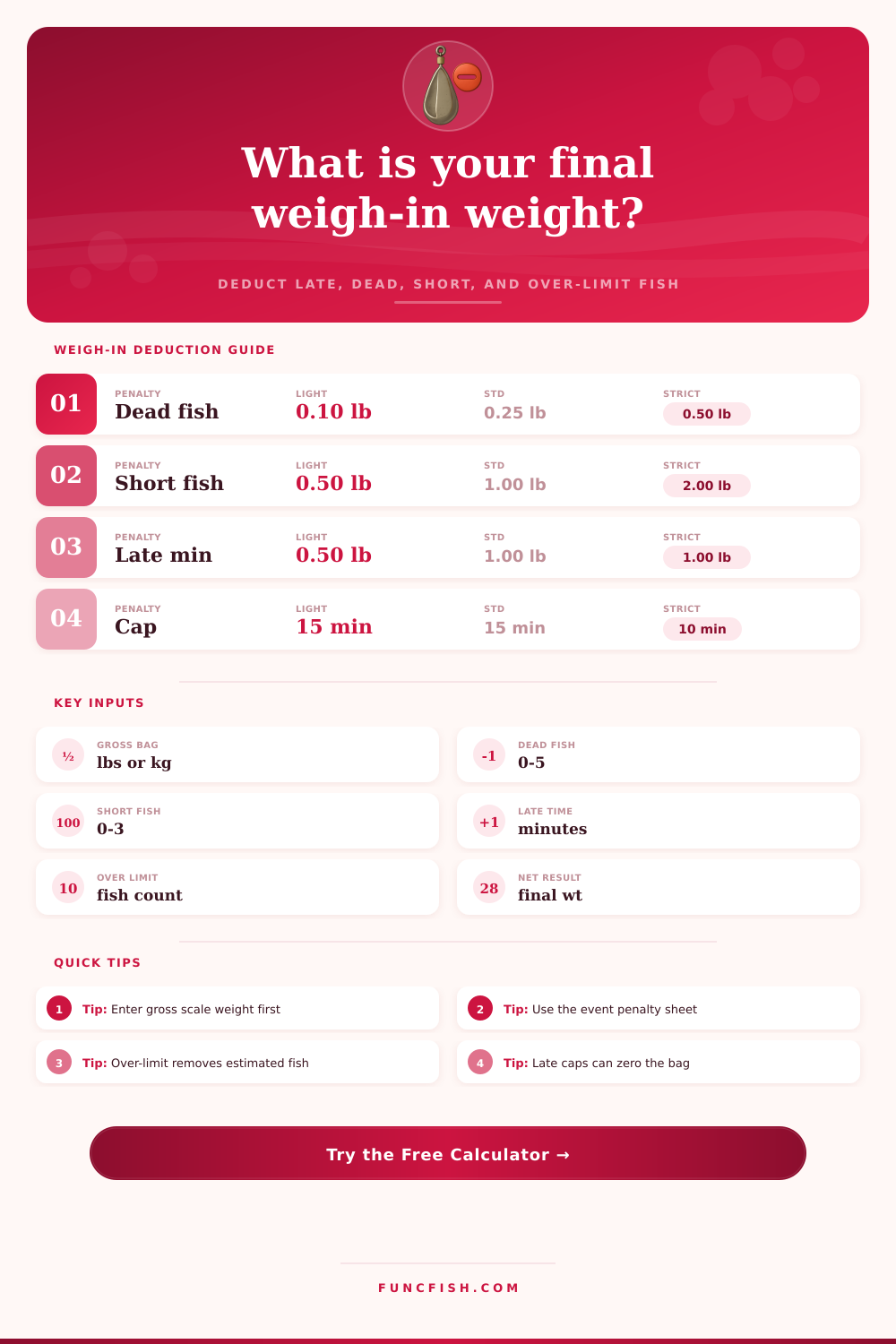
Convert gross scale weight into final tournament weight after dead fish, short fish, over-limit, and late weigh-in deductions.
📌Scenario presets
⚙Weigh-in settings
Adjusted weigh-in result
Full breakdown
📋Deduction schedule reference grid
Standard Club
Light Schedule
Strict Final
Kayak Photo
📊Penalty comparison tables
| Schedule | Dead fish deduction | Short fish handling | Late deduction | Over-limit handling |
|---|---|---|---|---|
| Standard club | 0.25 lb / 0.113 kg each | Remove estimated fish + 1.00 lb | 1.00 lb per minute, 15 minute cap | Remove estimated fish + 1.00 lb |
| Light conservation | 0.10 lb / 0.045 kg each | Remove estimated fish + 0.50 lb | 0.50 lb per minute, 15 minute cap | Remove estimated fish + 0.50 lb |
| Strict championship | 0.50 lb / 0.227 kg each | Remove estimated fish + 2.00 lb | 1.00 lb per minute, 10 minute cap | Remove estimated fish + 2.00 lb |
| Walleye team | 0.20 lb / 0.091 kg each | Remove estimated fish + 1.00 lb | 1.00 lb per minute, 15 minute cap | Remove estimated fish + 1.50 lb |
| Saltwater inshore | 0.50 lb / 0.227 kg each | Remove estimated fish + 2.00 lb | 0.50 lb per minute, 20 minute cap | Remove estimated fish + 2.00 lb |
| Kayak photo | 0.00 lb / 0.000 kg each | Length-to-weight estimate + 0.75 lb | 0.25 lb per minute, 20 minute cap | Remove estimated fish + 0.75 lb |
| Event format | Typical limit | Score sensitivity | Small-fish estimate | Best calculation check |
|---|---|---|---|---|
| Bass limit event | 5 fish | High | 1.25 to 3.00 lb | Verify dead fish and late time |
| Walleye team event | 5 fish | High | 2.00 to 4.50 lb | Check smallest fish removal |
| Panfish aggregate | 10 fish | Medium | 0.25 to 0.90 lb | Count over-limit fish carefully |
| Saltwater inshore | 3 fish | High | 1.50 to 5.00 lb | Separate short fish from dead fish |
| Kayak photo-to-weight | 5 fish | Medium | 0.75 to 2.50 lb | Use converted weight consistently |
| Championship final | 5 fish | Very high | 2.00 to 4.00 lb | Confirm late cap before standings |
💡Calculation checks
Tip: Enter the official gross scale weight before any deduction. Short and over-limit fish use the smallest or invalid fish estimate because those fish are normally removed from the credited bag before the additional penalty is applied.
Tip: If late time exceeds the schedule cap, this calculator flags the bag as a zero-weight result. Always compare the output against the event sheet used at the weigh-in table.
The weigh-in process is one of the specific parts of a fishing tournament. During the weigh-in process, the tournament rules is applied to your total fish weight. To complete the weigh-in process, you must place your bag of fish on the scale and watch the initial weight on the scales display.
The tournament organizers will apply penalty to that initial weight, which can reduce your total weight. Penalties are applied to account for the fact that you may have had a dead fish, a short fish, or that you might have arrived late for the weigh-in process. These penalties are applied to ensure that the rules of the fishing tournament are followed and to ensure that the fish resource in the tournament area are protected.
Weigh-In Penalties in Fishing Tournaments
Most tournaments will apply penalties for dead fish. A dead fish penalty is applied if the fish you caught died prior to being weighed on the weigh-in scale. The tournament organizers will apply a specific weight to the total weight of the fish that represents the weight of the dead fish.
The specific weight that is applied can differ between tournaments. A dead fish can significantly affect the outcome of the tournament as it can erase the weight advantage you earn throughout the tournament. Additionally, if a fish dies, many tournaments will eliminate your chance of receiving the big-fish award.
To avoid these problems, many anglers will use live well additives to keep there fish alive and many will check the amount of oxygen in the water to ensure that their fish stays alive. Tournament organizers apply penalties for short fish, or for anglers who have a limit of the amount of fish they can catch that a tournament allow. These penalties are different than the penalties for dead fish.
A short fish penalty is applied if the weight of a fish is less than the specified weight of a competition. Additionally, if an angler has more fish than the tournament limits, they will be penalized for the over-limit penalty. For both penalties, the tournament organizers will remove a specific estimated weight from the total weight of the fish that the anglor caught.
Additionally, an administrative penalty will also be applied to the total weight of the fish that is removed due to the short or over-limit penalty. The administrative penalty is to discourage anglers from undercounting the number of fish they have caught. An anglers can be significantly affected by having a short fish as the total penalty can be for a weight that is more than the weight of the fish that is caught.
Late arrival penalties are another penalty that the tournament organizers can apply. For late arrival penalties, the anglers must arrive at the weigh-in process at the time that is specified within the fishing tournament. If an angler shows up late, the tournament will apply a penalty to that angler.
Most fishing tournaments apply a specific weight for every minute that an angler is late to the weigh-in process. Most tournaments also have a maximum limit for the late arrival penalty. If an anglers late time goes beyond the maximum number of minutes for the late penalty, the total weight that that angler will be recorded with at the weigh-in process will be zero.
The tournament organizers apply the late arrival penalty to the anglers to ensure that the weigh-in process line does not sit in one spot for too long and to ensure that anglers do not travel too fast to the weigh-in process. Sometimes, even a few minutes late can mean receiving a late penalty. For example, if an anglers boat is slow or they have to cast their line multiple times to find a spot to fish, the anglor may become late to the weigh-in process.
Many anglers will use a calculator prior to the end of their fishing day to test the impact that the penalties may have on their total weight. These calculators ask for the total gross weight of the fish that the angler caught, the number of fish that the angler have, and the specific penalties for the tournament. Based off these numbers, the calculator will display the final credited weight that the angler will have for the day and the difference in weight between the angler and other competitors.
This number can help the anglor determine whether or not the number of penalties that they will incur are manageable, or if they need to change their fishing strategy. Tournament organizers apply different penalty calculations within different types of fishing tournaments. For example, kayak photo tournaments do not use dead fish penalties because the fish are released after taking their fish photo.
Youth fishing tournaments may apply smaller penalties because the focus of the tournament is on the youth anglors learning how to fish. Additionally, the weight of the fish that will be penalized for death will be more significant in a walleye fishing tournament than in another type of fishing tournament. By using reference tables for the different fishing tournaments, anglors can easily compare the penalty systems among the different types of fishing tournaments.
There are a few mistakes that anglors make with fishing tournament penalties. One of the most common is to assume that the penalty rules will be the same for the regular fishing event as the championship fishing event. Another mistake that anglors make is to assume that the estimated weight of the fish will be the same throughout the fishing event.
However, anglors may catch different types of fish throughout the day. Therefore, it is recommended that anglors run the numbers in the weight penalty calculator again each time they catch a new fish. The final credited weight will determine a fisherman’s rank in the fishing tournament.
Therefore, the calculator is a tool that anglors should of use to understand what their final credited weight will be.