Cull Weight Gain Calculator
Compare a new fish against your smallest livewell fish, scale accuracy, penalties, and tournament format to estimate true cull gain and the new bag weight.
🎯Cull scenario presets
⚙Cull weight inputs
Cull gain summary
Full breakdown
📊Cull decision benchmarks
Close Call
Clean Cull
Big Jump
Penalty Risk
📋Cull reference tables
| Scale method | Typical error | Close-call buffer | Best use |
|---|---|---|---|
| Certified digital scale | 0.5 oz / 14 g | 1 oz / 28 g | Final bag confirmation |
| Boat digital scale | 1.0 oz / 28 g | 2 oz / 57 g | Normal tournament culling |
| Cull beam balance | 1.5 oz / 43 g | 3 oz / 85 g | Fast same-day comparison |
| Spring scale | 2.5 oz / 71 g | 4 oz / 113 g | Rough field estimate |
| Hand estimate | 5.0 oz / 142 g | 8 oz / 227 g | Only when no scale is ready |
| Format | Common limit | Useful cull threshold | Calculator adjustment |
|---|---|---|---|
| Five fish bass limit | 5 fish | 3-4 oz / 85-113 g | Balanced buffer |
| Three fish kayak limit | 3 fish | 2-3 oz / 57-85 g | Higher upgrade percent |
| Six fish team limit | 6 fish | 4-6 oz / 113-170 g | More fish sorting |
| Two fish redfish limit | 2 fish | 2-4 oz / 57-113 g | Slot weight emphasis |
| Seven fish crappie limit | 7 fish | 1-2 oz / 28-57 g | Small ounce sensitivity |
| Species / bag type | Typical keeper | High-value gain | Handling note |
|---|---|---|---|
| Largemouth bass | 1.5-4 lb / 0.7-1.8 kg | 8 oz / 227 g | Tag every fish by weight slot |
| Smallmouth bass | 1.25-3.5 lb / 0.6-1.6 kg | 6 oz / 170 g | Reweigh in current or cold water |
| Walleye | 1.5-5 lb / 0.7-2.3 kg | 10 oz / 283 g | Watch length slot and oxygen |
| Redfish | 3-8 lb / 1.4-3.6 kg | 8 oz / 227 g | Slot length can override weight |
| Crappie | 0.5-1.5 lb / 0.2-0.7 kg | 2 oz / 57 g | Small scale error matters |
💡Practical cull checks
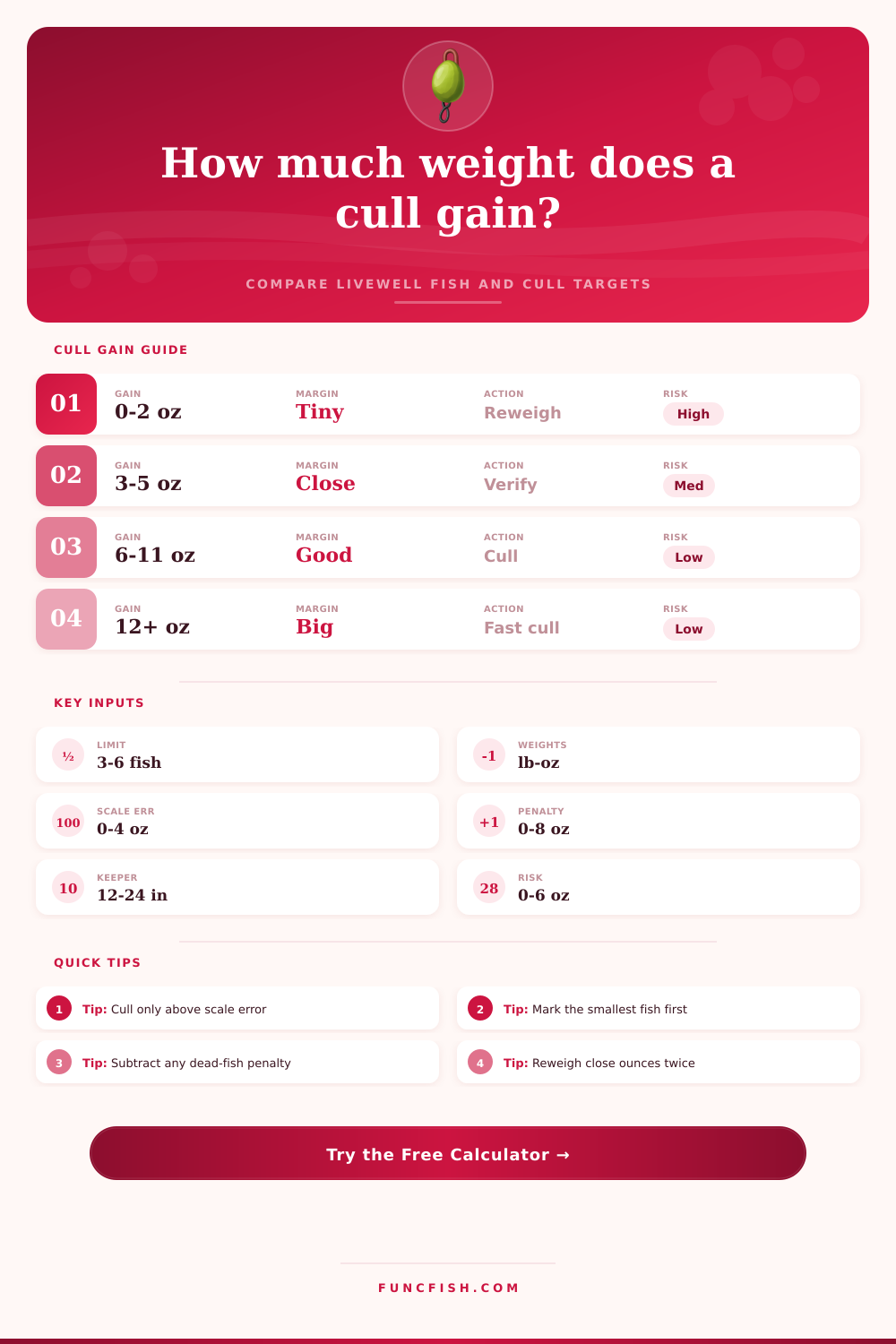
Scale buffer: Treat the cull as real only when the gain clears the combined scale error, extra allowance, and handling-risk buffer.
Penalty buffer: If a fish may draw a penalty, subtract that risk before deciding. A tiny gain can disappear at weigh-in.
Tournament fishing depend on small weight difference between the total weight of the fish and the tournament limit. Consequently, tournament fishing often require a person to decide whether to cull a fish from a livewell when bringing a new fish to the boat. Several factor must be considered when making such a decision.
The size of the fish will be one consideration, but others includes the accuracy of the scale, the risk of tournament penalty, the condition of the fish already on the boat, and the new weight of the fish being brought in. Every measurement of a fish will have some margin of error. The digital scale that is certified to measure the weight of the fish might not be accurate to the half ounce, and the spring scale might not be accurate to several ounce depending on the fish’s position on the scale.
How to Decide to Cull a Fish in a Tournament
The weight of the fish might also change due to the condition of the fish. A fish that has been handled rough or a fish that the warm water in which the fish is held stresses out will have an inaccurate measurement of it’s weight. The calculator account for this inaccuracy by allowing the person to choose the type of scale and the condition of the fish in the calculation of the risk of culling a fish from the livewell.
The species of the fish that is being caught also play a mathematical role in the fishing competition. For instance, a fisherman who is catching crappie fish and limited to seven fish will place more importance on the weight of the fish than a bass fisherman who is limited to five fish. This is due to the mathematical impact of a pound of fish in these two fishing competitions.
The calculator automatically adjust for the type of fish that is being caught and the fishing tournament format in which the competition is held. Another factor in the calculation is the tournament penalties for a short or dead fish. A penalty will reduce the total weight of the fisherman’s catch, negating the weight gain from the culling of a fish from the livewell.
Entering the tournament penalty into the calculator will subtract this value from the weight gain from the culling of a fish. In addition to the factors mention above, it is also suggested that an extra allowance for error in the calculation be given for the bouncing weight of the fish from the livewell on the boat. These reference tables on the page allow the fisherman to quick determine the risk of culling a fish based on the type of scale that is used and the type of fish tournament that is competed in.
The fisherman does not have to memorize these reference tables. These tables are a means of showing the fisherman why a two-ounce difference in weight might be risky in one situation and more comfortable in another. Many fisherman rely on their gut feeling when deciding whether or not to cull a fish from the livewell.
Unfortunately, their gut feeling will fail them if the weights of the fish are nearly the same and the leaderboards of the tournament closely match the weights of each fisherman. This calculator removes the mental math from the fisherman’s mind and allows them to focus on the variables that they can control in the livewell. There are specific step that can be used to decide whether or not to cull a fish from the livewell.
First, mark the smallest fish in the livewell. Next, reweigh any fish within the error and risk buffer of the calculation. Finally, only perform the swap of the fish in the livewell if the margin of weight between the fish is more greater than the threshold of safety that the calculator established.
The calculator will run the number after the fisherman enters the weights of the fish in the livewell. However, the calculator will not make that decision for the fisherman. It is up to the fisherman to make the final decision about whether or not the weight of the fish is worth the risk of culling it from the livewell.