Fish Per Livewell Gallon Calculator
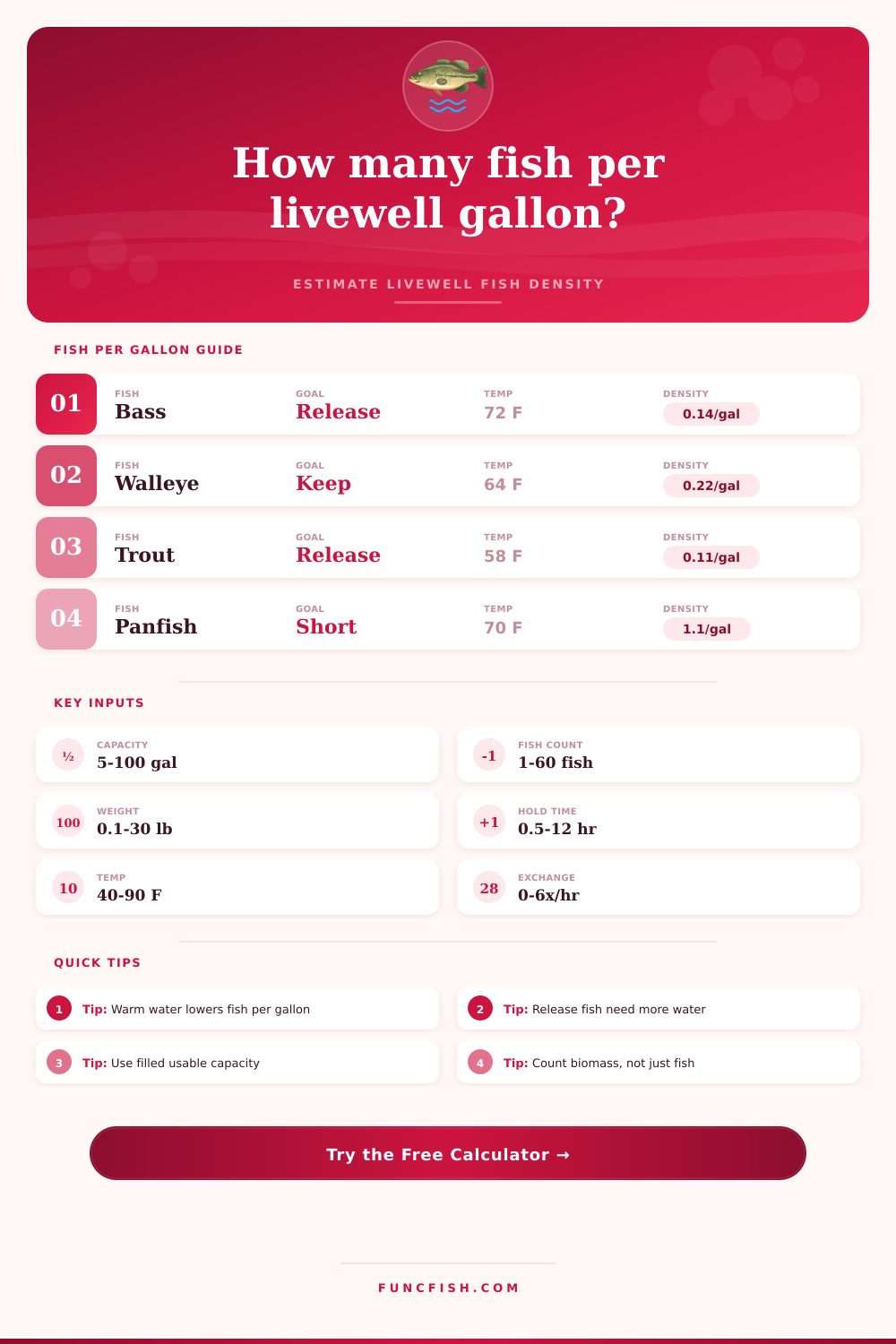
Estimate fish per gallon, gallons per fish, max holding count, biomass density, and water turnover for a livewell setup.
📌Scenario presets
⚙Livewell density settings
Livewell density forecast
Full density breakdown
📋Species density reference
Bass
Walleye
Trout
Panfish
📊Livewell density tables
| Species profile | Typical livewell fish | Release gallons per lb | Short-hold gallons per lb |
|---|---|---|---|
| Largemouth bass | 14-20 in / 1.5-5 lb | 2.3 gal/lb | 1.0 gal/lb |
| Smallmouth bass | 13-19 in / 1-4 lb | 2.4 gal/lb | 1.1 gal/lb |
| Walleye | 15-24 in / 1-6 lb | 2.2 gal/lb | 1.0 gal/lb |
| Trout | 10-18 in / 0.5-3 lb | 2.7 gal/lb | 1.3 gal/lb |
| Crappie | 9-14 in / 0.4-1.8 lb | 1.9 gal/lb | 0.8 gal/lb |
| Panfish | 6-10 in / 0.1-0.6 lb | 1.8 gal/lb | 0.7 gal/lb |
| Catfish | 16-30 in / 2-12 lb | 2.0 gal/lb | 0.9 gal/lb |
| Baitfish | 2-6 in / small biomass | 1.2 gal/lb | 0.4 gal/lb |
| Condition | Density effect | Calculator factor | Use when |
|---|---|---|---|
| Cold water below comfort | More fish per gallon | 0.88-1.00 | Cool stable holds |
| Warm water above comfort | Fewer fish per gallon | 1.03-1.55 | Summer livewells |
| Long hold time | Fewer fish per gallon | 1.00-1.45 | Long tournament days |
| Low exchange | Fewer fish per gallon | 1.00-1.30 | Weak pump or closed hold |
| Strong aeration | Slight density credit | 0.86-0.94 | Spray bar or oxygen |
| Divided livewell | Fewer fish per gallon | 1.08-1.18 | Reduced usable swim space |
| Livewell style | Usable volume | Circulation factor | Density note |
|---|---|---|---|
| Built-in boat livewell | 94% | 1.00 | Best baseline if pumps are working |
| Divided tournament well | 88% | 1.10 | Divider reduces usable room |
| Portable aerated tank | 90% | 1.08 | Heat and slosh add stress |
| Kayak livewell box | 82% | 1.18 | Small box needs conservative density |
| Round holding tank | 96% | 0.96 | Good water path and fewer corners |
| Cooler conversion | 86% | 1.12 | Corners and stratification matter |
💡Density checks
Tip: A livewell that can hold ten small panfish may be overloaded by two large fish because biomass and oxygen demand rise with weight.
Tip: When the calculator shows a tight target count, lower density first by adding water volume, shortening hold time, or improving exchange.
The ability to keep the fishes alive in the livewell depend upon several different variable. These variables include the water temperature, the size of the fish, the length of time that the fish are to be held, the amount of aeration that will be provided to the livewell, and the rate at which the livewell will be able to exchange its water for fresh water. Each of these variable has the potential to impact the ability of the livewell to keep the fish alive.
The number of fish that may be held within the livewell is dependent upon the oxygen demand of the fish and the stress that the fish may experience while within the livewell. Thus, each of these two factors has the potential to impact the survival of the fish that are to be held within the livewell. Fish require oxygen to survive.
Keeping Fish Alive in a Livewell
The fish use the oxygen that is consumed by the fish to fuel their bodies in relation to respiration, and the fish produce waste that reduce the quality of the water within the livewell. In general, the larger the fish, the more oxygen that they will require in comparison to smaller fish species of the same genus. However, because larger fish species require more space within the livewell than smaller species, the presence of larger fish will make it more difficultly to ensure that each of the fish in the livewell survive.
Additionally, the higher the temperature of the water within the livewell, the more rapid the fish within that livewell will use up the available oxygen within that livewell, as well as produce waste at a rapid rate. Thus, a livewell that may be sufficient in the morning may not be able to hold the same number of fish as those that are to be released back into the water, as the temperature of the water may have increased throughout the day. The goals that you have for the fish will also impact the requirements of the livewell; fish that are to be released require more oxygen and more frequent water changes than those that are to be kept for a short period.
The calculator that can be found on this page will allow you to enter the various data regarding your fish and your livewell to determine the capacity that your livewell should have. Such data includes the species of the fish, the average size of the fish that you will be holding in your livewell, the water temperature within the livewell, the length of time that the fish will be in the livewell, the level of aeration that will be provided to the livewell, and the exchange rate at which the livewell will exchange water for fresh water. Additionally, the calculator will adjust for the type of livewell that you have; divided livewells for tournament fishing provide less swimming room for the fish than round livewells of the same volume.
A “care margin” provides for the livewell to have some extra capacity beyond the maximum that is calculated for the livewell to hold the fish alive. Another factor to consider is the difference between fish count and biomass. Fish count is the number of fish that are to be held within the livewell.
Biomass is the weight of the fish. It is possible to have a larger count of smaller fish than a smaller count of large fish, but the biomass of the larger fish may make it more difficult to hold them within the livewell. Thus, you can enter the length and the weight of the fish into the calculator to provide an estimate of the total biomass of the fish, as well as factors that may influence the total biomass of the fish.
Additional factors that may affect the livewell include the rate at which the water within the livewell changes and the level of aeration provided to the water within the livewell. If the livewell changes its water one and a half times per hour, as compared to only half as often, then the livewell will be able to hold more fish. Aeration is provided within the livewell to distribute the oxygen to the fish; warm water contains less dissolved oxygen in comparison to water that is cooled.
Thus, the exchange rate for the water within the livewell will be less effective the higher the temperature of the water. The calculator accounts for the temperature of the water and the dissolved oxygen within that water, but it cannot account for, for example, whether the pump within the livewell is becoming blocked or whether the lid to the livewell is open. The reference tables that are included within the article provide the number of gallons of water per pound of fish for various species of fish and for various goals for the fish that are to be held within the livewell.
These numbers can be used as a starting point for the number of fish that are to be held within the livewell. For example, a walleye that is located in warm water with limited aeration will require more water to survive than a walleye that is contained within cool water with strong aeration. Thus, while the reference tables provide the baseline for the livewell and the survival of the fish, it is the calculator that allows the angler to adjust for their specific situation.
Many people make mistakes when using their livewells. For example, many people tend to fill their livewells to the top when they go onto the water from the fishing ramp. However, the livewell may not contain enough usable space for the fish due to the presence of the pumps, dividers, or even the fish themselves.
Additionally, most people dont account for how much the waste of the fish will fill the livewell when the exchange rate of the water within the livewell is slow. The calculator will help to reveal to the angler any potential problems with their livewell by entering the actual size of the livewell that is to become filled with fish and the actual water exchange rate of that livewell. It is a mistake for many anglers to believe that keeping more fish per gallon of water within the livewell is a better alternative to keeping fewer fish per gallon within the livewell.
However, it is always better to have the number of fish in the livewell that you have a maximum recommended number for the livewell. Additionally, if the fish do experience stress within the livewell, they will have poor condition when they are weighed in, and they may even die after being released from the livewell. Thus, the calculator will provide a recommendation for the maximum number of fish for your specific situation, but you should always have a number that is lower than that recommended maximum.
Using this calculator will allow people to consider the various factors that will impact the number of fish that should be contained within their livewell prior to beginning to fish. For example, if the water within the livewell will be warm and if the exchange rate of the water is slow, an angler may decide to have fewer fish in their livewell. An angler may also determine that they have cooler water in their livewell and that they may be able to aerate the water prior to the release of the fish.
Thus, by considering the various factors that may impact the number of fish that are to be contained within the livewell, people can make these decisions prior to leaving the fishing dock. Thus, the use of this calculator will allow anglers to have a clear picture in their mind of the capacity that their livewell should have according to their specific boat, species of fish, and conditions on the day that they are fishing.