Ice Needed for Cooler Calculator
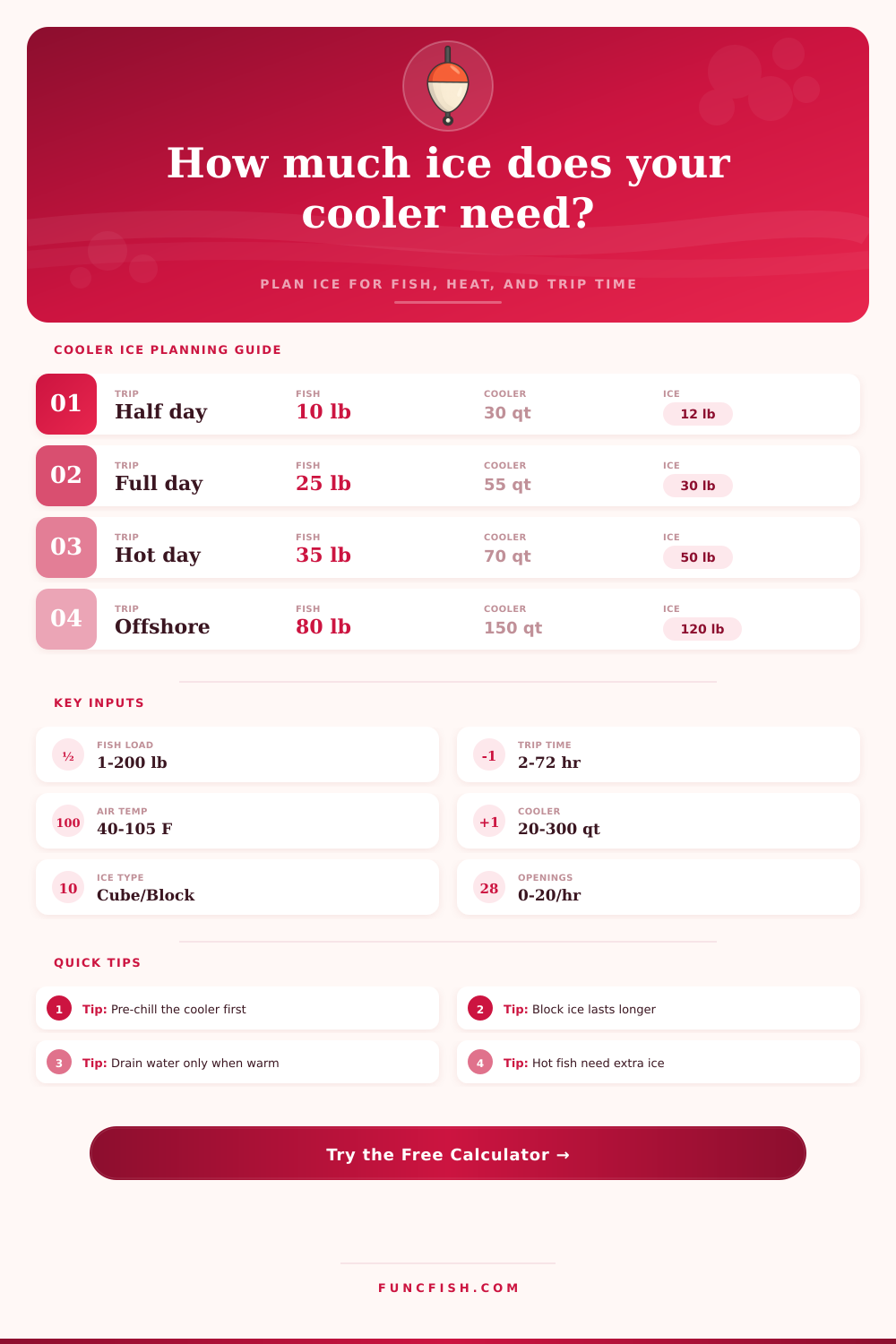
Estimate how much ice a fishing cooler needs from fish load, trip time, cooler insulation, air temperature, lid openings, and ice style.
📌Scenario presets
⚙Cooler ice settings
Cooler ice forecast
Full breakdown
🧊Ice and cooler reference grid
Cubed Ice
Block Ice
Slurry
Rotomolded
| Cooler type | Heat leak factor | Usable volume | Practical note |
|---|---|---|---|
| Thin-wall cooler | 1.35 | 88% | Needs the largest ice buffer in sun or wind. |
| Basic hard cooler | 1.00 | 90% | Works for day trips when pre-chilled. |
| Marine foam cooler | 0.75 | 91% | Good boat cooler for fish and bag ice. |
| Rotomolded cooler | 0.45 | 90% | Best long-hold insulation but heavy. |
| Soft-sided cooler | 1.45 | 82% | Use for short loads or fillets. |
| Insulated fish bag | 1.20 | 86% | Fits long fish but warms faster on deck. |
| Ice style | Effective cooling | Volume per lb | Best fit |
|---|---|---|---|
| Cubed bag ice | 1.00x | 0.66 qt | Fast fish coverage and easy layering. |
| Block ice | 0.94x | 0.54 qt | Long trips when fish are already cool. |
| Half block plus cubes | 0.98x | 0.60 qt | Balanced chilling and hold time. |
| Saltwater ice slurry | 1.08x | 0.72 qt | Fast chilling for whole fish. |
| Plate or flake ice | 1.04x | 0.70 qt | Good surface contact around fish. |
| Frozen jugs plus cubes | 0.88x | 0.58 qt | Clean cooler, slower direct chilling. |
| Fishing load | Typical fish weight | Starting point | Adjustment trigger |
|---|---|---|---|
| Trout or panfish | 5-20 lb | 0.8-1.2 lb ice per lb fish | Add ice for warm stream or bank temps. |
| Bass and walleye | 15-35 lb | 1.0-1.5 lb ice per lb fish | Add ice for long tournaments. |
| Catfish and pike | 25-60 lb | 1.2-1.8 lb ice per lb fish | Add space for bulky whole fish. |
| Salmon or striper | 40-90 lb | 1.3-2.0 lb ice per lb fish | Add more when fish start warm. |
| Offshore pelagics | 80-200 lb | 1.5-2.5 lb ice per lb fish | Use slurry or flake contact where possible. |
💡Cooler ice checks
Tip: Fish chilling load is highest right after the catch. Warm fish can use more ice than the cooler loses to outside heat.
Tip: If the fit status is tight, use block ice, pre-chill the cooler, split the load, or move drinks into a second cooler.
To effectively keep the fish cold in the cooler, one must use the correct amounts of ice. The correct amount of ice to use depend on several different variable. Many people make the mistake of using the same amount of ice for every trip out of the boat with the fish.
However, the temperature of the environment in which the cooler will be placed will change the amount of ice that is needed, as well as the temperature of the fish that will be stored in the cooler. Should the cooler not contain enough ice to effectively keep the fish cold, the quality of the fish will decrease. One of the first variables to consider in the determination of the amount of ice that will be needed is the temperature of the fish.
How Much Ice to Use to Keep Fish Cold
The temperature of the fish that are caught from the water will be at a higher temperature then the target temperature that will be used in the cooler. Additionally, the whole fish will contain more heat than the fish fillet due to the body of the fish. Thus, the temperature of the fish should be considered in the equation separately from the air temperature.
The second of the variables to consider is the type of cooler that will be used. Coolers of different type will allow for heat to enter the cooler at different rates. For instance, coolers with thick walls and made with rotomolded materials will lose heat at a slower rate than basic coolers, and basic coolers will lose heat at a slower rate than soft sided coolers.
Additionally, the environment in which the cooler will be placed will impact the cooler. For instance, coolers placed in the sun will allow for more heat to enter the cooler than those placed in the shade. Additionally, the number of times that the cooler is opened will affect the amount of heat that enter the cooler.
The third of the variables to consider is the type of ice that will be used in the cooler. For instance, cubed ice will allow for the quickest even distribution of cold temperatures to the fish, but will melt at a faster rate than block ice. Block ice will melt at a slower rate than cubed ice, and is, therefore, a better choice once the fish have reached cold temperatures.
Additionally, slurry ice or flake ice will allow for the fastest even distribution of cold temperatures to the fish, but may require the addition of more ice to accomplish this goal. However, block ice takes up less space than other types of ice, which is another reason that it may be of benefit to coolers that are already filled with fish and cooler gear. The fourth of the variables to consider is the management of the meltwater that exit the cooler.
The meltwater is the water that evaporates from the ice that has melted. This water will assist in maintaining the cold temperature inside of the cooler. However, if the drain plug is removed too soon, the cold meltwater will no longer be contained within the cooler.
Alternatively, if the drain plug on the cooler is always left open, the warm meltwater will not be able to exit the cooler, but the cold meltwater will be removed from the cooler. A planning margin should always be included in the equation to calculate the amount of ice that will be needed for the cooler. A planning margin is an extra amount of ice that accounts for variable that may happen that are not initially calculated.
For instance, a larger planning margin should be used if the cooler will be used on a hot day or on an extended trip. A larger planning margin accounts for the fact that error in the initial calculation of the ice will grow to be more extensive over time. Many people fail to use one of the most important variables of all: chilling the cooler prior to placing the fish into it.
You should pre-chill the cooler for a few hours prior to placing the fish into the cooler. By chilling the cooler prior to placing the fish into it, the body of the cooler will lose heat, and the ice will not be wasted in attempting to cool the cooler. The use of the ice calculator will allow for each of these variables to be accounted for, and will provide a target for the amount of ice that should be used in the cooler.
Each of these variables will need to be entered into the calculator, including the size of the cooler, the weight of the fish, the temperature of the fish, the temperature of the air, and the number of hour that the cooler will be on the water. Once these variables are entered, the calculator will provide a target for the amount of ice that should be used in the cooler to ensure that it remains cold for the entire trip out of the boat. To effectively keep the fish cold in the cooler, one must use the correct amounts of ice.
The correct amount of ice to use depend on several different variable. Many people make the mistake of using the same amount of ice for every trip out of the boat with the fish. However, the temperature of the environment in which the cooler will be placed will change the amount of ice that is needed, as well as the temperature of the fish that will be stored in the cooler.
Should the cooler not contain enough ice to effectively keep the fish cold, the quality of the fish will decrease. One of the first variables to consider in the determination of the amount of ice that will be needed is the temperature of the fish. The temperature of the fish that are caught from the water will be at a higher temperature then the target temperature that will be used in the cooler.
Additionally, the whole fish will contain more heat than the fish fillet due to the body of the fish. Thus, the temperature of the fish should be considered in the equation separately from the air temperature. The second of the variables to consider is the type of cooler that will be used.
Coolers of different type will allow for heat to enter the cooler at different rates. For instance, coolers with thick walls and made with rotomolded materials will lose heat at a slower rate than basic coolers, and basic coolers will lose heat at a slower rate than soft sided coolers. Additionally, the environment in which the cooler will be placed will impact the cooler.
For instance, coolers placed in the sun will allow for more heat to enter the cooler than those placed in the shade. Additionally, the number of times that the cooler is opened will affect the amount of heat that enter the cooler. The third of the variables to consider is the type of ice that will be used in the cooler.
For instance, cubed ice will allow for the quickest even distribution of cold temperatures to the fish, but will melt at a faster rate than block ice. Block ice will melt at a slower rate than cubed ice, and is, therefore, a better choice once the fish have reached cold temperatures. Additionally, slurry ice or flake ice will allow for the fastest even distribution of cold temperatures to the fish, but may require the addition of more ice to accomplish this goal.
However, block ice takes up less space than other types of ice, which is another reason that it may be of benefit to coolers that are already filled with fish and cooler gear. The fourth of the variables to consider is the management of the meltwater that exit the cooler. The meltwater is the water that evaporates from the ice that has melted.
This water will assist in maintaining the cold temperature inside of the cooler. However, if the drain plug is removed too soon, the cold meltwater will no longer be contained within the cooler. Alternatively, if the drain plug on the cooler is always left open, the warm meltwater will not be able to exit the cooler, but the cold meltwater will be removed from the cooler.
A planning margin should always be included in the equation to calculate the amount of ice that will be needed for the cooler. A planning margin is an extra amount of ice that accounts for variable that may happen that are not initially calculated. For instance, a larger planning margin should be used if the cooler will be used on a hot day or on an extended trip.
A larger planning margin accounts for the fact that error in the initial calculation of the ice will grow to be more extensive over time. Many people fail to use one of the most important variables of all: chilling the cooler prior to placing the fish into it. You should pre-chill the cooler for a few hours prior to placing the fish into the cooler.
By chilling the cooler prior to placing the fish into it, the body of the cooler will lose heat, and the ice will not be wasted in attempting to cool the cooler. The use of the ice calculator will allow for each of these variables to be accounted for, and will provide a target for the amount of ice that should be used in the cooler. Each of these variables will need to be entered into the calculator, including the size of the cooler, the weight of the fish, the temperature of the fish, the temperature of the air, and the number of hour that the cooler will be on the water.
Once these variables are entered, the calculator will provide a target for the amount of ice that should be used in the cooler to ensure that it remains cold for the entire trip out of the boat. To effectively keep the fish cold in the cooler, one must use the correct amounts of ice. The correct amount of ice to use depend on several different variable.
Many people make the mistake of using the same amount of ice for every trip out of the boat with the fish. However, the temperature of the environment in which the cooler will be placed will change the amount of ice that is needed, as well as the temperature of the fish that will be stored in the cooler. Should the cooler not contain enough ice to effectively keep the fish cold, the quality of the fish will decrease.
One of the first variables to consider in the determination of the amount of ice that will be needed is the temperature of the fish. The temperature of the fish that are caught from the water will be at a higher temperature then the target temperature that will be used in the cooler. Additionally, the whole fish will contain more heat than the fish fillet due to the body of the fish.
Thus, the temperature of the fish should be considered in the equation separately from the air temperature. The second of the variables to consider is the type of cooler that will be used. Coolers of different type will allow for heat to enter the cooler at different rates.
For instance, coolers with thick walls and made with rotomolded materials will lose heat at a slower rate than basic coolers, and basic coolers will lose heat at a slower rate than soft sided coolers. Additionally, the environment in which the cooler will be placed will impact the cooler. For instance, coolers placed in the sun will allow for more heat to enter the cooler than those placed in the shade.
Additionally, the number of times that the cooler is opened will affect the amount of heat that enter the cooler. The third of the variables to consider is the type of ice that will be used in the cooler. For instance, cubed ice will allow for the quickest even distribution of cold temperatures to the fish, but will melt at a faster rate than block ice.
Block ice will melt at a slower rate than cubed ice, and is, therefore, a better choice once the fish have reached cold temperatures. Additionally, slurry ice or flake ice will allow for the fastest even distribution of cold temperatures to the fish, but may require the addition of more ice to accomplish this goal. However, block ice takes up less space than other types of ice, which is another reason that it may be of benefit to coolers that are already filled with fish and cooler gear.
The fourth of the variables to consider is the management of the meltwater that exit the cooler. The meltwater is the water that evaporates from the ice that has melted. This water will assist in maintaining the cold temperature inside of the cooler.
However, if the drain plug is removed too soon, the cold meltwater will no longer be contained within the cooler. Alternatively, if the drain plug on the cooler is always left open, the warm meltwater will not be able to exit the cooler, but the cold meltwater will be removed from the cooler. A planning margin should always be included in the equation to calculate the amount of ice that will be needed for the cooler.
A planning margin is an extra amount of ice that accounts for variable that may happen that are not initially calculated. For instance, a larger planning margin should be used if the cooler will be used on a hot day or on an extended trip. A larger planning margin accounts for the fact that error in the initial calculation of the ice will grow to be more extensive over time.
Many people fail to use one of the most important variables of all: chilling the cooler prior to placing the fish into it. You should pre-chill the cooler for a few hours prior to placing the fish into the cooler. By chilling the cooler prior to placing the fish into it, the body of the cooler will lose heat, and the ice will not be wasted in attempting to cool the cooler.
The use of the ice calculator will allow for each of these variables to be accounted for, and will provide a target for the amount of ice that should be used in the cooler. Each of these variables will need to be entered into the calculator, including the size of the cooler, the weight of the fish, the temperature of the fish, the temperature of the air, and the number of hour that the cooler will be on the water. Once these variables are entered, the calculator will provide a target for the amount of ice that should be used in the cooler to ensure that it remains cold for the entire trip out of the boat.
To effectively keep the fish cold in the cooler, one must use the correct amounts of ice. The correct amount of ice to use depend on several different variable. Many people make the mistake of using the same amount of ice for every trip out of the boat with the fish.
However, the temperature of the environment in which the cooler will be placed will change the amount of ice that is needed, as well as the temperature of the fish that will be stored in the cooler. Should the cooler not contain enough ice to effectively keep the fish cold, the quality of the fish will decrease. One of the first variables to consider in the determination of the amount of ice that will be needed is the temperature of the fish.
The temperature of the fish that are caught from the water will be at a higher temperature then the target temperature that will be used in the cooler. Additionally, the whole fish will contain more heat than the fish fillet due to the body of the fish. Thus, the temperature of the fish should be considered in the equation separately from the air temperature.
The second of the variables to consider is the type of cooler that will be used. Coolers of different type will allow for heat to enter the cooler at different rates. For instance, coolers with thick walls and made with rotomolded materials will lose heat at a slower rate than basic coolers, and basic coolers will lose heat at a slower rate than soft sided coolers.
Additionally, the environment in which the cooler will be placed will impact the cooler. For instance, coolers placed in the sun will allow for more heat to enter the cooler than those placed in the shade. Additionally, the number of times that the cooler is opened will affect the amount of heat that enter the cooler.
The third of the variables to consider is the type of ice that will be used in the cooler. For instance, cubed ice will allow for the quickest even distribution of cold temperatures to the fish, but will melt at a faster rate than block ice. Block ice will melt at a slower rate than cubed ice, and is, therefore, a better choice once the fish have reached cold temperatures.
Additionally, slurry ice or flake ice will allow for the fastest even distribution of cold temperatures to the fish, but may require the addition of more ice to accomplish this goal. However, block ice takes up less space than other types of ice, which is another reason that it may be of benefit to coolers that are already filled with fish and cooler gear. The fourth of the variables to consider is the management of the meltwater that exit the cooler.
The meltwater is the water that evaporates from the ice that has melted. This water will assist in maintaining the cold temperature inside of the cooler. However, if the drain plug is removed too soon, the cold meltwater will no longer be contained within the cooler.
Alternatively, if the drain plug on the cooler is always left open, the warm meltwater will not be able to exit the cooler, but the cold meltwater will be removed from the cooler. A planning margin should always be included in the equation to calculate the amount of ice that will be needed for the cooler. A planning margin is an extra amount of ice that accounts for variable that may happen that are not initially calculated.
For instance, a larger planning margin should be used if the cooler will be used on a hot day or on an extended trip. A larger planning margin accounts for the fact that error in the initial calculation of the ice will grow to be more extensive over time. Many people fail to use one of the most important variables of all: chilling the cooler prior to placing the fish into it.
You should pre-chill the cooler for a few hours prior to placing the fish into the cooler. By chilling the cooler prior to placing the fish into it, the body of the cooler will lose heat, and the ice will not be wasted in attempting to cool the cooler. The use of the ice calculator will allow for each of these variables to be accounted for, and will provide a target for the amount of ice that should be used in the cooler.
Each of these variables will need to be entered into the calculator, including the size of the cooler, the weight of the fish, the temperature of the fish, the temperature of the air, and the number of hour that the cooler will be on the water. Once these variables are entered, the calculator will provide a target for the amount of ice that should be used in the cooler to ensure that it remains cold for the entire trip out of the boat. To effectively keep the fish cold in the cooler, one must use the correct amounts of ice.
The correct amount of ice to use depend on several different variable. Many people make the mistake of using the same amount of ice for every trip out of the boat with the fish. However, the temperature of the environment in which the cooler will be placed will change the amount of ice that is needed, as well as the temperature of the fish that will be stored in the cooler.
Should the cooler not contain enough ice to effectively keep the fish cold, the quality of the fish will decrease. One of the first variables to consider in the determination of the amount of ice that will be needed is the temperature of the fish. The temperature of the fish that are caught from the water will be at a higher temperature then the target temperature that will be used in the cooler.
Additionally, the whole fish will contain more heat than the fish fillet due to the body of the fish. Thus, the temperature of the fish should be considered in the equation separately from the air temperature. The second of the variables to consider is the type of cooler that will be used.
Coolers of different type will allow for heat to enter the cooler at different rates. For instance, coolers with thick walls and made with rotomolded materials will lose heat at a slower rate than basic coolers, and basic coolers will lose heat at a slower rate than soft sided coolers. Additionally, the environment in which the cooler will be placed will impact the cooler.
For instance, coolers placed in the sun will allow for more heat to enter the cooler than those placed in the shade. Additionally, the number of times that the cooler is opened will affect the amount of heat that enter the cooler. The third of the variables to consider is the type of ice that will be used in the cooler.
For instance, cubed ice will allow for the quickest even distribution of cold temperatures to the fish, but will melt at a faster rate than block ice. Block ice will melt at a slower rate than cubed ice, and is, therefore, a better choice once the fish have reached cold temperatures. Additionally, slurry ice or flake ice will allow for the fastest even distribution of cold temperatures to the fish, but may require the addition of more ice to accomplish this goal.
However, block ice takes up less space than other types of ice, which is another reason that it may be of benefit to coolers that are already filled with fish and cooler gear. The fourth of the variables to consider is the management of the meltwater that exit the cooler. The meltwater is the water that evaporates from the ice that has melted.
This water will assist in maintaining the cold temperature inside of the cooler. However, if the drain plug is removed too soon, the cold meltwater will no longer be contained within the cooler. Alternatively, if the drain plug on the cooler is always left open, the warm meltwater will not be able to exit the cooler, but the cold meltwater will be removed from the cooler.
A planning margin should always be included in the equation to calculate the amount of ice that will be needed for the cooler. A planning margin is an extra amount of ice that accounts for variable that may happen that are not initially calculated. For instance, a larger planning margin should be used if the cooler will be used on a hot day or on an extended trip.
A larger planning margin accounts for the fact that error in the initial calculation of the ice will grow to be more extensive over time. Many people fail to use one of the most important variables of all: chilling the cooler prior to placing the fish into it. You should pre-chill the cooler for a few hours prior to placing the fish into the cooler.
By chilling the cooler prior to placing the fish into it, the body of the cooler will lose heat, and the ice will not be wasted in attempting to cool the cooler. The use of the ice calculator will allow for each of these variables to be accounted for, and will provide a target for the amount of ice that should be used in the cooler. Each of these variables will need to be entered into the calculator, including the size of the cooler, the weight of the fish, the temperature of the fish, the temperature of the air, and the number of hour that the cooler will be on the water.
Once these variables are entered, the calculator will provide a target for the amount of ice that should be used in the cooler to ensure that it remains cold for the entire trip out of the boat. To effectively keep the fish cold in the cooler, one must use the correct amounts of ice. The correct amount of ice to use depend on several different variable.
Many people make the mistake of using the same amount of ice for every trip out of the boat with the fish. However, the temperature of the environment in which the cooler will be placed will change the amount of ice that is needed, as well as the temperature of the fish that will be stored in the cooler. Should the cooler not contain enough ice to effectively keep the fish cold, the quality of the fish will decrease.
One of the first variables to consider in the determination of the amount of ice that will be needed is the temperature of the fish. The temperature of the fish that are caught from the water will be at a higher temperature then the target temperature that will be used in the cooler. Additionally, the whole fish will contain more heat than the fish fillet due to the body of the fish.
Thus, the temperature of the fish should be considered in the equation separately from the air temperature. The second of the variables to consider is the type of cooler that will be used. Coolers of different type will allow for heat to enter the cooler at different rates.
For instance, coolers with thick walls and made with rotomolded materials will lose heat at a slower rate than basic coolers, and basic coolers will lose heat at a slower rate than soft sided coolers. Additionally, the environment in which the cooler will be placed will impact the cooler. For instance, coolers placed in the sun will allow for more heat to enter the cooler than those placed in the shade.
Additionally, the number of times that the cooler is opened will affect the amount of heat that enter the cooler. The third of the variables to consider is the type of ice that will be used in the cooler. For instance, cubed ice will allow for the quickest even distribution of cold temperatures to the fish, but will melt at a faster rate than block ice.
Block ice will melt at a slower rate than cubed ice, and is, therefore, a better choice once the fish have reached cold temperatures. Additionally, slurry ice or flake ice will allow for the fastest even distribution of cold temperatures to the fish, but may require the addition of more ice to accomplish this goal. However, block ice takes up less space than other types of ice, which is another reason that it may be of benefit to coolers that are already filled with fish and cooler gear.
The fourth of the variables to consider is the management of the meltwater that exit the cooler. The meltwater is the water that evaporates from the ice that has melted. This water will assist in maintaining the cold temperature inside of the cooler.
However, if the drain plug is removed too soon, the cold meltwater will no longer be contained within the cooler. Alternatively, if the drain plug on the cooler is always left open, the warm meltwater will not be able to exit the cooler, but the cold meltwater will be removed from the cooler. A planning margin should always be included in the equation to calculate the amount of ice that will be needed for the cooler.
A planning margin is an extra amount of ice that accounts for variable that may happen that are not initially calculated. For instance, a larger planning margin should be used if the cooler will be used on a hot day or on an extended trip. A larger planning margin accounts for the fact that error in the initial calculation of the ice will grow to be more extensive over time.
Many people fail to use one of the most important variables of all: chilling the cooler prior to placing the fish into it. You should pre-chill the cooler for a few hours prior to placing the fish into the cooler. By chilling the cooler prior to placing the fish into it, the body of the cooler will lose heat, and the ice will not be wasted in attempting to cool the cooler.
The use of the ice calculator will allow for each of these variables to be accounted for, and will provide a target for the amount of ice that should be used in the cooler. Each of these variables will need to be entered into the calculator, including the size of the cooler, the weight of the fish, the temperature of the fish, the temperature of the air, and the number of hour that the cooler will be on the water. Once these variables are entered, the calculator will provide a target for the amount of ice that should be used in the cooler to ensure that it remains cold for the entire trip out of the boat.
To effectively keep the fish cold in the cooler, one must use the correct amounts of ice. The correct amount of ice to use depend on several different variable. Many people make the mistake of using the same amount of ice for every trip out of the boat with the fish.
However, the temperature of the environment in which the cooler will be placed will change the amount of ice that is needed, as well as the temperature of the fish that will be stored in the cooler. Should the cooler not contain enough ice to effectively keep the fish cold, the quality of the fish will decrease. One of the first variables to consider in the determination of the amount of ice that will be needed is the temperature of the fish.
The temperature of the fish that are caught from the water will be at a higher temperature then the target temperature that will be used in the cooler. Additionally, the whole fish will contain more heat than the fish fillet due to the body of the fish. Thus, the temperature of the fish should be considered in the equation separately from the air temperature.
The second of the variables to consider is the type of cooler that will be used. Coolers of different type will allow for heat to enter the cooler at different rates. For instance, coolers with thick walls and made with rotomolded materials will lose heat at a slower rate than basic coolers, and basic coolers will lose heat at a slower rate than soft sided coolers.
Additionally, the environment in which the cooler will be placed will impact the cooler. For instance, coolers placed in the sun will allow for more heat to enter the cooler than those placed in the shade. Additionally, the number of times that the cooler is opened will affect the amount of heat that enter the cooler.
The third of the variables to consider is the type of ice that will be used in the cooler. For instance, cubed ice will allow for the quickest even distribution of cold temperatures to the fish, but will melt at a faster rate than block ice. Block ice will melt at a slower rate than cubed ice, and is, therefore, a better choice once the fish have reached cold temperatures.
Additionally, slurry ice or flake ice will allow for the fastest even distribution of cold temperatures to the fish, but may require the addition of more ice to accomplish this goal. However, block ice takes up less space than other types of ice, which is another reason that it may be of benefit to coolers that are already filled with fish and cooler gear. The fourth of the variables to consider is the management of the meltwater that exit the cooler.
The meltwater is the water that evaporates from the ice that has melted. This water will assist in maintaining the cold temperature inside of the cooler. However, if the drain plug is removed too soon, the cold meltwater will no longer be contained within the cooler.
Alternatively, if the drain plug on the cooler is always left open, the warm meltwater will not be able to exit the cooler, but the cold meltwater will be removed from the cooler. A planning margin should always be included in the equation to calculate the amount of ice that will be needed for the cooler. A planning margin is an extra amount of ice that accounts for variable that may happen that are not initially calculated.
For instance, a larger planning margin should be used if the cooler will be used on a hot day or on an extended trip. A larger planning margin accounts for the fact that error in the initial calculation of the ice will grow to be more extensive over time. Many people fail to use one of the most important variables of all: chilling the cooler prior to placing the fish into it.
You should pre-chill the cooler for a few hours prior to placing the fish into the cooler. By chilling the cooler prior to placing the fish into it, the body of the cooler will lose heat, and the ice will not be wasted in attempting to cool the cooler. The use of the ice calculator will allow for each of these variables to be accounted for, and will provide a target for the amount of ice that should be used in the cooler.
Each of these variables will need to be entered into the calculator, including the size of the cooler, the weight of the fish, the temperature of the fish, the temperature of the air, and the number of hour that the cooler will be on the water. Once these variables are entered, the calculator will provide a target for the amount of ice that should be used in the cooler to ensure that it remains cold for the entire trip out of the boat. To effectively keep the fish cold in the cooler, one must use the correct amounts of ice.
The correct amount of ice to use depend on several different variable. Many people make the mistake of using the same amount of ice for every trip out of the boat with the fish. However, the temperature of the environment in which the cooler will be placed will change the amount of ice that is needed, as well as the temperature of the fish that will be stored in the cooler.
Should the cooler not contain enough ice to effectively keep the fish cold, the quality of the fish will decrease. One of the first variables to consider in the determination of the amount of ice that will be needed is the temperature of the fish. The temperature of the fish that are caught from the water will be at a higher temperature then the target temperature that will be used in the cooler.
Additionally, the whole fish will contain more heat than the fish fillet due to the body of the fish. Thus, the temperature of the fish should be considered in the equation separately from the air temperature. The second of the variables to consider is the type of cooler that will be used.
Coolers of different type will allow for heat to enter the cooler at different rates. For instance, coolers with thick walls and made with rotomolded materials will lose heat at a slower rate than basic coolers, and basic coolers will lose heat at a slower rate than soft sided coolers. Additionally, the environment in which the cooler will be placed will impact the cooler.
For instance, coolers placed in the sun will allow for more heat to enter the cooler than those placed in the shade. Additionally, the number of times that the cooler is opened will affect the amount of heat that enter the cooler. The third of the variables to consider is the type of ice that will be used in the cooler.
For instance, cubed ice will allow for the quickest even distribution of cold temperatures to the fish, but will melt at a faster rate than block ice. Block ice will melt at a slower rate than cubed ice, and is, therefore, a better choice once the fish have reached cold temperatures. Additionally, slurry ice or flake ice will allow for the fastest even distribution of cold temperatures to the fish, but may require the addition of more ice to accomplish this goal.
However, block ice takes up less space than other types of ice, which is another reason that it may be of benefit to coolers that are already filled with fish and cooler gear. The fourth of the variables to consider is the management of the meltwater that exit the cooler. The meltwater is the water that evaporates from the ice that has melted.
This water will assist in maintaining the cold temperature inside of the cooler. However, if the drain plug is removed too soon, the cold meltwater will no longer be contained within the cooler. Alternatively, if the drain plug on the cooler is always left open, the warm meltwater will not be able to exit the cooler, but the cold meltwater will be removed from the cooler.
A planning margin should always be included in the equation to calculate the amount of ice that will be needed for the cooler. A planning margin is an extra amount of ice that accounts for variable that may happen that are not initially calculated. For instance, a larger planning margin should be used if the cooler will be used on a hot day or on an extended trip.
A larger planning margin accounts for the fact that error in the initial calculation of the ice will grow to be more extensive over time. Many people fail to use one of the most important variables of all: chilling the cooler prior to placing the fish into it. You should pre-chill the cooler for a few hours prior to placing the fish into the cooler.
By chilling the cooler prior to placing the fish into it, the body of the cooler will lose heat, and the ice will not be wasted in attempting to cool the cooler. The use of the ice calculator will allow for each of these variables to be accounted for, and will provide a target for the amount of ice that should be used in the cooler. Each of these variables will need to be entered into the calculator, including the size of the cooler, the weight of the fish, the temperature of the fish, the temperature of the air, and the number of hour that the cooler will be on the water.
Once these variables are entered, the calculator will provide a target for the amount of ice that should be used in the cooler to ensure that it remains cold for the entire trip out of the boat. To effectively keep the fish cold in the cooler, one must use the correct amounts of ice. The correct amount of ice to use depend on several different variable.
Many people make the mistake of using the same amount of ice for every trip out of the boat with the fish. However, the temperature of the environment in which the cooler will be placed will change the amount of ice that is needed, as well as the temperature of the fish that will be stored in the cooler. Should the cooler not contain enough ice to effectively keep the fish cold, the quality of the fish will decrease.
One of the first variables to consider in the determination of the amount of ice that will be needed is the temperature of the fish. The temperature of the fish that are caught from the water will be at a higher temperature then the target temperature that will be used in the cooler. Additionally, the whole fish will contain more heat than the fish fillet due to the body of the fish.
Thus, the temperature of the fish should be considered in the equation separately from the air temperature. The second of the variables to consider is the type of cooler that will be used. Coolers of different type will allow for heat to enter the cooler at different rates.
For instance, coolers with thick walls and made with rotomolded materials will lose heat at a slower rate than basic coolers, and basic coolers will lose heat at a slower rate than soft sided coolers. Additionally, the environment in which the cooler will be placed will impact the cooler. For instance, coolers placed in the sun will allow for more heat to enter the cooler than those placed in the shade.
Additionally, the number of times that the cooler is opened will affect the amount of heat that enter the cooler. The third of the variables to consider is the type of ice that will be used in the cooler. For instance, cubed ice will allow for the quickest even distribution of cold temperatures to the fish, but will melt at a faster rate than block ice.
Block ice will melt at a slower rate than cubed ice, and is, therefore, a better choice once the fish have reached cold temperatures. Additionally, slurry ice or flake ice will allow for the fastest even distribution of cold temperatures to the fish, but may require the addition of more ice to accomplish this goal. However, block ice takes up less space than other types of ice, which is another reason that it may be of benefit to coolers that are already filled with fish and cooler gear.
The fourth of the variables to consider is the management of the meltwater that exit the cooler. The meltwater is the water that evaporates from the ice that has melted. This water will assist in maintaining the cold temperature inside of the cooler.
However, if the drain plug is removed too soon, the cold meltwater will no longer be contained within the cooler. Alternatively, if the drain plug on the cooler is always left open, the warm meltwater will not be able to exit the cooler, but the cold meltwater will be removed from the cooler. A planning margin should always be included in the equation to calculate the amount of ice that will be needed for the cooler.
A planning margin is an extra amount of ice that accounts for variable that may happen that are not initially calculated. For instance, a larger planning margin should be used if the cooler will be used on a hot day or on an extended trip. A larger planning margin accounts for the fact that error in the initial calculation of the ice will grow to be more extensive over time.
Many people fail to use one of the most important variables of all: chilling the cooler prior to placing the fish into it. You should pre-chill the cooler for a few hours prior to placing the fish into the cooler. By chilling the cooler prior to placing the fish into it, the body of the cooler will lose heat, and the ice will not be wasted in attempting to cool the cooler.
The use of the ice calculator will allow for each of these variables to be accounted for, and will provide a target for the amount of ice that should be used in the cooler. Each of these variables will need to be entered into the calculator, including the size of the cooler, the weight of the fish, the temperature of the fish, the temperature of the air, and the number of hour that the cooler will be on the water. Once these variables are entered, the calculator will provide a target for the amount of ice that should be used in the cooler to ensure that it remains cold for the entire trip out of the boat.
To effectively keep the fish cold in the cooler, one must use the correct amounts of ice. The correct amount of ice to use depend on several different variable. Many people make the mistake of using the same amount of ice for every trip out of the boat with the fish.
However, the temperature of the environment in which the cooler will be placed will change the amount of ice that is needed, as well as the temperature of the fish that will be stored in the cooler. Should the cooler not contain enough ice to effectively keep the fish cold, the quality of the fish will decrease. One of the first variables to consider in the determination of the amount of ice that will be needed is the temperature of the fish.
The temperature of the fish that are caught from the water will be at a higher temperature then the target temperature that will be used in the cooler. Additionally, the whole fish will contain more heat than the fish fillet due to the body of the fish. Thus, the temperature of the fish should be considered in the equation separately from the air temperature.
The second of the variables to consider is the type of cooler that will be used. Coolers of different type will allow for heat to enter the cooler at different rates. For instance, coolers with thick walls and made with rotomolded materials will lose heat at a slower rate than basic coolers, and basic coolers will lose heat at a slower rate than soft sided coolers.
Additionally, the environment in which the cooler will be placed will impact the cooler. For instance, coolers placed in the sun will allow for more heat to enter the cooler than those placed in the shade. Additionally, the number of times that the cooler is opened will affect the amount of heat that enter the cooler.
The third of the variables to consider is the type of ice that will be used in the cooler. For instance, cubed ice will allow for the quickest even distribution of cold temperatures to the fish, but will melt at a faster rate than block ice. Block ice will melt at a slower rate than cubed ice, and is, therefore, a better choice once the fish have reached cold temperatures.
Additionally, slurry ice or flake ice will allow for the fastest even distribution of cold temperatures to the fish, but may require the addition of more ice to accomplish this goal. However, block ice takes up less space than other types of ice, which is another reason that it may be of benefit to coolers that are already filled with fish and cooler gear. The fourth of the variables to consider is the management of the meltwater that exit the cooler.
The meltwater is the water that evaporates from the ice that has melted. This water will assist in maintaining the cold temperature inside of the cooler. However, if the drain plug is removed too soon, the cold meltwater will no longer be contained within the cooler.
Alternatively, if the drain plug on the cooler is always left open, the warm meltwater will not be able to exit the cooler, but the cold meltwater will be removed from the cooler. A planning margin should always be included in the equation to calculate the amount of ice that will be needed for the cooler. A planning margin is an extra amount of ice that accounts for variable that may happen that are not initially calculated.
For instance, a larger planning margin should be used if the cooler will be used on a hot day or on an extended trip. A larger planning margin accounts for the fact that error in the initial calculation of the ice will grow to be more extensive over time. Many people fail to use one of the most important variables of all: chilling the cooler prior to placing the fish into it.
You should pre-chill the cooler for a few hours prior to placing the fish into the cooler. By chilling the cooler prior to placing the fish into it, the body of the cooler will lose heat, and the ice will not be wasted in attempting to cool the cooler. The use of the ice calculator will allow for each of these variables to be accounted for, and will provide a target for the amount of ice that should be used in the cooler.
Each of these variables will need to be entered into the calculator, including the size of the cooler, the weight of the fish, the temperature of the fish, the temperature of the air, and the number of hour that the cooler will be on the water. Once these variables are entered, the calculator will provide a target for the amount of ice that should be used in the cooler to ensure that it remains cold for the entire trip out of the boat. To effectively keep the fish cold in the cooler, one must use the correct amounts of ice.
The correct amount of ice to use depend on several different variable. Many people make the mistake of using the same amount of ice for every trip out of the boat with the fish. However, the temperature of the environment in which the cooler will be placed will change the amount of ice that is needed, as well as the temperature of the fish that will be stored in the cooler.
Should the cooler not contain enough ice to effectively keep the fish cold, the quality of the fish will decrease. One of the first variables to consider in the determination of the amount of ice that will be needed is the temperature of the fish. The temperature of the fish that are caught from the water will be at a higher temperature then the target temperature that will be used in the cooler.
Additionally, the whole fish will contain more heat than the fish fillet due to the body of the fish. Thus, the temperature of the fish should be considered in the equation separately from the air temperature. The second of the variables to consider is the type of cooler that will be used.
Coolers of different type will allow for heat to enter the cooler at different rates. For instance, coolers with thick walls and made with rotomolded materials will lose heat at a slower rate than basic coolers, and basic coolers will lose heat at a slower rate than soft sided coolers. Additionally, the environment in which the cooler will be placed will impact the cooler.
For instance, coolers placed in the sun will allow for more heat to enter the cooler than those placed in the shade. Additionally, the number of times that the cooler is opened will affect the amount of heat that enter the cooler. The third of the variables to consider is the type of ice that will be used in the cooler.
For instance, cubed ice will allow for the quickest even distribution of cold temperatures to the fish, but will melt at a faster rate than block ice. Block ice will melt at a slower rate than cubed ice, and is, therefore, a better choice once the fish have reached cold temperatures. Additionally, slurry ice or flake ice will allow for the fastest even distribution of cold temperatures to the fish, but may require the addition of more ice to accomplish this goal.
However, block ice takes up less space than other types of ice, which is another reason that it may be of benefit to coolers that are already filled with fish and cooler gear. The fourth of the variables to consider is the management of the meltwater that exit the cooler. The meltwater is the water that evaporates from the ice that has melted.
This water will assist in maintaining the cold temperature inside of the cooler. However, if the drain plug is removed too soon, the cold meltwater will no longer be contained within the cooler. Alternatively, if the drain plug on the cooler is always left open, the warm meltwater will not be able to exit the cooler, but the cold meltwater will be removed from the cooler.
A planning margin should always be included in the equation to calculate the amount of ice that will be needed for the cooler. A planning margin is an extra amount of ice that accounts for variable that may happen that are not initially calculated. For instance, a larger planning margin should be used if the cooler will be used on a hot day or on an extended trip.
A larger planning margin accounts for the fact that error in the initial calculation of the ice will grow to be more extensive over time. Many people fail to use one of the most important variables of all: chilling the cooler prior to placing the fish into it. You should pre-chill the cooler for a few hours prior to placing the fish into the cooler.
By chilling the cooler prior to placing the fish into it, the body of the cooler will lose heat, and the ice will not be wasted in attempting to cool the cooler. The use of the ice calculator will allow for each of these variables to be accounted for, and will provide a target for the amount of ice that should be used in the cooler. Each of these variables will need to be entered into the calculator, including the size of the cooler, the weight of the fish, the temperature of the fish, the temperature of the air, and the number of hour that the cooler will be on the water.
Once these variables are entered, the calculator will provide a target for the amount of ice that should be used in the cooler to ensure that it remains cold for the entire trip out of the boat. To effectively keep the fish cold in the cooler, one must use the correct amounts of ice. The correct amount of ice to use depend on several different variable.
Many people make the mistake of using the same amount of ice for every trip out of the boat with the fish. However, the temperature of the environment in which the cooler will be placed will change the amount of ice that is needed, as well as the temperature of the fish that will be stored in the cooler. Should the cooler not contain enough ice to effectively keep the fish cold, the quality of the fish will decrease.
One of the first variables to consider in the determination of the amount of ice that will be needed is the temperature of the fish. The temperature of the fish that are caught from the water will be at a higher temperature then the target temperature that will be used in the cooler. Additionally, the whole fish will contain more heat than the fish fillet due to the body of the fish.
Thus, the temperature of the fish should be considered in the equation separately from the air temperature. The second of the variables to consider is the type of cooler that will be used. Coolers of different type will allow for heat to enter the cooler at different rates.
For instance, coolers with thick walls and made with rotomolded materials will lose heat at a slower rate than basic coolers, and basic coolers will lose heat at a slower rate than soft sided coolers. Additionally, the environment in which the cooler will be placed will impact the cooler. For instance, coolers placed in the sun will allow for more heat to enter the cooler than those placed in the shade.
Additionally, the number of times that the cooler is opened will affect the amount of heat that enter the cooler. The third of the variables to consider is the type of ice that will be used in the cooler. For instance, cubed ice will allow for the quickest even distribution of cold temperatures to the fish, but will melt at a faster rate than block ice.
Block ice will melt at a slower rate than cubed ice, and is, therefore, a better choice once the fish have reached cold temperatures. Additionally, slurry ice or flake ice will allow for the fastest even distribution of cold temperatures to the fish, but may require the addition of more ice to accomplish this goal. However, block ice takes up less space than other types of ice, which is another reason that it may be of benefit to coolers that are already filled with fish and cooler gear.
The fourth of the variables to consider is the management of the meltwater that exit the cooler. The meltwater is the water that evaporates from the ice that has melted. This water will assist in maintaining the cold temperature inside of the cooler.
However, if the drain plug is removed too soon, the cold meltwater will no longer be contained within the cooler. Alternatively, if the drain plug on the cooler is always left open, the warm meltwater will not be able to exit the cooler, but the cold meltwater will be removed from the cooler. A planning margin should always be included in the equation to calculate the amount of ice that will be needed for the cooler.
A planning margin is an extra amount of ice that accounts for variable that may happen that are not initially calculated. For instance, a larger planning margin should be used if the cooler will be used on a hot day or on an extended trip. A larger planning margin accounts for the fact that error in the initial calculation of the ice will grow to be more extensive over time.
Many people fail to use one of the most important variables of all: chilling the cooler prior to placing the fish into it. You should pre-chill the cooler for a few hours prior to placing the fish into the cooler. By chilling the cooler prior to placing the fish into it, the body of the cooler will lose heat, and the ice will not be wasted in attempting to cool the cooler.
The use of the ice calculator will allow for each of these variables to be accounted for, and will provide a target for the amount of ice that should be used in the cooler. Each of these variables will need to be entered into the calculator, including the size of the cooler, the weight of the fish, the temperature of the fish, the temperature of the air, and the number of hour that the cooler will be on the water. Once these variables are entered, the calculator will provide a target for the amount of ice that should be used in the cooler to ensure that it remains cold for the entire trip out of the boat.