Sinker Weight by Current Calculator
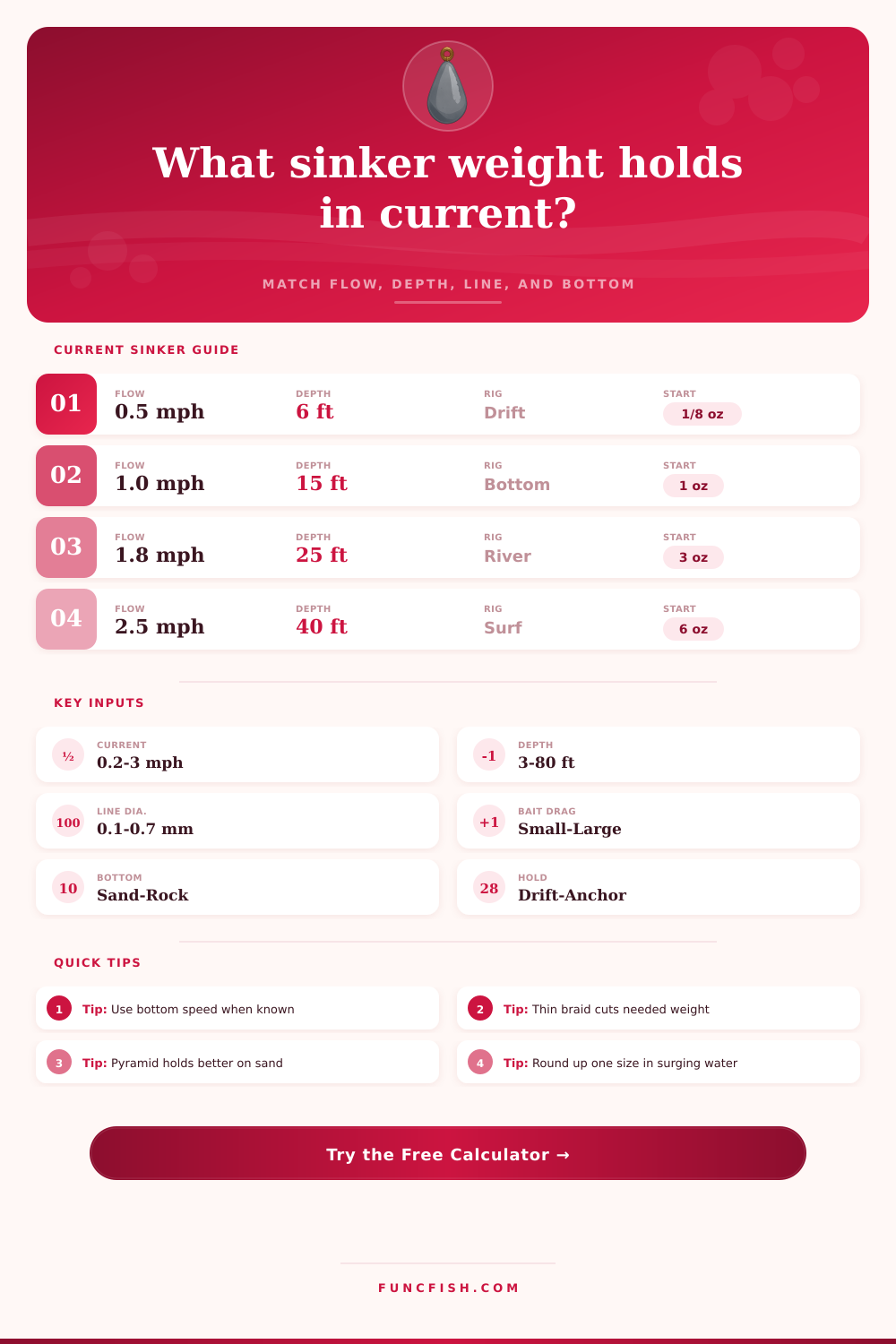
Estimate the sinker size needed to hold, drift, or slow a rig by combining current speed, depth, line drag, bait profile, sinker shape, and bottom grip.
📌Scenario presets
⚙Current and rig inputs
Current sinker forecast
The estimate rounds up to common sinker sizes because turbulent current, surges, and line belly can quickly overpower a perfect mathematical match.
Full breakdown
📋Sinker shape reference
Split Shot
Egg
Bank
Pyramid
Flat No-Roll
Sputnik
Bell
Pencil Lead
📊Current and rig reference tables
| Current speed | Common feel | Starting sinker | Best shapes |
|---|---|---|---|
| 0.2 to 0.5 mph / 0.3 to 0.8 km/h | Light creek push | 1/32 to 1/4 oz / 1 to 7 g | Split shot, pencil, egg |
| 0.6 to 1.0 mph / 1.0 to 1.6 km/h | Steady drift | 1/4 to 1 oz / 7 to 28 g | Egg, bank, bell |
| 1.1 to 1.8 mph / 1.8 to 2.9 km/h | Firm river flow | 1 to 3 oz / 28 to 85 g | No-roll, bank, pyramid |
| 1.9 to 2.6 mph / 3.1 to 4.2 km/h | Heavy tide or chute | 3 to 6 oz / 85 to 170 g | Pyramid, sputnik, no-roll |
| 2.7+ mph / 4.3+ km/h | Hard surge | 6 oz+ / 170 g+ | Sputnik, pyramid, anchor rigs |
| Rig style | Hold target | Line angle effect | Weight note |
|---|---|---|---|
| Controlled drift | Tick bottom often | Moderate belly is acceptable | Use the smallest size that touches bottom |
| Standard bottom rig | Small creep | Line belly adds drag with depth | Round up when bites need a stable bait |
| Carolina rig | Slide over cover | Long casts increase drag | Egg or no-roll sizes keep feel cleaner |
| Three-way river rig | Hold lane | Dropper keeps bait off bottom | Bank sinkers work well in broken current |
| Surf fish-finder | Anchor in surge | Wave pull changes load quickly | Pyramid or sputnik grip matters most |
| Deep dropper | Near vertical | Depth multiplies line drag | Thin braid and heavier bank sinkers help |
| Species group | Typical rig | Current window | Practical sinker band |
|---|---|---|---|
| Trout | Shot line / drift rig | 0.2 to 1.0 mph | 1/64 to 1/4 oz / 0.4 to 7 g |
| Bass | Carolina / bottom contact | 0.3 to 1.2 mph | 1/8 to 1 oz / 3.5 to 28 g |
| Walleye | Three-way / slip rig | 0.6 to 1.8 mph | 1/2 to 3 oz / 14 to 85 g |
| Catfish | Slip or no-roll rig | 0.7 to 2.2 mph | 1 to 6 oz / 28 to 170 g |
| Surf species | Fish-finder rig | 1.0 to 2.8 mph | 2 to 8 oz / 57 to 227 g |
| Sturgeon | Anchored bait rig | 1.0 to 3.0 mph | 4 to 16 oz / 113 to 454 g |
| Adjustment | Lower weight | Raise weight | Why it matters |
|---|---|---|---|
| Line diameter | Thin braid below 0.20 mm | Heavy mono above 0.40 mm | Line drag grows with diameter and line length |
| Bait profile | Bare hook or slim worm | Live bait or bait cluster | Wide bait catches more flow |
| Bottom type | Sticky mud or calm gravel | Smooth rock or shell | Friction changes how quickly sinkers creep |
| Rod angle | High rod or vertical drop | Low rod across flow | More line in current means more side load |
| Hold goal | Natural drift | Anchor in place | Strict holding needs reserve beyond the base estimate |
💡Current-weight checks
Bottom touch: If the rig never taps bottom, go up one common size. If it pins and feels dead, step down or switch to a lower-grip shape.
Line belly: Long casts, low rod tips, and thick mono add more pull than many anglers expect. Shortening the angle can reduce needed weight.
Selecting a sinker weight require that you consider a variety of different variables regarding the effect that the current will have upon your bait and upon the sinker weight it self. If the sinker weight are too light for the strength of the current, the current will move the bait away from the fish. However, if the sinker weight is too heavy, the fish will feel the line too tight to bite upon the sinker weight.
Both the current and a variety of other factors will influence the strength of the current’s effect upon the selected sinker weight. For example, the depth at which you cast the bait will impact the number of inch of the fishing line that are in contact with the current; the deeper into the water the line is cast, the more line will be in contact with the current, and thus the stronger the current will be in relation to the sinker weight. Similarly, the diameter of the fishing line will impact the strength of the current’s effect upon the sinker weight; the thicker the fishing line, the more water that it will move, and the more effective that the current will act upon the sinker weight.
How to Choose the Right Sinker Weight
The profile of the bait will also affect the movement of the bait in the current; a bulky piece of bait will not move in the same way than a slim worm. Additionally, the type of bottom upon which the bait will land will affect the action of the sinker weight; sinker weight will be able to dig into sand, but will not be able to do so upon rock or shell bottoms. Lastly, the shape of the sinker weight will affect the way in which the sinker weight interact with the bottom upon which the bait lands; for example, sinker weights that are flat coins will not roll o
A sputnik sinker has wire legs that will allow it to grip the bottom of the surf wash.
A bank sinker might not have wire legs to grip the bottom in surf wash. You must choose the right sinker weight shape for the type of bottom your fishing. The shape of the sinker weight will determine whether the sinker weight will stay in place on the bottom or if it will move.
The angle of your rod is another factor in whether the current will expose the sinker weight in the surf zone. If you hold your rod at a low angle to the water, it put more of the fishing line into the current of the surf zone. Putting the line into the current of the surf zone will increase the drag that the sinker weight experience.
Holding the rod at a higher angle to the water will lift more of the line out of the current of the surf zone. This will reduce the drag that the sinker weight experiences. Holding the rod in a vertical angle will reduce the effect of the current on the sinker weight.
The feedback that you get from your fishing rig will allow you to determine whether the sinker weight that you are using is the correct sinker weight. If the sinker does not touch the bottom, you need to use a heavier sinker weight or change the angle of your rod. If the sinker weight stick to the bottom but your bait feels lifeless, you need to use a lighter sinker weight or a different shape for the sinker weight.
You will not find one perfect sinker weight for all situations. However, you will find a sinker weight that provide you with helpful feedback when you fish. When you find the right sinker weight, you can make small adjustments to it instead of guess at what might work for your fishing rig.