Diving Plug Depth by Line Out Calculator
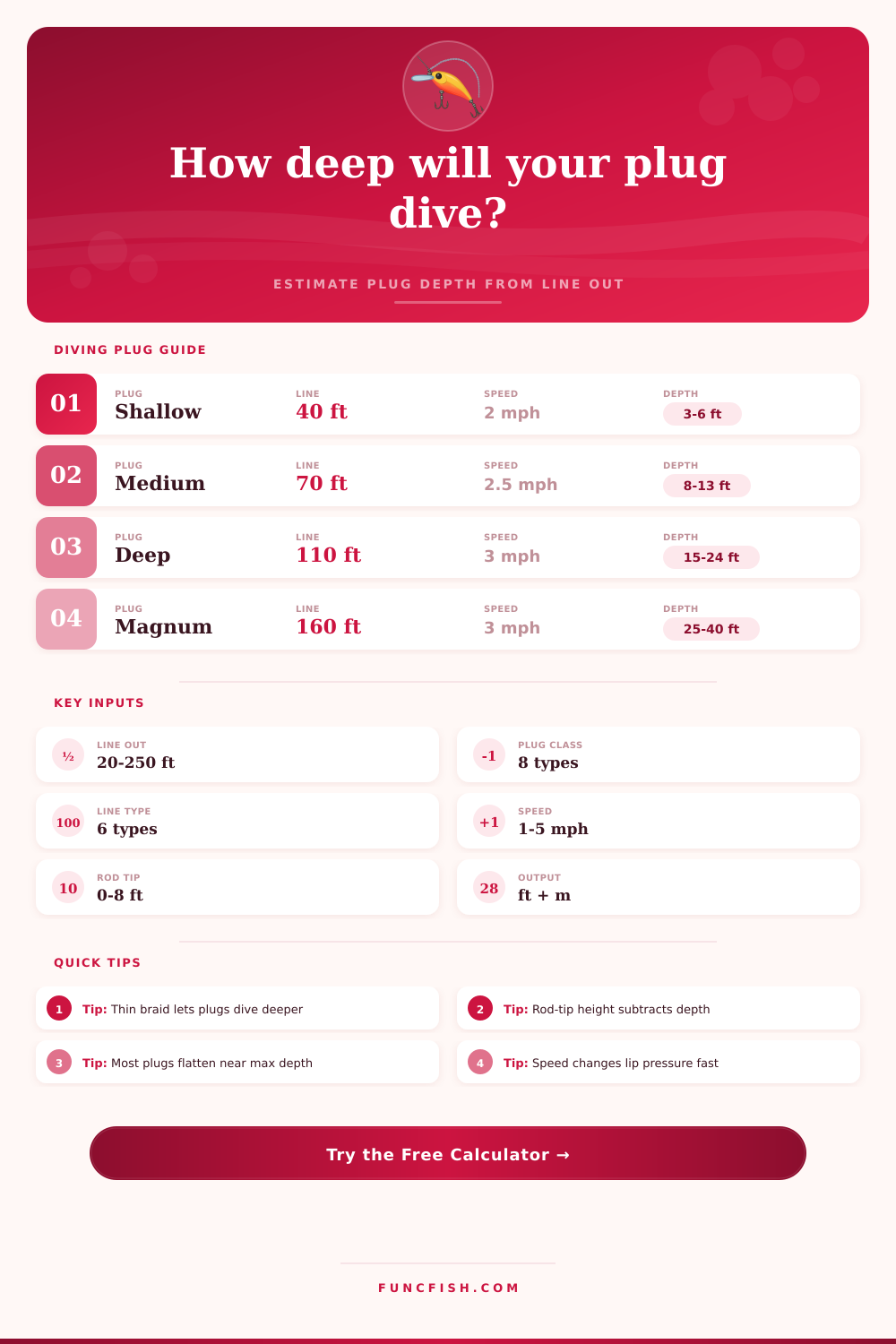
Estimate how deep a diving plug or crankbait will run from line out, lure dive class, line diameter, speed, current, rod-tip height, and tuning condition.
📌Scenario presets
⚙Line-out and plug inputs
Diving plug depth estimate
Full breakdown
📋Plug class reference grid
Short lip, high buoyancy, fast curve. Best for shallow lines and high rod-tip control.
Wide wobble and bill resistance. Line diameter changes depth quickly in shallow cover.
Moderate bill and stable dive curve. Often reaches useful depth with 60 to 90 ft out.
Large lip and lower line angle. Thin line and steady speed matter more than extra line.
Long bill with a slow flattening curve. More line adds depth, but gains taper late.
Slender body, moderate lip, and strong speed sensitivity. Current changes are visible.
Heavy trolling plug with broad bill. Often needs long line out and low rod position.
Depth is mostly retrieve speed, rod angle, and sink time rather than bill dive.
📊Line-out depth references
| Plug class | Typical max | Half-depth line | Near-max line | Notes |
|---|---|---|---|---|
| Wake or subsurface | 1-3 ft / 0.3-0.9 m | 12-20 ft | 35-45 ft | Rod tip dominates final depth |
| Shallow squarebill | 3-7 ft / 0.9-2.1 m | 20-35 ft | 55-75 ft | Wide wobble creates drag |
| Medium diving crank | 8-14 ft / 2.4-4.3 m | 35-55 ft | 80-110 ft | Good all-around curve |
| Deep diving crank | 15-24 ft / 4.6-7.3 m | 55-85 ft | 120-165 ft | Benefits from thinner line |
| Extra-deep crankbait | 22-32 ft / 6.7-9.8 m | 75-110 ft | 150-210 ft | Late curve gains are small |
| Magnum trolling plug | 25-45 ft / 7.6-13.7 m | 90-140 ft | 180-280 ft | Needs steady tow pressure |
| Line material | Depth tendency | Diameter effect | Best use | Adjustment cue |
|---|---|---|---|---|
| Monofilament | Shallower | High drag | Floating crankbaits | Add line or lower rod |
| Copolymer mono | Slightly shallow | Medium-high drag | Casting and trolling | Use true diameter |
| Fluorocarbon | Slightly deeper | Medium drag | Deep crank casting | Good low-stretch option |
| 8-strand braid | Deeper | Low drag | Long-line trolling | Use leader length separately |
| 4-strand braid | Deep | Low-medium drag | Current or weeds | Rough surface adds drag |
| Lead-core assist | Much deeper | Sinking line | Trolling only | Watch lure action loss |
💡Practical checks
Tip: Published dive depths usually assume a specific line diameter, speed, and long cast or troll. Change the actual diameter first when your estimate looks off.
Tip: If the plug is contacting bottom too hard, reduce line out before changing lure class. The curve is most sensitive before the plug reaches about 80% of max depth.
When you want to control the depth of a diving plug, you must understand that the amount of line that you let out isnt the only factor that will determine the depth of the diving plug. The type of diving plug that you use, the speed of the boat that you are on, the type of line that you use for your diving plug, the current in the water, and the height of the tip of the fishing rod can affect the depth of a diving plug. While it may seem like you can simply add more lines to a diving plug to increase it’s depth into the water, you must also consider these other factors that can help to determine the correct depth for your diving plug.
A calculator will help you to determine the depth of your diving plug by combining each of these factors: the length of the fishing line, the class of the diving plug, the type of line, the speed of the boat, the current in the water, and the position of the rod tip. The class of the diving plug will determine the maximum depth that the diving plug can reach. For instance, a shallow squarebill diving plug will have a short lip and a wide wobble in its design that creates drag for the diving plug that prevents it from diving very deep into the water.
How to Control the Depth of a Diving Plug
In contrast, a magnum trolling diving plug will have a large bill and a heavier body that allows it to continue gaining depth even after a squarebill diving plug has plateaued in its gains of depth. Other classes of diving plugs include medium cranks, deep cranks, floating minnows, and lipless baits. Each of these diving plug designs rely upon different mechanics than the squarebill and magnum diving plugs; you can select the exact class of diving plug that you use in the calculator to determine the depth that the diving plug will reach.
The diameter of the line that you use for your diving plug will increase the amount of resistance that your diving plug encounters in the water, which can help to alter the depth of the diving plug. For instance, if you use monofilament line, it is both thick in its diameter and buoyant, which will cause your diving plug to sit higher in the water. Eight-strand braided line has a thinner diameter than monofilament line, which allows it to slice through the water with less resistance and allow the diving plug to reach a steeper angle and dive deeper into the water.
Fluorocarbon line has properties in the middle of monofilament line and braided line. A diving line calculator will account for the diameter of the fishing line that you use, which allows for an accurate calculation of the depth that your diving plug will reach. The speed of the boat that you are on and the current in the water will change how the line interacts with the bill of the diving plug.
At a certain speed of the boat, the diving plug will reach its maximum depth. However, if the speed of the boat changes, or if it moves into a head current in the water, the depth of the diving plug may decrease. A diving line calculator accounts for these variables and allows for adjustments to be made for flat-line trolling, long-line spreads, kayak fishing, or casting the fishing line into desired spots.
The height of the tip of the fishing rod can also impact the depth of the diving plug. When you raise the tip of the fishing rod, the angle of the line can be lifted, which will reduce the depth of the diving plug. A diving line calculator accounts for the height of the tip of the fishing rod; it may ask you to select whether your fishing rod is positioned in a low, neutral, or high position to account for this variable.
In addition to the variables mentioned above, there are two additional factors that can cause small changes to the depth of the diving plug: the density of the water and the tune of the diving plug. The density of the water changes based off the temperature of the water. Deep, cold water is denser than water that is warmed by the sun.
The faster that a diving plug will float to the surface, the more resistance it will fight with its bill. Additionally, diving plugs that is suspended between the rod sweeps will maintain a depth in the water that the angler sets. The output of the calculator will display for you the depth of your diving plug, the length of line needed to reach your target depth, and the confidence range.
For example, if the result of the calculation indicates that the diving plug is only 90% of the way to its adjusted maximum depth, you will not experience much of a gain in depth if you add more line to the fishing plug. However, if the result of the calculation indicates that the diving plug is only 50% of the way to its adjusted maximum depth, it is still capable of diving deeper into the water. Using the calculator, you can more or less easily understand which variable to adjust if your diving plug is either too shallow or it is hitting the bottom of the fishbowl.
If the depth of the diving plug is too shallow, lowering the rod tip will add depth to your fishing line. Using braid line rather than monofilament line will also allow your diving plug to go deeper into the water. Additionally, changing the speed of the boat will change the depth of the diving plug; reducing the speed will cause the depth of the diving plug to decrease, while increasing the speed will allow for the diving plug to dive deeper.
You can make these adjustments all with the assistance of the calculator so that you dont have to experiment with adjusting each of these variables to determine the depth you need for your fishing situation. You should of used the calculator to avoid alot of trial and error. It is a moddern way to fishing.
Its much easier than before.