Fishing Rod Line Weight to Lure Weight Matcher
Compare a rod's printed line class and lure rating with your actual line, leader, total lure weight, casting style, line material, and fishing scenario.
📌Scenario presets
⚙Rod, line, and lure settings
Line to Lure Match Results
Calculation breakdown
📊Rod power quick reference
Ultralight
Medium
Medium Heavy
Surf / Offshore
📑Rating and matching tables
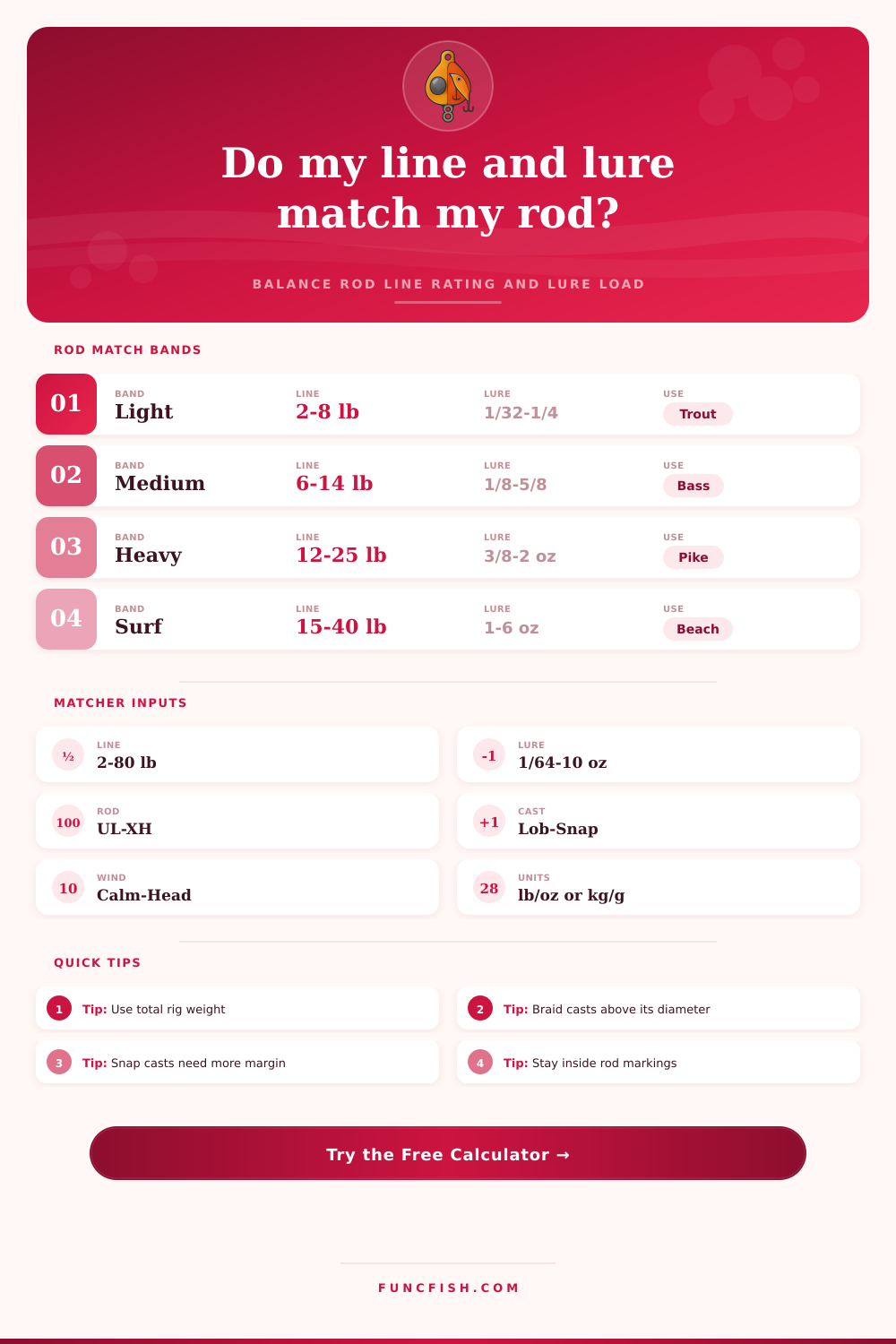
| Rod power | Typical line rating | Typical lure rating | Matcher note |
|---|---|---|---|
| Ultralight | 2-6 lb / 0.9-2.7 kg | 1/64-1/8 oz / 0.4-3.5 g | Tiny changes in jig head weight strongly affect load. |
| Light | 4-8 lb / 1.8-3.6 kg | 1/32-1/4 oz / 0.9-7 g | Pairs well with thin mono or light braid plus leader. |
| Medium light | 4-10 lb / 1.8-4.5 kg | 1/16-3/8 oz / 1.8-10.6 g | Finesse bass and walleye sweet spot. |
| Medium | 6-14 lb / 2.7-6.4 kg | 1/8-5/8 oz / 3.5-17.7 g | Most balanced with lures near the middle third. |
| Medium heavy | 10-20 lb / 4.5-9.1 kg | 1/4-1 oz / 7-28 g | Better with the upper half of the lure rating. |
| Heavy | 12-25 lb / 5.4-11.3 kg | 3/8-2 oz / 10.6-57 g | Use more lure mass for clean blank loading. |
| Extra heavy | 20-50 lb / 9.1-22.7 kg | 1-6 oz / 28-170 g | Designed for big baits, heavy rigs, and controlled casts. |
| Surf / offshore | 15-80 lb / 6.8-36 kg | 1-10 oz / 28-283 g | Wind, line bow, and casting style change safe load quickly. |
| Line material | Diameter feel | Stretch / shock | Matcher adjustment |
|---|---|---|---|
| Monofilament | Reference diameter | High stretch | Forgives abrupt loads and widens the usable range. |
| Fluorocarbon | Slightly dense | Moderate stretch | Adds sink and sensitivity but feels firmer on snap casts. |
| Copolymer | Near mono | Medium stretch | Balanced all-around adjustment for mixed techniques. |
| 4-strand braid | Thin, rough | Very low stretch | Raises shock penalty and makes underloaded rods feel sharper. |
| 8-strand braid | Very thin | Very low stretch | Casts well, but needs margin near the lure max. |
| Wire leader | Stiff front end | Low stretch | Use heavier rods and avoid hard snap loading. |
| Lead core | Thick, heavy | Moderate | Line bow and water drag matter more than printed break strength. |
| Fly line | Mass-based line | Rod matched by grain | The lure is treated as a streamer payload behind fly line mass. |
| Scenario | Common line | Common lure | Best match zone |
|---|---|---|---|
| Panfish ultralight | 2-4 lb mono | 1/64-1/16 oz jig | Lower third of rod rating. |
| Trout stream | 4-6 lb mono / fluoro | 1/16-1/8 oz spoon | Middle of light rod range. |
| Bass spinnerbait | 12-17 lb mono / fluoro | 3/8-1/2 oz plus skirt | Middle to upper half. |
| Walleye jig | 6-10 lb braid plus leader | 1/8-3/8 oz jig | Lower to middle on ML rods. |
| Catfish bottom rig | 15-30 lb mono | 1-3 oz sinker plus bait | Upper half with smooth lob. |
| Inshore paddletail | 10-20 lb braid | 1/4-3/4 oz jig | Middle with wind allowance. |
| Pike swimbait | 30-50 lb braid | 1-3 oz bait | Upper half on heavy rods. |
| Surf plug | 20-40 lb braid | 1-4 oz plug or sinker | Below max for power casts. |
💡Matcher notes
Use the printed rod rating as the hard boundary. The calculator can show a high score near the top of a range, but repeated snap casts with braid or a dense sinker rig deserve extra margin below the lure maximum.
Match line and lure as a pair, not separate choices. A line at the low end of the rod rating usually feels better with lighter lures, while line near the high end usually needs more lure weight to load the blank cleanly.
There are two important specification of fishing rods: the line rating and the lure rating. The line rating of the fishing rod indicate the breaking strength of the fishing rod. However, the line rating isnt the only important rating of a fishing rod.
The lure rating indicates the weight of the lure that the fishing rod is designed to use. Both the line and lure specification of a fishing rod must be balance with one another. If the fishing rod has a light line but use a heavy lure, the tip of the fishing rod will be overloaded and it will not function correct.
How to Match Your Fishing Rod, Line and Lure
However, if the fishing rod has a heavy line but uses a light lure, the fishing rod will not load enough to bend in the correct way. If these two specification are not balanced with each other, fishing rods will have shorter casts with less feel when the fish strike the lure. The material of the fishing line will change the way that the fishing rod react to the weight of the lure.
If the fishing line is made of monofilament material, it will stretch. The stretch of this material will absorb the load if the lure land on the water. Braided fishing line does not stretch as much as monofilament line.
Therefore, any movement of the lure will directly be transmit to the fishing rod. Fluorocarbon fishing line has sink and abrasion resistance, but it does not stretch as much as monofilament line. Thus, the type of fishing line will change how the rod will feel when using the same lure on two different fishing rod.
There are other factor that will change the way that the fishing rod interact with the weight of the lure that is being used. For example, a smooth lob cast with a tailwind may allow a fisherman to use a lure that is heavier than what is recommended by the lure rating of the fishing rod. However, a snap cast into a headwind will load the fishing rod more.
Vertical jigging will place the load on the fishing rod from the opposite side of the fish from which lure was cast. Thus, wind and casting style are other factor that will alter the interaction between the lure and the fishing rod. Another factor that will impact the choice of fishing rod and fishing line is the type of fish that the angler desire to catch.
For species such as panfish and small trout, fish will require a light fishing rod and small jig. However, bass and walleye requires a medium fishing rod strength. Pike and surf species are the strong and large fish species that live in large body of water; hence, they require a fishing rod with more strength to defeat them.
Many people commit mistake when choosing fishing rods. For example, many people will purchase the fishing rod with the heaviest line possible and then notice that there light lures do not work well on the fishing rod. Additionally, people will use heavy lure on light fishing rods in an attempt to increase the distance of their casts.
However, this can cause damage to the tip of the fishing rod. To avoid these mistake, the total weight of the fishing lure should be within the lure rating of the fishing rod. Additionally, the material of the fishing line and the casting style should also be considered.