Fishing Reel Weight To Rod Balance Calculator
Estimate the reel weight, balance point, counterweight, and tip-heavy load for spinning, casting, surf, fly, trolling, and offshore rod setups.
📌Scenario presets
⚙Rod, reel, and target inputs
Measure rod balance with the bare rod resting on a narrow edge. Enter that distance from the butt cap to the balance point; the calculator then adds reel, line, lure, and optional butt weight moments.
Rod balance results
Use the cards below to compare current balance, ideal reel weight, and butt counterweight.
Calculation breakdown
📊Typical reel and rod data
1000 Spinning
2500 Spinning
Baitcaster
Surf Reel
Fly Reel
Round Reel
Lever Drag
Line Fill
📐Balance reference tables
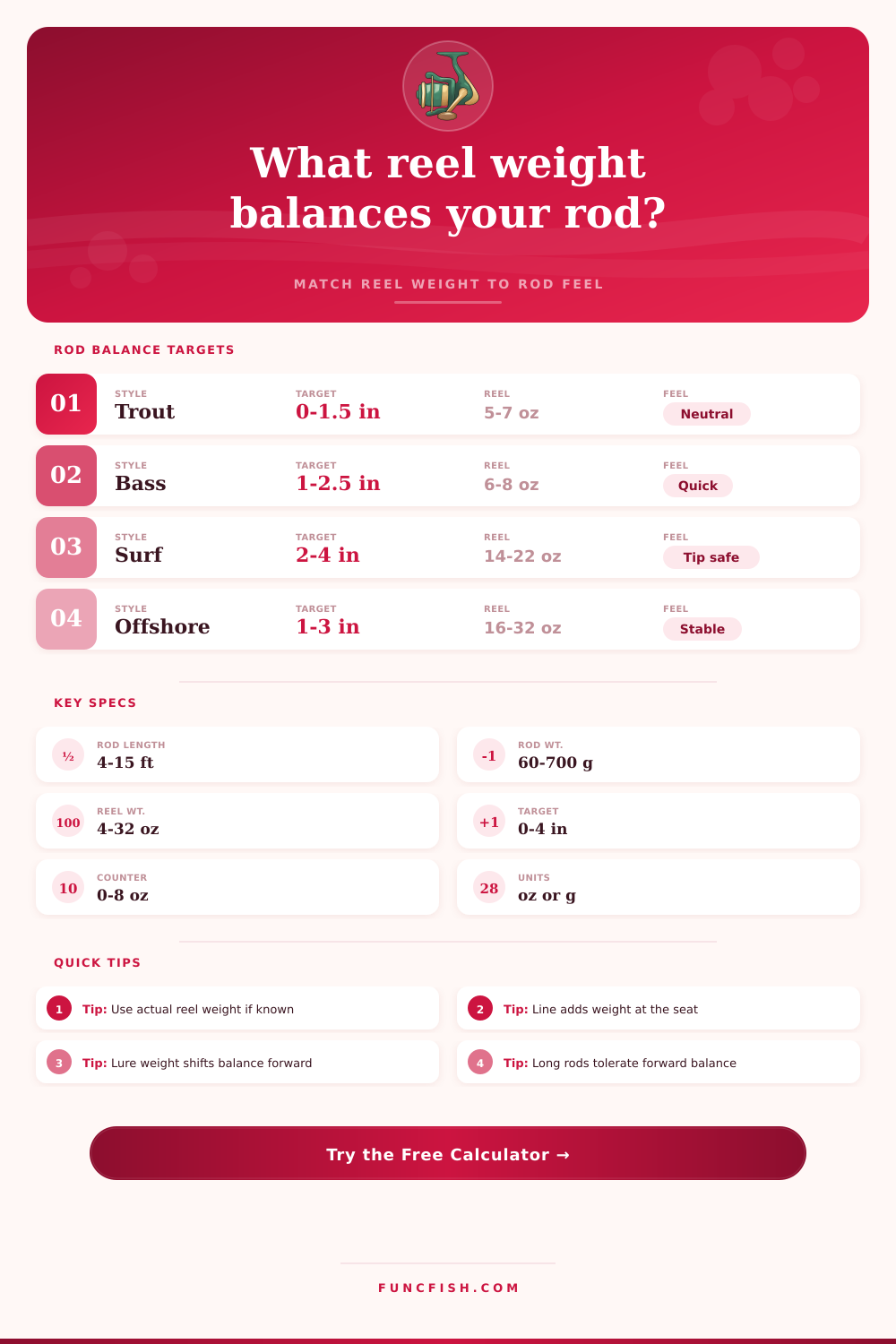
| Fishing style | Common rod length | Target ahead of seat | Typical reel weight | Balance feel |
|---|---|---|---|---|
| Panfish ultralight | 4 ft 6 in to 6 ft 6 in | 0 to 1 in | 5 to 7 oz / 140 to 200 g | Light, wrist-friendly |
| Trout stream spinning | 5 ft 6 in to 7 ft | 0.5 to 1.5 in | 5.5 to 8 oz / 155 to 225 g | Neutral drift control |
| Bass spinning | 6 ft 8 in to 7 ft 4 in | 1 to 2 in | 7 to 9.5 oz / 200 to 270 g | Fast tip recovery |
| Bass casting | 6 ft 10 in to 7 ft 6 in | 1 to 2.5 in | 6.2 to 8.5 oz / 175 to 240 g | Slight tip-forward |
| Walleye jigging | 6 ft 3 in to 7 ft 2 in | 0.5 to 1.5 in | 6.5 to 8.5 oz / 185 to 240 g | Tip sensitivity |
| Kayak inshore | 6 ft 6 in to 7 ft 6 in | 1 to 2.5 in | 8 to 12 oz / 225 to 340 g | Stable one-hand work |
| Surf casting | 9 ft to 13 ft | 2 to 4 in | 14 to 25 oz / 400 to 710 g | Forward load control |
| Offshore trolling | 5 ft 6 in to 7 ft | 1 to 3 in | 16 to 32 oz / 450 to 905 g | Power under load |
| Rod build | Blank behavior | Handle mass effect | Balance expectation | Calculator note |
|---|---|---|---|---|
| Split-grip carbon | Low rear mass | Moves balance forward | Needs slightly heavier reel | Use measured bare balance |
| Full cork freshwater | Moderate rear mass | Balances most 2500 reels | Neutral with common sizes | Good baseline setting |
| EVA inshore | Moderate to heavy | Absorbs reel weight well | Handles larger spools | Add lure rig weight |
| Long surf handle | Long lever arm | Butt helps balance tip | Forward target is normal | Do not force neutral |
| Fly cork grip | Light reel seat area | Reel weight matters more | Near seat or butt-heavy | Include backing weight |
| Glass trolling rod | Higher blank mass | Less wrist-sensitive | Stable under rod holder load | Use loaded lure weight |
| Reel class | Typical weight | Common rod match | Line allowance | Balance caution |
|---|---|---|---|---|
| 1000 spinning | 5.8 to 7 oz / 165 to 200 g | UL and light rods | 0.2 to 0.4 oz | Can feel tip-heavy on long rods |
| 2500 spinning | 7 to 9.2 oz / 200 to 260 g | ML and medium rods | 0.3 to 0.7 oz | Versatile balance range |
| 4000 spinning | 9.5 to 12.5 oz / 270 to 355 g | Inshore and heavy spinning | 0.6 to 1.1 oz | May over-balance light rods |
| Baitcaster | 6.2 to 8.5 oz / 175 to 240 g | Bass casting rods | 0.3 to 0.6 oz | Seat position is key |
| Long-cast surf | 14 to 25 oz / 400 to 710 g | 9 to 13 ft surf rods | 1 to 2 oz | Forward balance is expected |
| Offshore lever drag | 16 to 32 oz / 450 to 905 g | Trolling and stand-up rods | 1 to 3 oz | Check harness or rail use |
The calculator treats the rod as a measured mass at its bare balance point and then adds reel, line, lure, and butt weight as separate moments.
💡Balance calculation notes
A rod listed at the same length and power can balance differently because handle length, guide train, blank taper, and grip material shift the bare rod center of mass.
A small butt cap weight can calm a tip-heavy rod, but total setup mass still rises. Use it when wrist comfort matters more than absolute lightness.
A sinker, plug, float rig, or bait hanging near the tip adds a strong forward moment. For surf and catfish rigs, calculate with the working rig attached.
Vertical jigging and fly fishing often feel better near neutral, while surf casting and heavy cover rods can work well with a controlled forward balance.
The balance of a fishing rod are determined by several physical factors. The balance of a fishing rod is important because the balance of a fishing rod affect how the fishing rod feels in your hand. The weight of the reel, the position of the seat of the reel, the length of the handle of the fishing rod, and even the amount of line that is on the fishing rods spool can affect the balance of a fishing rod.
Changing the weight of the fishing rods reel or the amount of line on its spool will change the balance point of that fishing rod. A fishing rod that is balanced proper will feel good when you hold it in your hand and cast with it; a poorly balanced fishing rod may feel as though the tip of the rod is often pulling downward. One of the primary factors that will affect the balance of a fishing rod is the weight of the fishing rods reel.
How to Measure and Improve Fishing Rod Balance
You must often balance the weight of the reel according to the type of fishing rod that you are using. For instance, a heavy fishing reel may be appropriate for adding balance to a long surf fishing rod, but the same type of heavy reel may make a short trout fishing rod feel sluggish when casting and reeling in the fish. Depending upon the type of fishing that you will be performing with your fishing rod, you may want to have the balance point of your fishing rod be closer to the fishing rods tip or to its handle.
A fishing rod balance calculator will use mathematical formulas to determine the balance point of your fishing rod. The fishing rod balance calculator will use the data that you enter regarding your fishing rod to provide you with an estimate of the fishing rods balance. Fishing rod balance calculators will typically ask for the length of the fishing rod, its bare weight, the location of the seat of its reel, the weight of the fishing rods reel, and the weight of any fishing lure that it will have attach to the fishing rod.
Based off these entries, the calculator will provide you with information about where the balance point of the fishing rod will be, and whether adding a counterweight to the butt of the fishing rod will help it reach your target balance range. Each of the factors that you enter into these calculators is important to the calculation of its balance point; for instance, changing the weight of the fishing rods lure will change its forward moment, and moving the fishing rods reel seat will change the fishing rods lever arm. Many anglors find the balance point of their fishing rod by measuring the weight of the fishing rod when it is bare and rested on the edge of a narrow object.
Measuring the weight of the fishing rod when it is bare allows an angler to find the balance point of the fishing rods handle in relation to the fishing rods tip. Once the angler finds the balance point for the fishing rods bare components, you can calculate the balance point of the fishing rod with its equipped component by adding the weights of the fishing rods reel, the fishing line, and the fishing lure to the fishing rods weight. Based on these calculations, fishing anglors can determine whether the fishing rod with its current equipment will feel light at the tip of the rod, neutral in the middle of the fishing rod, or loaded toward the butt of the rod.
These determinations can help anglors to make a decision about whether to use a different fishing rod or to add a counterweight to the butt of their fishing rod. The balance point of a fishing rod can change when being use under real life fishing conditions. For instance, the fishing rod may feel balanced when measured on a table, but it may feel unbalanced while the angler is battling the effects of the wind while fishing, or when the anglers grip upon the fishing rod isnt comfortable.
Fishing rods that are balanced in a neutral fashion while being measured on the bench may feel tip-heavy when being used in a current. Fishing rod balance calculators provide anglers with the tip-heavy index of their fishing rod, which allows the angler to understand how the fishing rod may feel in relation to the type of fishing they are to perform. The site provides reference tables that contain information about the typical weights of fishing rod reels, and the balance ranges that are typically targeted for each type of fishing rod.
These tables provide anglors with a starting point for balance point calculations for their fishing rods. However, these tables are not strict rules; for instance, fishing rods that are used for surf fishing may be balanced in a tip-forward fashion due to their length and weight, but fishing rods that are used for fly fishing may have balance points that are even more neutral. It is often possible to add a counterweight to the butt of a fishing rod to compensate for the fishing rods imbalances.
For instance, adding a counterweight to the fishing rods butt may help fix an issue with a tip-heavy fishing rod. However, adding a counterweight to the fishing rod will increase its total weight. Some anglers may prefer this increased weight to the tip-heavy fishing rod to improve their comfort while fishing, but others may prefer to change the fishing rods reel to fix the balance issue without increasing the total weight of the fishing rod.
Fishing rod balance calculators help anglors to make these two different types of balance fix by presenting them side-by-side. Many anglors may believe that a fishing rod should have only a single balance point. However, the balance point of a fishing rod may change according to the fishing techniques that is to be performed with that fishing rod.
For instance, the balance point of a bass fishing rod may be forward-biased for fishing in flip techniques, but a different balance for finesse fishing with the same type of rod. While balance calculators often provide an “goal setting” feature that allows anglors to program an expected balance point for their fishing rod, the balance that the fishing rod feels when being cast will change. For instance, adding more line to a fishing rod will change the fishing rods balance point, and the calculator will help anglors to understand these changes.
It could of been easier if the calculator worked more naturaly.