Fly Line Front Taper Length Calculator
Estimate the front taper length that matches head length, line weight, fly resistance, leader length, wind, rod action, and fly line profile.
📌Scenario presets
⚙Taper inputs
Front taper recommendation
Full breakdown
📋Fly line profile data
Delicate Dry
General WF
Indicator
Bass Bug
Streamer Tip
Saltwater WF
Scandi Head
Skagit Head
📏Reference tables
| Line use | Typical head length | Front taper range | Best taper behavior |
|---|---|---|---|
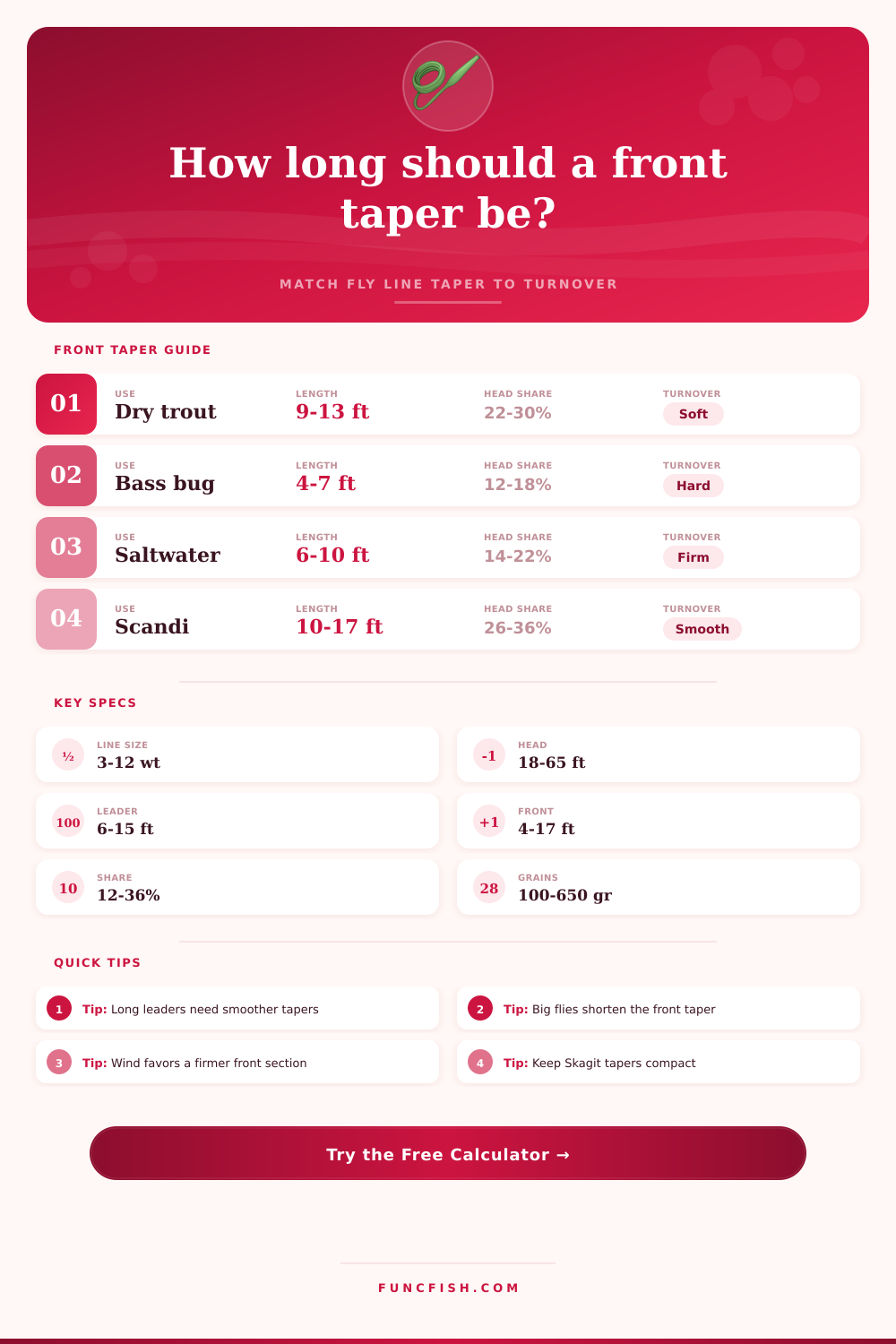
| Spring creek dry fly | 35-45 ft / 10.7-13.7 m | 9-15 ft / 2.7-4.6 m | Long, progressive, soft landing |
| All-purpose WF trout | 33-42 ft / 10.1-12.8 m | 7-12 ft / 2.1-3.7 m | Balanced turnover and presentation |
| Indicator nymph | 32-43 ft / 9.8-13.1 m | 6-11 ft / 1.8-3.4 m | Stable loop with some punch |
| Bass bug taper | 26-35 ft / 7.9-10.7 m | 4-8 ft / 1.2-2.4 m | Short, aggressive, high turnover |
| Streamer sink-tip | 24-32 ft / 7.3-9.8 m | 3-8 ft / 0.9-2.4 m | Compact taper and firm mass transfer |
| Saltwater WF | 30-40 ft / 9.1-12.2 m | 6-11 ft / 1.8-3.4 m | Wind-cutting loop with a firm tip |
| Scandi head | 31-46 ft / 9.4-14.0 m | 10-18 ft / 3.0-5.5 m | Long front taper for anchor control |
| Skagit head | 18-27 ft / 5.5-8.2 m | 2-5 ft / 0.6-1.5 m | Very compact taper for sink tips |
| Rod size | AFFTA 30 ft weight | Common head range | Front taper note |
|---|---|---|---|
| 3 wt | 100 gr / 6.5 g | 30-40 ft / 9.1-12.2 m | Long taper protects fine tippets |
| 4 wt | 120 gr / 7.8 g | 32-42 ft / 9.8-12.8 m | Dry fly profiles can stay smooth |
| 5 wt | 140 gr / 9.1 g | 33-45 ft / 10.1-13.7 m | Most balanced trout tapers sit midrange |
| 6 wt | 160 gr / 10.4 g | 32-44 ft / 9.8-13.4 m | Nymph and streamer lines shorten slightly |
| 7 wt | 185 gr / 12.0 g | 30-40 ft / 9.1-12.2 m | More line mass supports firmer turnover |
| 8 wt | 210 gr / 13.6 g | 28-40 ft / 8.5-12.2 m | Salt and bass fronts are usually compact |
| 10 wt | 280 gr / 18.1 g | 28-38 ft / 8.5-11.6 m | Big flies and wind shorten the taper |
| 12 wt | 380 gr / 24.6 g | 30-40 ft / 9.1-12.2 m | Heavy heads need enough tip stability |
| Fly or rig | Air load | Taper shift | Recommended front behavior |
|---|---|---|---|
| Tiny dry or emerger | Very low | Longer by 1-2 ft | Fine, gradual front taper |
| Standard dry fly | Low | Near baseline | Progressive front with soft turnover |
| Weighted nymph | Medium | Shorter by 0-1 ft | Balanced front and stable belly |
| Indicator rig | High | Shorter by 1-3 ft | Firmer mass transfer near the tip |
| Deer hair bass bug | Very high | Shorter by 2-5 ft | Aggressive front taper |
| Large pike fly | Very high | Shorter by 2-5 ft | Compact taper and strong turnover |
| Scandi steelhead fly | Medium | Longer by 1-3 ft | Smooth pull through the anchor |
| Intruder with sink tip | High | Very short front | Skagit-style punch into the tip |
💡Practical checks
Tip: A longer front taper improves delicate fly placement, but it can collapse when a bulky fly, indicator, or strong headwind absorbs too much turnover energy.
Tip: For two-hand lines, treat the front taper and tip as one working system. A compact Skagit head can use a short front taper because the sink tip completes the delivery.
You throw your dry fly which is supposed to float down on a feather and it lands like a hammer. Before your line hits the water, the fish are gone. In this case, poor casting isn’t always the cause. The cause can be a design feature of the line’s taper. Reel size, rod weight… those is things most anglers obsess about. But they overlook main thing that decides how your fly lands. That is the first part of your fly line, which controls whether you get a soft turnover or a splashdown event. The front tapers.
This is where the fat belly gradually taper into a finer tip. This is what takes up the kinetic energy at the end of the cast. The longer and more gradual taper spreads it, letting your delicate fly sits down quietly. The shorter and sharper taper focuses it, great if you’re punching through the wind, not so great when presenting small emergers. If this is off, you are fighting with your own gear each cast.
Why Your Fly Lands Too Hard
If you examine the calculator (above) you’ll note it doesn’t simply ask what line weight you’re using. It factors in rod action, casting tempo, wind conditions, fly resistance, leader length, and head length. Every input change the energy transfer equation. Additional leader length, for instance, will alter how the loop uncoils. A longer leader has more material to pick up speed; a 10-foot leader isn’t like a 15-foot leader. That increased drag require adjustment which is what the tool does with the suggested taper length.
The other thing is wind. Calm air allows for a longer, softer taper where the line have time to slow down on its own. Add a stiff headwind and now that long taper collapse at midair. This dumps the leader into water before it gets where it is supposed to be. With increased wind, the calculator reduce the recommended front portion so there is enough weight to maintain a stable loop behind the tip.
Rod action is subtle yet important. A fast-action graphite rod loads rapidly and will release energy quickly. It is best suited for a firmer taper to accommodate that burst of energy. Conversely, slow glass rods loads slowly and transfer energy gently. Long more gradual progressive tapers works well here as they mimic the languid nature of this bait. Using both will allow the line to move freely, it won’t break apart in mid-air or stall out.
If you scroll down, there are several reference tables that break out various situations. These include everything from Skagit intruder rigs to spring creek dry flies. What you’ll find is that they recommend a very short front taper for bass bugs as opposed to longer tapers for trout dry flies. Bass bugs are bulky and have high aerodynamic drag. Aggressive mass transfer help you turn ’em over in distance. Trout dry flies call for finesse. The science behind what you’re throwing come through in the data.
In two-handed fishing, it’s about different things. You have super-long front tapers for control over the anchor point (Scandis in still water). Skagits use very short, punchy tapers where the sink tip do the work of turning over the line. It can be frustrating if you try and force your one-hand logic onto switch rods. The profiles is separated here nicely by the calculator so that you don’t mistake a light trout presentation for a hunk of steelhead tackle.
Line customization can be a bit of a guessing game for many anglers. Change your line until it feel good. Instead, go with what the calculator recommends for your own specific rig and tweak away. Make a cast. Did that fly land a bit heavy? Lengthen the front taper. Windy day and it’s stalling? Shorten it up. When we know our starting point, these tweaks become purposeful instead of random.
The front taper acts like a shock absorber for your presentation. If you don’t have one, then all the energy transferred by the rod will hit the fly simultaneously. Ideally, you’d like just enough absorption to soften the impact while maintaining momentum in the line. This is something that requires practice but having a good starting point could of saved hundreds of casts. Vary the variables, determine where the sweet spot is, and let your line do the thing it was designed to do. That soft landing is what separates a great cast from a good one.