Fly Line Rear Taper Length Calculator
Estimate rear taper length from fly line weight, head geometry, belly mass, running line diameter, casting style, and the way you want the line to carry or shoot.
📌Rear taper presets
⚙Line design inputs
Front taper plus belly plus rear taper.
Leave enough front taper for turnover style.
If unknown, use your intended carry belly.
Line held outside the rod tip before shooting.
Rear taper design result
Full breakdown
📋Line profile data grid
Trout WF
Long Belly
Bass Bug
Streamer Tip
Salt WF
Scandi
Skagit
DT Trim
📏Rear taper reference tables
| Line profile | Typical head | Rear taper range | Design intent |
|---|---|---|---|
| Short shooting head | 22-32 ft / 6.7-9.8 m | 2.5-5 ft / 0.8-1.5 m | Fast load and quick shoot |
| Bass or pike WF | 30-38 ft / 9.1-11.6 m | 3.5-6.5 ft / 1.1-2 m | Compact turnover with bulky flies |
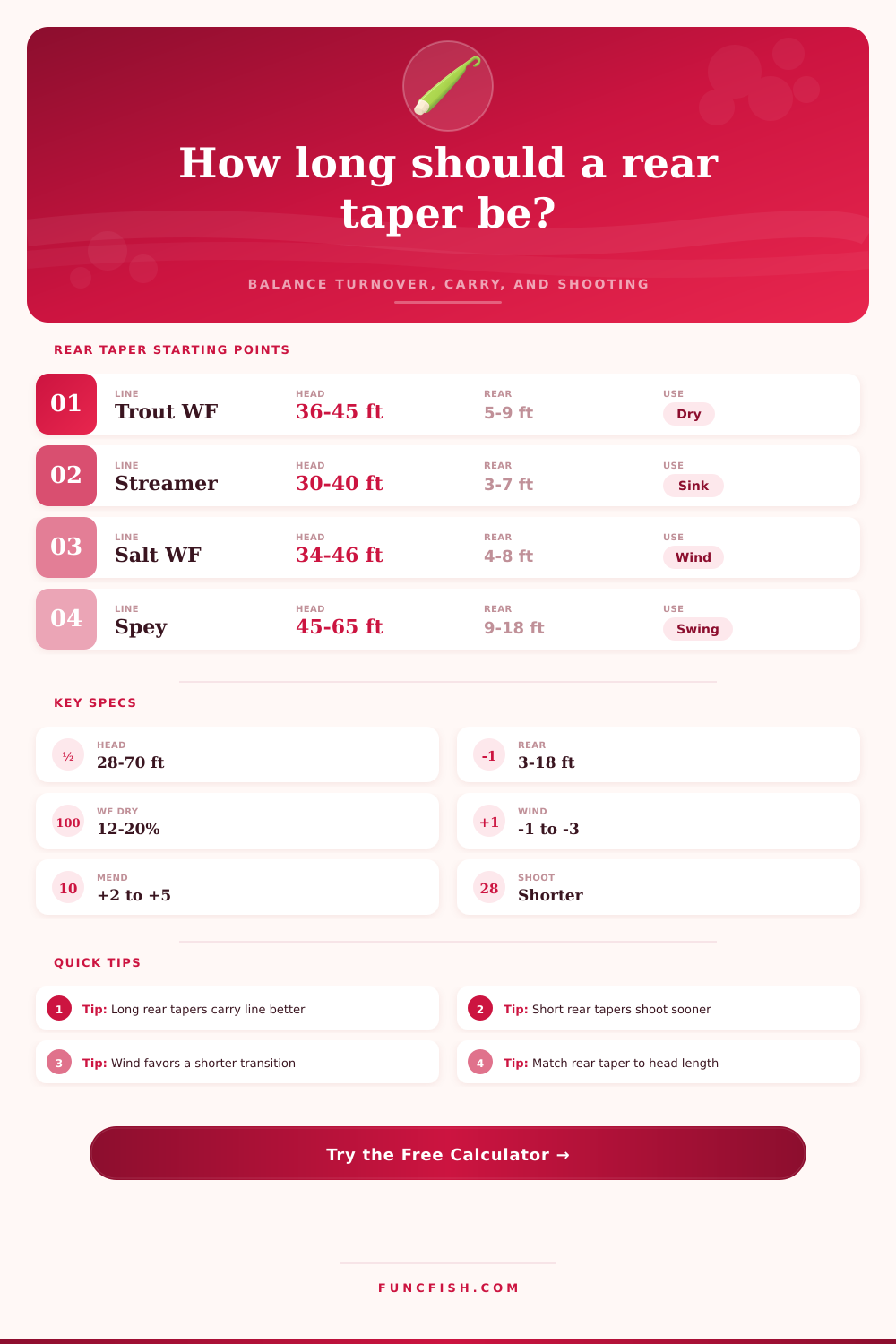
| Trout weight forward | 36-45 ft / 11-13.7 m | 5-9 ft / 1.5-2.7 m | Balanced turnover and line control |
| Long belly trout | 45-60 ft / 13.7-18.3 m | 9-16 ft / 2.7-4.9 m | Longer carry and mending |
| Scandi or spey | 38-65 ft / 11.6-19.8 m | 8-18 ft / 2.4-5.5 m | Smooth anchor release |
| Double taper trim | 40-55 ft / 12.2-16.8 m | 8-15 ft / 2.4-4.6 m | Progressive mass fade |
| Line weight | AFFTA 30 ft mass | Common belly diameter | Rear taper note |
|---|---|---|---|
| 3 wt | 100 grains / 6.5 g | 0.035-0.039 in / 0.89-0.99 mm | Keep transitions subtle for delicate turnover |
| 5 wt | 140 grains / 9.1 g | 0.040-0.046 in / 1.02-1.17 mm | Use 6-9 ft as a balanced trout starting point |
| 7 wt | 185 grains / 12 g | 0.047-0.053 in / 1.19-1.35 mm | Shorten when throwing wind-resistant streamers |
| 8 wt | 210 grains / 13.6 g | 0.050-0.056 in / 1.27-1.42 mm | Saltwater tapers often stay compact |
| 10 wt | 280 grains / 18.1 g | 0.060-0.068 in / 1.52-1.73 mm | Steeper rear tapers load quickly but slap harder |
| 12 wt | 380 grains / 24.6 g | 0.072-0.082 in / 1.83-2.08 mm | Big-game lines need stable mass transfer |
| Adjustment | Rear taper shift | Effect on cast | Best match |
|---|---|---|---|
| More mending | +2 to +5 ft / +0.6 to +1.5 m | Longer carry and softer hinge | Rivers, dries, indicators |
| More shooting | -1.5 to -4 ft / -0.5 to -1.2 m | Earlier release from the guides | Surf, flats, stillwater distance |
| Heavy fly or wind | -1 to -3 ft / -0.3 to -0.9 m | More compact rear mass | Streamers, poppers, crabs |
| Delicate turnover | +1 to +3 ft / +0.3 to +0.9 m | Smoother energy fade | Dry flies and soft leaders |
| Thin running line | +0.5 to +2 ft / +0.2 to +0.6 m | Reduces abrupt diameter drop | Mono running line, euro line |
💡Calculation checks
Tip: If the result leaves less than a third of the head as level belly, shorten the front taper or increase total head length before trimming the rear taper.
Tip: A large belly-to-running-line diameter drop needs a longer rear taper so the line does not hinge when aerialized beyond the belly.
The rear taper is the back end of the fly line head. It affects your cast by either allowing the line to pass freely over the rod guide or stopping it because it does not glide wellly. Sometimes when you are making a really nice cast, the line just sits there in mid-cast. Most of the time, that’s caused by your rear taper and not necessarily your casting. Getting familiar with this area can help you get more life out of your casts and learn when to turn over the fly.
Most anglers focus on front taper because it controls turnover, but they ignore the rear because they cannot see it while casting. Line Geometry is handled by calculator. Based off the belly diameter and head length, it calculates an estimate of where transition should begin. A thicker belly need a more gradual taper to avoid shock loading. Otherwise the line won’t fly true if you skip this step.
Why Rear Taper Matters for Your Casts
The rear taper is like the accelerator pedal on your cast. On rivers, a long taper allows good mending and provides smooth power delivery. It gives you a soft feel to help put delicate dry flies where they need to be while not spooking any trout. For punching poppers through heavy cover or surf casting, a short taper shoots the fly out quickly and aggressively.
Tradeoff: Control vs. Distance. In other words, you seldom have both on one line. It change to fit your situation. When choosing windy saltwater conditions, the tool will recommend a shorter taper. Air resistance kills momentum fast in open flats. A compact rear mass cuts through better then a long trailing tail that catches every breeze.
For nymphing with an indicator, the system recommends a longer transition that helps keep the line manageable without whipping around during mends (upstream). A common mindset about fly lines is they are unchangeable. You purchase a five-weight, weight forward line and that’s it for anything else. Even with the same line weight, amount of belly and what sits at the core drastically affects performance. Mono versus a braided core flies differenty. Coating stiffness (saltwater stiffens) hold its form yet resists collapsing on the guides. These features along with the taper design work together in your finished cast. Failing to account for them results in dissapears because the line doesn’t act like you were told.
Customize it to fit you If you like rolling a long cast into those skinny tree trunks, use a bit of a longer taper to let you anchor that cast and keep more weight back past the tip. Like to shoot a head out there a ways? No problem, change the taper on the butt end of the rod to something shorter. It align with physics of the line and what you’re trying to do. “Don’t fear tinkering around with minor adjustments. A little tweak to two feet on your rear taper will seem like a completely different rod. It makes an instant impact on how it transfers energy.
I’ve had guys cut down their lines to cater specifically to this area, but you have to measure carefully and use some sort of heat sealer to do so. With that information in hand, you’ll make your tweaks without wasting money. Your line won’t feel sluggish or disconnected from your rod tip. Good rear taper fades into the cadence of your cast, suddenly the line isn’t on your mind. Now it’s all about the fish. When that transition is correct, the energy flow smoothly between rod and fly. That smooth flow is what separates a functional cast from a beautiful one. Effort becomes grace instead of brute force. Look behind you if your line is hanging in mid-air. Maybe the answer lies at the back of your head.