Fly Rod Line Weight Overline Calculator
Estimate whether to fish the marked line weight, overline by a half or full size, or stay lighter based on AFTMA grains, rod action, head style, fly load, wind, and actual casting distance.
📌Scenario presets
⚙Rod and line settings
Overline match forecast
Full breakdown
📋AFTMA line weight reference
Trout Light
Trout Standard
Warmwater
Salt / Pike
📊Overline and grain tables
| Marked line | 30 ft standard | Approx grams | One-line-up target |
|---|---|---|---|
| 2 wt | 80 grains | 5.2 g | 100 grains |
| 3 wt | 100 grains | 6.5 g | 120 grains |
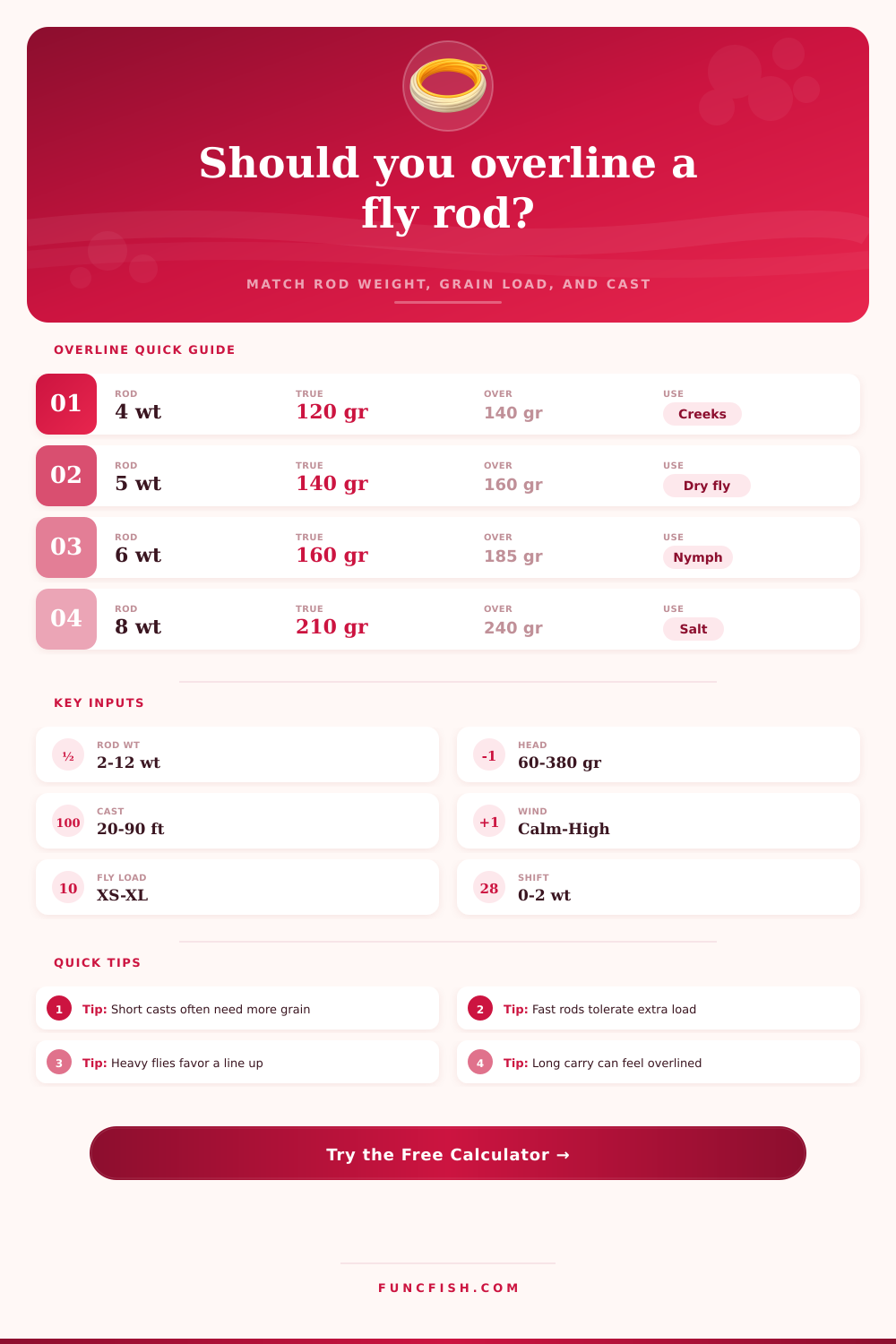
| 4 wt | 120 grains | 7.8 g | 140 grains |
| 5 wt | 140 grains | 9.1 g | 160 grains |
| 6 wt | 160 grains | 10.4 g | 185 grains |
| 7 wt | 185 grains | 12.0 g | 210 grains |
| 8 wt | 210 grains | 13.6 g | 240 grains |
| 9 wt | 240 grains | 15.6 g | 280 grains |
| 10 wt | 280 grains | 18.1 g | 330 grains |
| Condition | Typical shift | Why it changes load | Watch point |
|---|---|---|---|
| Short casts under 35 ft | +0.3 to +0.7 wt | Less line outside the tip | Do not overload close roll casts |
| Fast graphite rod | +0.3 to +0.6 wt | Stiffer blank needs more grain | Long carry may feel heavy |
| Long belly or DT line | -0.2 to 0 wt | More line can be carried | False cast control matters |
| Bulky or weighted fly | +0.3 to +0.8 wt | Mass helps turn over the rig | Open loop and slow down |
| Saltwater wind | +0.2 to +0.6 wt | Quick loading and line speed | Avoid too much hinge at the tip |
| Rod use | Common line match | Overline cue | Stay true cue |
|---|---|---|---|
| Small creek dry fly | True to +1 | Most casts under 30 ft | Soft glass rod |
| General trout | True to +0.5 | Fast 5 wt and nymphs | Dry fly at 45 to 60 ft |
| Streamer trout | +0.5 to +1 | Sink tip and weighted fly | Full head already heavy |
| Bass or pike | +0.5 to +1.5 | Bulky air-resistant fly | Long casts with big head |
| Saltwater flats | True to +1 | Wind and one-shot casts | Calm day and long carry |
💡Practical checks
Tip: Treat the result as a grain window, not a brand rule. Many modern WF lines already weigh a half-size heavy, so compare actual head grains when known.
Tip: If the rod feels great at 25 ft but collapses at 55 ft, shorten the carried head or return closer to the marked rod weight.
Your rod balances well in your hand, but you feel your casts lack power because the line is too light. The tip isn’t flexing and loading it effectivly. Switching up from small stream fishing to bigger waters are a common occurrence.
Use our line calculator here to see what works best for your specific conditions and rod type. That will save you from trying different thing out which is frustrating when getting used to something new.
How to Choose the Right Fly Line Weight
It’s never really about casting skill but typically distance vs. Mass. When you pull some line onto the reel and load a fly rod, it store energy as a lever. That’s why you can’t throw very far on calm water because you’re never bending the rod enough to unleash all that stored energy. To force it into that bend you want more grain weight up near the head section.
The trick is figuring out how much more line mass you need and the tool calculates that based off how long you typically throw compared to the stiffness of your rod blank. Glass and bamboo rods is slow-action which means they don’t require near as much line weight to bend as fast graphite rods which has a higher stiffness. So without that additional weight, the rod behaves more like a stiff stick than a spring.
Air resistance fights the motion of the fine fly line when there is wind, so that completely changes the equation. Without any momentum, a normal weight line won’t even make its way forward into a headwind. This is what makes overlining by a whole size or more common for fishing in windy conditions in salt water or on lakes. It has enough energy to knock down those bulky flies and the heavier line cut through the gusts. You’ll wear yourself out trying to overcome the wind with light line before ever landing a fish.
Instead, as the page’s reference tables shows, the amount of grain required shifts according to the pressure from the environment, not simply the rating of the rod. It’s common for many people to think that they need to match the number on the rod blank. It’s just a myth perpetuated by marketing. With today’s fly lines, the grain weight of what is actualy on the reel doesn’t necessarily correlate with the name of the line weight on it.
For example, one company could have a five-weight line that weighs 40 grains lighter then another company’s five-weight line. The important thing to consider is the weight of the head, typically measured in grains per thirty foot increments. Just because the number matches up perfectly on the spool to the rod doesn’t mean you’re not going to be underloading your rod if your line is light for the size. By being able to plug in what you know the grain weight of the line to be, it closes that gap between physical reality and marketing labels.
However, too heavy of a line selection can be risky. Too much force on a line two sizes over your recommended would of eventually crack the tip out or damage the ferrule. And it’s bad for distance; the loop just collapses and doesn’t unroll until there isn’t enough left to go far. So you’re looking for the sweet spot between loading the rod all the way but not bogging it down. You don’t want a dragging line; you want a flowing line.
Where’s that? Well, that depends on your personal casting tempo. For example, you might be able to get away with a little heavier line if you have a punchy, aggressive stroke compared to someone who has a soft, relaxed delivery. Context matters more than rigid rules for gear matching. A six-weight rod could require a five-weight line if fishing a delicate dry fly in protected water. It might also require a seven-weight line when chucking some heavy streamers on a blustery day. No one is wrong; just right for the situation at hand.
It’s a matter of feel and something you learn over time but begin with data. When you adjust your expectations to match up with what your rod can realy handle instead of what it says it should be, then you gain control of the cast again. The energy transfer smooths out and the line stops fighting you. And that’s when it gets easier and more predictable out there.