Fishing Line Spool Memory Removal Length Calculator
Estimate how much coiled or kinked line to strip from a reel while checking spool fill drop, remaining usable line, and reserve for the next fishing session.
📌Scenario presets
⚙Spool memory settings
Spool memory removal estimate
Calculation breakdown
📊Line memory data grid
Light Mono
Fluorocarbon
Copolymer
Braid
📐Reference tables
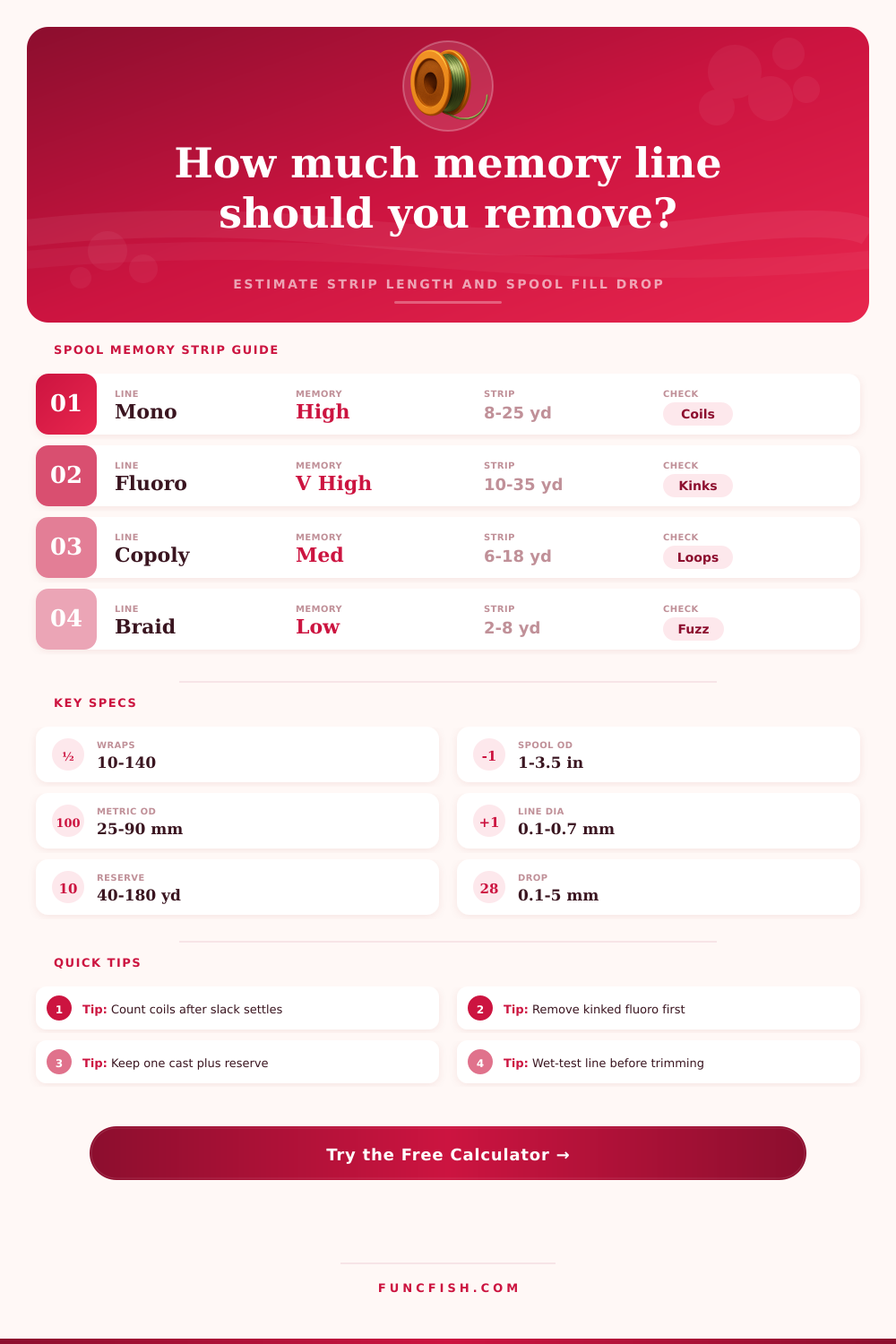
| Line material | Memory factor | Usual removal trigger | Suggested goal setting | Field check before cutting |
|---|---|---|---|---|
| Nylon monofilament | 1.05-1.28 | Round coils that spring off the spool | Balanced or clean | Pull 10 yd, slack it, count repeat coils |
| Fluorocarbon main line | 1.28-1.55 | Hard loops, corners, or kinked hook-set section | Clean or tournament | Run fingers lightly for flat spots |
| Copolymer line | 1.12-1.25 | Loose coils near the lure end after storage | Balanced | Check if coils relax after wet stretching |
| Braided main line | 0.38-0.58 | Fuzzy, faded, or wind-knot damaged section | Conservative | Inspect fibers rather than coil shape |
| Fly tippet or leader | 1.20-1.40 | Curly tippet, wind knots, leader butt coil | Clean | Look for pigtails near knots |
| Wire or hard leader | 1.60-1.95 | Any kink or sharp bend in the leader | Tournament | Do not fish a bent bite section |
| Reel size or spool class | Typical outside diameter | Line lay width | Layer length behavior | Best input check |
|---|---|---|---|---|
| 1000 spinning | 1.25-1.55 in / 32-39 mm | 0.45-0.65 in / 11-17 mm | Small drops matter quickly | Measure across filled lip |
| 2500 spinning | 1.55-1.90 in / 39-48 mm | 0.65-0.90 in / 17-23 mm | Balanced for bass and walleye | Measure the current fill, not spool rim |
| 4000 surf/inshore | 1.90-2.40 in / 48-61 mm | 0.85-1.15 in / 22-29 mm | Long casts need more reserve | Confirm braid backing does not show |
| Baitcaster | 1.20-1.55 in / 30-39 mm | 0.80-1.05 in / 20-27 mm | Wide line lay adds layer capacity | Measure exposed wound line diameter |
| Conventional trolling | 2.10-3.50 in / 53-89 mm | 1.10-2.00 in / 28-51 mm | Deep spools hide big reserves | Use the top filled diameter |
| Fly reel arbor | 2.00-3.20 in / 51-81 mm | 0.65-1.10 in / 17-28 mm | Leader trim rarely changes fill | Measure leader coil section directly |
| Scenario | Common line | Typical current line | Memory risk | Reserve priority |
|---|---|---|---|---|
| Bass spinning finesse | 6-10 lb mono or fluoro | 90-130 yd / 82-119 m | Medium at lure end | One long cast plus working fish room |
| Trout stream | 2-6 lb mono or fluoro | 60-100 yd / 55-91 m | High on small spools | Light drag and knot freshness |
| Walleye jigging | 6-12 lb fluoro or braid leader | 80-140 yd / 73-128 m | Medium from vertical loops | Depth plus a hard surge buffer |
| Surf casting | 12-25 lb mono or braid leader | 180-300 yd / 165-274 m | High near shock leader knots | Long cast plus wave sweep reserve |
| Catfish bottom | 15-40 lb mono | 120-220 yd / 110-201 m | Medium from storage set | Structure abrasion and long runs |
| Fly trout | 3X-6X tippet | Leader section only | High on fine tippet | Presentation length and knot strength |
| Comparison point | Conservative trim | Balanced reset | Clean first-cast reset | Tournament reserve reset |
|---|---|---|---|---|
| Goal multiplier | 0.85 x adjusted wraps | 1.00 x adjusted wraps | 1.20 x adjusted wraps | 1.35 x adjusted wraps |
| Best for | Low-memory braid or short sessions | Most mono and copolymer reels | Fluoro coils and small spools | Kinked line or high-stakes trips |
| Reserve impact | Lowest line loss | Moderate line loss | Noticeable line loss | Highest line loss |
| When to stop early | When coils relax after wet stretch | When no repeat loops remain | When the cast section lies straight | Only after all suspect wraps are gone |
🚩Calculation notes
Memory wrap note: The calculator treats each visible coil as one suspect spool wrap, then adjusts it by line material, severity, and goal. If a section has sharp kinks, cut past the last kink even when the numeric result is lower.
Reserve note: Keep enough line for your longest cast or working pull plus the minimum reserve. If the reserve rating warns against trimming, the safer move is often to respool or reverse the line instead of cutting deeper.
Maybe you’ve felt the rubber-band slap of line back against itself before entering water. Annoying? Yes. Presentation killer? Yep. That’s spool memory acting up. Spooled fishing line prefer to retain the shape it had when wound onto your own spool or the one it came off at factory. Monofilament nylon has trouble forgetting its coiled past. Fluorocarbon is even more problematic because it is so stiff and holds its shape so wellly.
The tool above will tell you how many feet of curling-up, stiff line to cut away so that subsequent fifty yards will act like a straight shot and not a tangled mess. Now most guys just start cutting line until they feel “right” but that’s a pretty poor measurement for geometrically-minded folks. Remember what happens when you take off outer layers? You’re not just taking away length. You’re also making it thinner and losing layer. To account for this, the calculator use the tightness of each layer (i.e., number of visible coils) to turn them into an exact amount of lost material.
How to Fix Fishing Line Memory
A moderate memory issue will probably result in a couple yards of trimming. If it is flat against rim of the spool or kinked out of shape due to a hard fight, it means deeper cuts ahead. And how close to perfect do you want your casts? How much reserve line are you willing to sacrifice for best performance?
But what about line type? Turns out that makes a difference too. Braid is woven fiber, which doesn’t retain spring tension like solid monofilament so it has very little memory. Unless your braids gets damaged or fuzzy, they don’t require frequent trims. Monofilament falls somewhere between these two; copolymer in particular have more snap back and less stretch than typical nylon. And when you’re fishing with heavy fluorocarbon, especially in deep water, you’ve got a line that will not coil up and straighten out on its own. It is great for sinking baits but terrible for launching them a long way if you has some coil on it. So the tool’s chart of aggressiveness by line type gives you a frame of reference so you know what to expect before grabbing those scissors.
Now add in different spool sizes and math completely flips. Cutting down a few yards drops your spool dramatically on a small spinning reel. It takes you 20 yards to even see the difference in spool diameter on a big offshore conventional reel. And taking off ten yards may send that fill line down far enough that it impact your drag engagement or leaves you dangerously low to make that long run. This is where the spool width and current spool diameter comes into play.
This isn’t just how many feet of line you have on. It’s about whether you will have enough line left after cutting it to bring a good fish to the boat. The first thirty yards should be straight, but the next hundred yards should be there too when it gets heavy. You don’t want to cut off too much but you also don’t want to leave too much on there either. Too little, and you’re going to have shorter casts or backlashes. Too much and you’ll likely run out of line in the middle of a fight, particularly when fighting around structure as leader gets chewed up.
The reserve rating tells you how close you are to getting too aggressive with cuts. You know, if it’s telling you there isn’t enough line left for another cast, you might wanna stop cutting this reel up and consider just respooling it all with new line. The best fix could of been the most expensive in the long haul sometimes.
Spool memory boils down to perspective and patience. Each time you grab that rod you’re sacrificing a couple bucks’ worth of line for peace of mind. And while I’d rather go ahead and take off another yard just to be sure, who wants to lose a bass at the last second because your line wrapped around on itself when she made her turn? We all want the same thing. We want a smooth cast to get our lure where it’s supposed to be, with plenty of power left over if something decides to eat. That fine line between a full spool and a clean cast is what this sport is actualy about.