Fishing Line Backing to Braid Splice Length Calculator
Estimate how much overlap, insertion, serving, or knot build length to use when joining reel backing to braid, using line tests, diameters, connection method, drag, and fishing load.
📌Scenario presets
⚙Backing-to-braid inputs
Splice length forecast
Formula breakdown
🧵Line and material reference
16-Carrier Hollow
8-Carrier Solid
Dacron Backing
Mono Backing
📊Reference tables
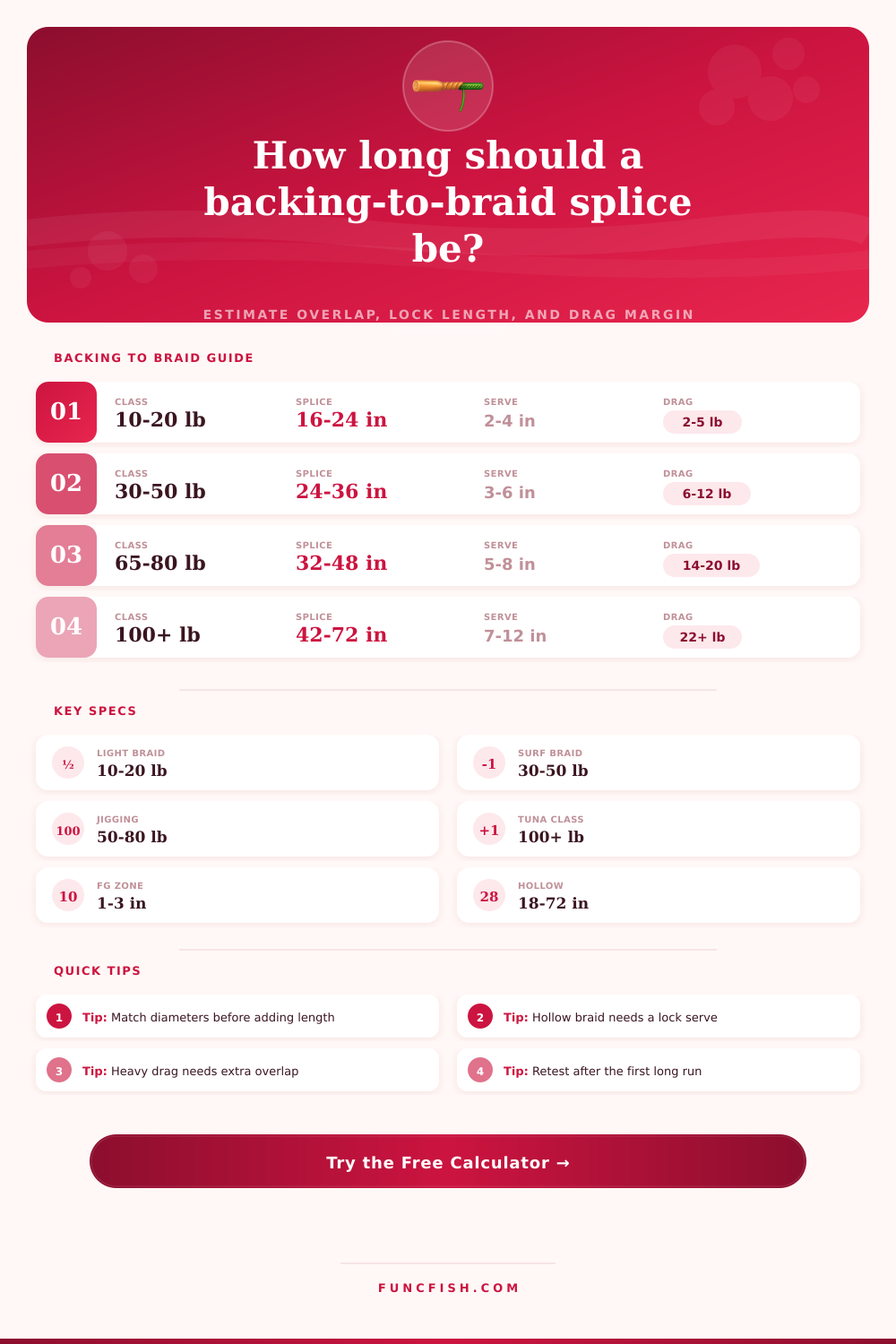
| Weak line class | Hollow-core insertion | Lock serve range | Solid braid knot zone | Typical drag cap | Calculation note |
|---|---|---|---|---|---|
| 10-20 lb / 4.5-9.1 kg | 16-24 in / 41-61 cm | 2-4 in / 5-10 cm | 0.8-1.5 in / 2-4 cm | 2-5 lb / 0.9-2.3 kg | Thin braid is sensitive to crossed wraps and sharp diameter jumps. |
| 30-50 lb / 13.6-22.7 kg | 24-36 in / 61-91 cm | 3-6 in / 8-15 cm | 1.2-2.2 in / 3-6 cm | 6-12 lb / 2.7-5.4 kg | Common surf and inshore class where casting shock adds overlap. |
| 65-80 lb / 29.5-36.3 kg | 32-48 in / 81-122 cm | 5-8 in / 13-20 cm | 1.8-3.0 in / 5-8 cm | 14-20 lb / 6.4-9.1 kg | Jigging and big inshore runs need more lock length. |
| 100-130 lb / 45.4-59.0 kg | 42-72 in / 107-183 cm | 7-12 in / 18-30 cm | 2.5-4.0 in / 6-10 cm | 22-35 lb / 10-15.9 kg | Heavy hollow systems should be served, tension tested, and trimmed clean. |
| Connection method | Best with | Modeled efficiency | Length driver | Diameter tolerance | Use when |
|---|---|---|---|---|---|
| Hollow-core insertion | Hollow braid to backing or top-shot | 90-96% | Inserted bury length | Good if snug | You can needle the backing inside hollow braid. |
| Hollow insertion with serve | Heavy drag and offshore systems | 94-98% | Bury plus serve | Very good | Drag is high or fish may run deep into backing. |
| FG or PR knot | Solid braid to mono, fluoro, or Dacron | 84-94% | Wrap count and compression | Moderate | The braid cannot be opened for a true splice. |
| Alberto or double uni | Light to medium reel backing joins | 72-84% | Wrap stack and tag finish | Fair | Fast setup matters more than maximum strength. |
| Diameter ratio | Match rating | Length adjustment | Strength effect | Finish cue | Example |
|---|---|---|---|---|---|
| 1.00-1.25x | Excellent | Minimal | Full modeled efficiency | Standard serve or finish | 50 lb Dacron to 50 lb hollow braid |
| 1.26-1.75x | Good | Add 5-15% | Small compression loss | Seat slowly under tension | Mono backing to mid-weight braid |
| 1.76-2.50x | Caution | Add 15-35% | Moderate slip risk | Use a longer finish zone | Thick mono to thin braid |
| Over 2.50x | High mismatch | Add 35% or change line | Grip becomes unpredictable | Step through an intermediate loop | Heavy Dacron to thin casting braid |
| Fishing use | Common braid | Common backing | Preferred join | Starting overlap | Load warning |
|---|---|---|---|---|---|
| Bass and walleye reels | 10-30 lb solid braid | Mono arbor backing | FG, Alberto, or double uni | 1-2 in knot build | Hooksets matter more than long runs. |
| Surf casting | 30-50 lb solid or hollow | Mono or Dacron backing | FG, PR, or served hollow | 2-36 in by method | Cast shock can exceed steady drag. |
| Offshore jigging | 50-100 lb metered braid | Braid or hollow backing | PR or hollow insertion | 3-54 in by method | Repeated vertical loads heat and polish wraps. |
| Tuna and shark | 80-200 lb hollow braid | Hollow or heavy Dacron | Long served insertion | 42-84 in | Use longer serves when drag stays high. |
💡Calculation tips
Use the weaker line: The calculator bases retained break strength on the lower of braid test and backing test. If one side is intentionally lighter, the splice length still grows when drag, diameter mismatch, or repeated load cycles rise.
Separate bury from finish: Hollow-core systems need enough buried length to grip and enough lock serve to stop walking. Solid braid knots use a short build zone, but their finish quality has a larger effect on retained strength.
When you’re standing on the dock or wading in the surf and casting into a breeze, you might hear that distinct pop when your line fails at the connection point. Rather than feeling the hook set, you hear it. That’s frustrating because you have faith in the backing and the braid, but not the join.
The majority of us view the join between our main line and reel backing as an afterthought. We slap a knot on there and cross our fingers. After all, we think it has to be strong because its made of X material. What we forget is that it’s surface area and friction which are the heroes here. To establish a solid link, it’s not so much a matter of total tensile strength as it is one of geometry.
Why Fishing Line Connections Fail and How to Fix Them
When you feed a Dacron or mono leader into a braided mainline with a hollow core, your confidence comes from the mechanical bite of the inner strands gripping the outside shell. Too little of an insertion and the line will slip out under load. Too much and it’ll add drag in the water, ruin its casting action and create bulk.
Achieving that magic mix involves consideration of three variables: 1) The diameter mismatch between the two lines; 2) the expected type of load; and 3) the security factor required for the targeted species. Casting shock is not the same as steady drag pressure; most folks don’t realize this. When you cast, the line go from zero to top speed instantly, in a fraction of a second. That surge in acceleration can exceed your drag setting by several pounds before the drag even has time to engage.
If there isn’t sufficient lock length to keep the splice together, it might peel out on a hard pitch-cast but hold up just fine under smooth trolling loads. This accounts for whether we’re talking about hard casting acceleration or smooth drag pressure. It also accounts for how often we expect to hit that knot with heavy tension. Finally, it includes heat buildup in the fibers from long runs which polishes them down and reduces their grip.
There’s also the sneak-up-on-you variable of diameter compatibility. If your braid’s core is much larger than your backing, it won’t seat correctly and will leave gaps with no friction. To move force effectively you want them snug together based off how they fit. When they’re matching well, the surface area is completely covered so a shorter serve will bear enormous amounts of weight. With a difference in line size, you must make up for it with length. That seems counterintuitive but I’ve found that sometimes a loose, long splice holds better than a short, tight one that leaves gaps in core.
The physics also change with material choice. For offshore tuna work and heavier jigging with hollow-core braids, its all about pure mechanical insertion. There is no knot bulk or glue, just strand-on-strand friction. You need to bury it deeper and use more precision so that vibration doesn’t cause the backing to walk out.
Bass guys are typically tying their solid braid on with an Albright or FG knot. With those approaches, wrap count and the cleanliness of the coil seat is big factors in how well the system retains strength. Messy finish equals weak finish.
Here is where it gets really good: the page breaks down the line classes and lays out the reference tables. You can see here how far you should spool your light trout fly backings versus your heavy shark surf lines. It makes sense why they’re so different because the risk factors are so very different. If your ten-pound braid splice fails, you lose a little fish. If an eighty-pound hollow-core splice blows up at depth, you may lose a trip and a lot of time.
When it comes to line, fishing line failure isn’t so much because the line breaks. Most times it’s because the connection slips. Even though there are some really strong braids out there now, if you don’t leave enough slack in your connection for them to grab onto, it won’t work when you need it most.
Measure. Tie. Test. You should of spent the extra minutes and cast hard at a dock cleat before you ever try to cast for a fish. If the knot holds that abuse, it will hold the fish. And that peace of mind is worth far more then an additional minute setting it up right.