Fishing Reel Oscillation Rate Calculator
Estimate spool or line-guide oscillation speed, one-way stroke timing, line-lay pitch, cross-wrap angle, and retrieve rate from your reel geometry and handle cadence.
📌Scenario presets
⚙Reel and line inputs
Reel oscillation results
Calculation breakdown
📊Oscillation style data
Fast spool travel creates open line pitch and quick edge visits for general mono and fluorocarbon use.
More rotor wraps per stroke produce a tighter, flatter lay that helps thin braid leave the spool cleanly.
Worm-shaft travel moves the guide across the spool face; pitch changes with spool diameter and line load.
Very slow oscillation stacks dense parallel wraps, useful for casting distance when line tension stays even.
📐Reference tables
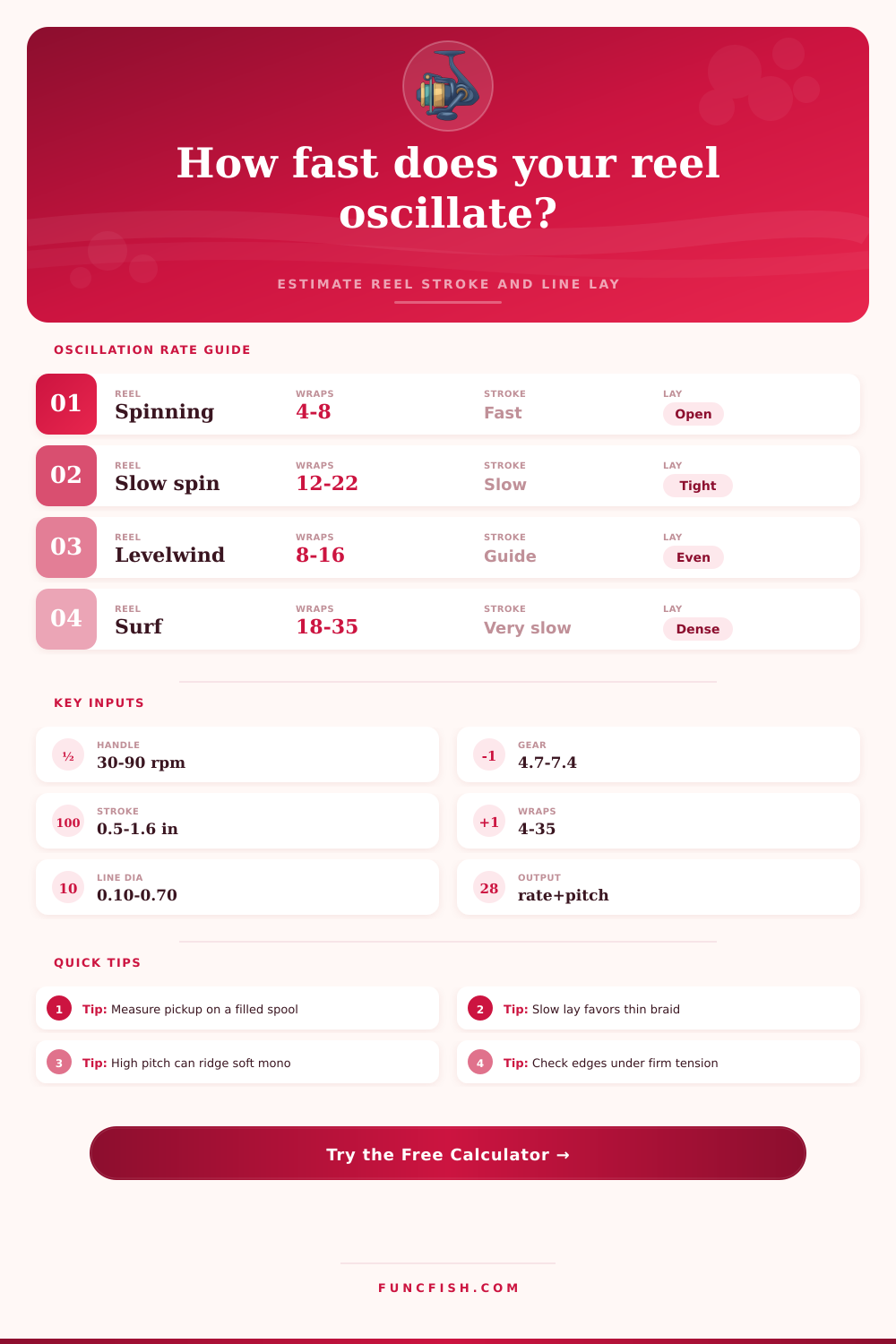
| Reel type | Typical wraps per one-way stroke | Best line match | Common warning sign |
|---|---|---|---|
| Standard freshwater spinning | 4 to 8 wraps | Mono, fluoro, general braid | Loose ridges if retrieve tension is low |
| Slow-oscillation spinning | 12 to 22 wraps | Thin braid and long leaders | Stacked braid if overfilled |
| Surf long-cast spinning | 18 to 35 wraps | Small diameter braid or tapered mono | Wind knots from slack line loops |
| Low-profile baitcaster | 7 to 14 spool wraps | Braid, fluoro, mono main line | Line piles near one frame side |
| Round levelwind or trolling | 10 to 18 spool wraps | Mono, braid backing, wire line | Guide lag under heavy load |
| Pitch-to-line ratio | Line lay read | Practical use | Adjustment to try |
|---|---|---|---|
| Under 1.0x | Very dense | Thin braid, careful long casting | Reduce overfill and keep tension steady |
| 1.0x to 2.5x | Balanced close lay | Most spinning and finesse setups | Use normal fill and smooth cadence |
| 2.5x to 5.0x | Open practical lay | Mono, fluoro, heavy cover casts | Watch for valleys under slack pickup |
| Over 5.0x | Wide pitch | Heavy line or short-range work | Add tension or reduce line diameter mismatch |
| Technique | Handle cadence | Preferred lay | Useful check |
|---|---|---|---|
| Finesse spinning | 35 to 60 rpm | Close, low ridge | Pitch near 1.2x to 2.2x line diameter |
| Power casting | 45 to 75 rpm | Even, moderate pitch | Guide reaches both shoulders cleanly |
| Surf casting retrieve | 30 to 55 rpm | Dense and smooth | No loops trapped at the spool lip |
| Trolling reset | 25 to 50 rpm | Firm, level packing | Stroke rate stays stable under drag load |
Measurement tip: If the reel has no published oscillation ratio, count how many rotor wraps or spool wraps occur while the spool or line guide travels from one edge to the other. Enter that count as wraps per one-way stroke.
Interpretation tip: A faster oscillation rate is not automatically better. The useful target is an even pitch for the line diameter, with clean edge reversal and enough tension to prevent loose loops.
Oscillations is the movement of a spool or a line guide back and forth along an axis. Oscillation occurs every time you turns the handle on a spinning reel or a levelwind reel. The speed of the oscillation determines how fishing line will stack on the spool.
If the oscillation speed is too fast for the line diameters, the fishing line will lay in ridges on the spool. If the oscillation speed is too slow, the fishing line will pack tight on the spool and create valleys on the line. Such issues with the fishing line will become more noticeable when you cast or when a fish pulls on the fishing line.
How reel oscillation affects fishing line on the spool
The relationship between the handle cadence, gear ratio, and number of wraps the rotor makes on a spool during one stroke determines the oscillation rate of a reel. For instance, a spinning reel that makes eight wraps on the spool per stroke will cross the usable area of the spool twice as slow than a spinning reel that makes sixteen wraps on the spool per stroke. The ratio of the number of wraps on the spool that a spinning reel makes will determine whether the fishing line will lay open on the spool or pack dense on the spool.
Changing the stroke length on the reel or the number of wraps the fishing line makes on the spool can change the ratio. The diameter of the fishing line is another important factor in determining the oscillation rate. The pitch of the oscillation is measured in relation to the thickness of the fishing line.
For example, a fishing line pitch that is appropriate for 0.30 mm braided fishing line may not be appropriate for 0.45 mm monofilament fishing line. In this example, the 0.45 mm monofilament line may create noticeable gaps between the line wraps on the spool. The pitch of the oscillation is relative to the thickness of the fishing line being used.
Therefore, changing the fishing line will also change the way the line lay on the spool. The tension with which you retrieve your fishing line is also another important factor. If you use light tension to retrieve the line, thin braided fishing line will settle into the gaps between the wraps of the previous section of line.
However, if you use steady tension when you retrieve your fishing line, each new wrap will sit on the previous wrap of line on the spool. Using steady tension will allow for a smooth fishing line cylinder on the spool, whereas using varying or inconsistent tension will lead to ridges along the fishing line on the shoulders of the spool. The fill level of the spool also changes the way in which the oscillation of the line affect the fishing line.
An underfilled spool changes the geometry of the spool. A change in the geometry of the spool changes the way the line oscillates. An underfilled spool will cause the fishing line to make more wraps on the spool during a given period of time than a full spool will make.
This is why a spinning reel will feel different when you add fifty yard of backing to the line; the stroke length is the same but the area of the spool that the fishing line moves across has changed. The angle at which you turn the handle on the reel is another factor that can influence the rate of oscillation. A finesse angler who casts with a forty-five rpm cadence will experience a different oscillation rate than a surf caster that use thirty-five rpm.
The surf caster uses a slower cadence to allow the fishing line to settle under its own weight before the next section of fishing line is deposited on the spool. The finesse angler who uses a faster cadence allows the pitch of the fishing line to remain in an open position to prevent the thin braid from digging into the previous wrap of fishing line when a fish makes a run for the boat. To ensure that the fishing line has a good lay on the spinning reel, the oscillation pitch must match the diameter of the fishing line.
If the pitch of the oscillation is much smaller than the diameter of the fishing line, the line will make dense wraps on the spool and may create trapped loop of line. If the pitch of the oscillation is several times larger than the diameter of the fishing line, the line will create ridges on the spool that will reduce the casting distance of the angler. Many anglers will experience these issues when they change from braid to monofilament fishing line without adjusting the stroke or the number of wraps of the fishing line on the spool.
Another small but important factor that influences the lay of the fishing line is the edge clearance of the spool. The fishing line should have a few hundredths of an inch of space on each end of the spool. This allows for the fishing line to exit the spool without the guide of the spinning reel forcing the line against the frame of the reel.
If there is not enough clearance on the end of the spool, even with a correct pitch of the oscillation, a ridge will form on the fishing line that will grow with every retrieve of the line from the spool. This calculator calculates the mathematical calculations necessary to determine the oscillation rate, one-way stroke time, pitch, retrieve speed, and retrieve length for you. All you must do is enter your handle speed, gear ratio, stroke length, and wraps on the spool.
The calculator will provide you with the oscillation rate of your spinning fishing reel, the one-way stroke length of your spinning fishing reel, the pitch of the oscillation relative to the diameter of your fishing line, the retrieve speed in feet per minute, and the retrieve length in feet. While both the fastest oscillation and the slowest oscillation have their place, the goal is to find the right oscillation rate for your fishing line and the tension that you can maintain while fishing. A spinning fishing reel that lays the fishing line evenly under light pressure will allow the line to have a good performance when a fish begins to pull on the line.
The oscillation rate of a spinning fishing reel is the mechanism that allows for the even flat foundation of the fishing line on the spool.