Palomar Knot Length Needed Calculator
Estimate how much line to pull through the eye before tying a Palomar knot, including the pass-through loop, overhand take-up, tag trim, and cinch shrink.
📌Scenario presets
⚙Knot and terminal inputs
Palomar line length estimate
Full calculation breakdown
🧵Line material data
Mono
Fluoro
8x Braid
Tippet
📏Palomar length reference table
| Terminal setup | Typical eye ID | Object passed through loop | Starting tag range | Finished trim |
|---|---|---|---|---|
| Small fly, size 10 to 16 hook | 0.04-0.07 in / 1.0-1.8 mm | 0.3-0.7 in / 8-18 mm | 4-7 in / 10-18 cm | 1-2 mm |
| Drop shot hook or finesse jig | 0.06-0.10 in / 1.5-2.5 mm | 0.8-1.8 in / 20-46 mm | 7-11 in / 18-28 cm | 2-3 mm |
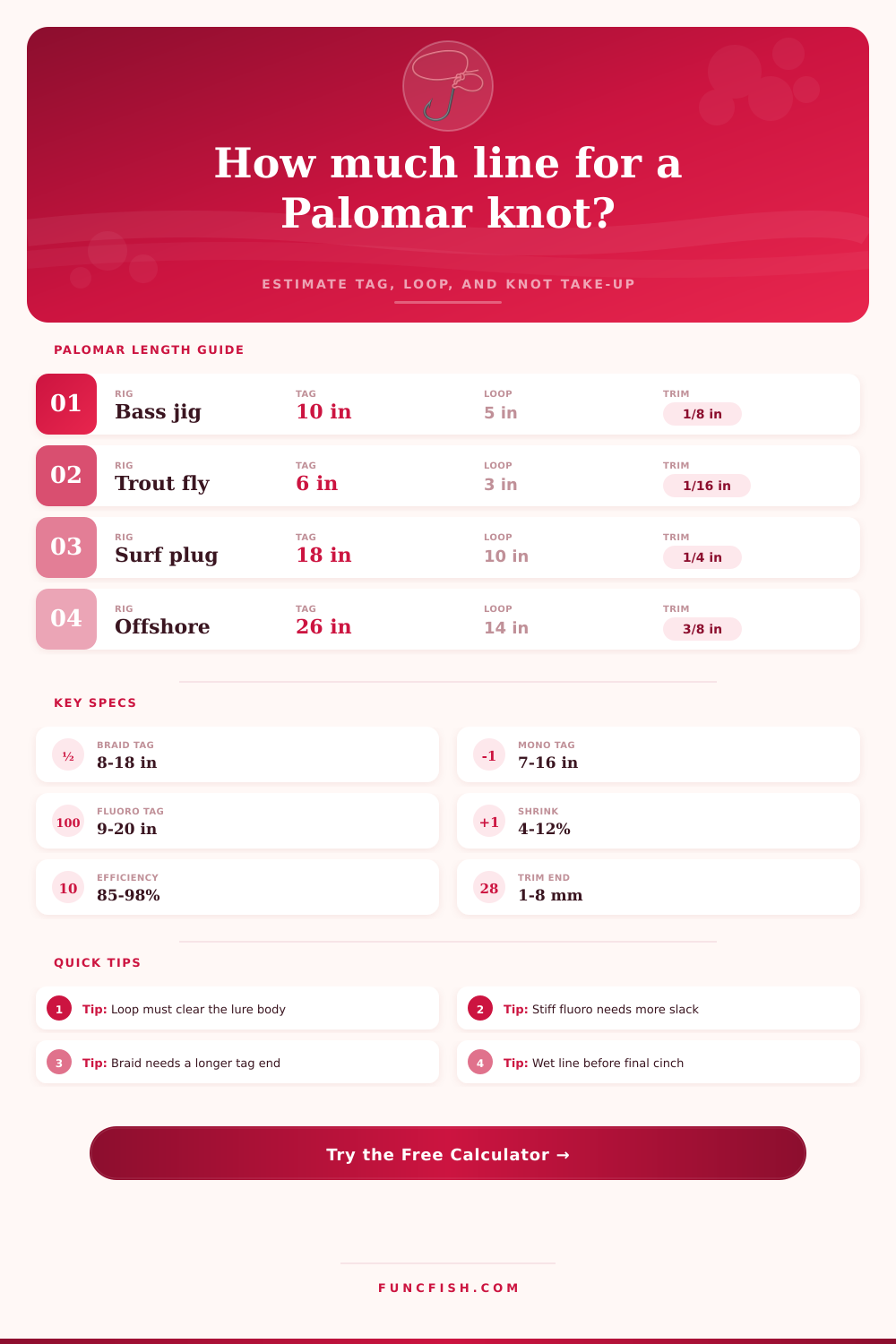
| Bass jig, worm hook, spinnerbait | 0.08-0.14 in / 2.0-3.6 mm | 2-4 in / 5-10 cm | 9-15 in / 23-38 cm | 3-5 mm |
| Snap swivel or catfish swivel | 0.10-0.18 in / 2.5-4.6 mm | 1.5-3 in / 4-8 cm | 9-16 in / 23-41 cm | 4-6 mm |
| Surf plug or large hard bait | 0.14-0.24 in / 3.6-6.1 mm | 4-7 in / 10-18 cm | 15-26 in / 38-66 cm | 5-8 mm |
| Offshore jig, popper, heavy swivel | 0.18-0.35 in / 4.6-8.9 mm | 5-10 in / 13-25 cm | 20-36 in / 51-91 cm | 6-10 mm |
🐟Species and gear comparison grid
Trout
4-8 lbSmall hooks and flies usually need a compact loop, short tag trim, and light seating pressure.
Bass
10-20 lbJigs, hooks, and spinnerbaits need enough loop length for the whole head or body to pass cleanly.
Catfish
20-50 lbSwivels and thick mono leaders add eye bend take-up and benefit from a longer tag reserve.
Inshore
15-40 lbSpoons, jig heads, and snaps often need a wider pass loop than the eye size suggests.
📊Line behavior table
| Line material | Palomar fit | Length adjustment | Strength estimate | Tag guidance |
|---|---|---|---|---|
| Nylon monofilament | Excellent for most sizes | Add 5% seating shrink | 92-97% when dressed | Leave 1/8-1/4 in / 3-6 mm |
| Fluorocarbon | Good if wetted and seated slowly | Add 8% shrink plus stiffness room | 85-93% depending on diameter | Leave 3/16-5/16 in / 5-8 mm |
| 4-carrier braid | Strong but can bite into itself | Add 7% and a longer tag | 94-98% with clean cinch | Leave 1/4-3/8 in / 6-10 mm |
| 8-carrier braid | Very strong, slick coating | Add 6% plus tag reserve | 95-99% with firm seating | Leave 1/4-3/8 in / 6-10 mm |
| Copolymer | Good general purpose choice | Add 6% seating shrink | 90-96% when lubricated | Leave 1/8-1/4 in / 3-6 mm |
| Heavy mono leader | Works, but needs big loop | Add 10% and extra handling room | 88-94% if fully seated | Leave 1/4-1/2 in / 6-13 mm |
🔗Terminal pass-through table
| Terminal type | Loop driver | Profile factor | Width factor | Best use |
|---|---|---|---|---|
| Single hook or jig hook | Hook shank or jig head length | 1.45x length | 3.0x width | Bass, walleye, panfish |
| Hard bait with trebles | Full lure body and hook hangers | 1.75x length | 3.8x width | Crankbaits and plugs |
| Barrel swivel or snap swivel | Swivel body plus snap shape | 1.35x length | 3.2x width | Bottom rigs and leaders |
| Fly or micro jig | Small hook gap | 1.25x length | 2.8x width | Trout and panfish |
| Snap, clip, or spoon | Clip bend and spoon shoulder | 1.55x length | 3.5x width | Pike, inshore, trolling |
| Large plug or popper | Body length and belly hooks | 1.9x length | 4.0x width | Surf and offshore casting |
💡Calculation tips
Loop sizing: For a Palomar knot, the object has to pass through the doubled loop after the overhand knot is formed. Large plugs and treble-hook lures usually need far more starting tag than the line diameter alone would suggest.
Seating reserve: Fluorocarbon, heavy mono, and slick braid can shorten noticeably during the final pull. A small reserve prevents the finished tag from disappearing into the knot as it cinches.
📝Species reference table
| Species or use | Common line range | Typical terminal | Starting tag habit | Notes for calculator inputs |
|---|---|---|---|---|
| Panfish | 2-6 lb / 0.9-2.7 kg | Micro jig, small hook | 4-7 in / 10-18 cm | Use fly or micro jig terminal profile |
| Trout | 4-8 lb / 1.8-3.6 kg | Fly, spoon, small jig | 5-9 in / 13-23 cm | Low trim length keeps light tippet neat |
| Bass | 8-20 lb / 3.6-9.1 kg | Jig, worm hook, spinnerbait | 8-15 in / 20-38 cm | Measure jig head or hook shank length |
| Walleye | 6-15 lb / 2.7-6.8 kg | Jig head or snap | 7-13 in / 18-33 cm | Snap clips need extra width clearance |
| Catfish | 15-50 lb / 6.8-22.7 kg | Swivel, circle hook | 10-18 in / 25-46 cm | Heavy mono increases knot take-up |
| Surf species | 20-60 lb / 9.1-27.2 kg | Plug, spoon, heavy snap | 15-28 in / 38-71 cm | Use full plug body length for loop clearance |
| Offshore pelagics | 50-100 lb / 22.7-45.4 kg | Jig, popper, heavy swivel | 22-40 in / 56-102 cm | Heavy line and large eyes need more reserve |
The overhand knot gets pulled through the eye and around as you pull tag end through… but the loop doesn’t look big enough for the jig head you want to hang on there. That’s one of the problems with Palomar knots: It can be difficult tying the knot right because getting the loop size correct are a struggle. If you don’t get sufficient slack when pulling the first time, you’ll snap the line or leave yourself a nasty tag end. So most folks guess at how much slack they need… And many fails.
But why does the Palomar knot work? It works because it essentially doubles the line by reducing stress to half on either side while maintaining almost full breaking strength. The catch is that it takes up some real estate, meaning you want sufficient line to be able to create a loop that’s big enough for your terminal tackle to slide in without any trouble. If your line is too short, the loop will be small and tight. Forcing a large lure through a narrow opening creates friction that will weaken knot before it even hits the water.
How to Tie a Perfect Palomar Knot
It is better to start with more line than you need rather then struggling to force a large lure through a small loop, but knowing exactly how much to use help reduce extra bulk and waste at the connection. Line: How much line? Because various lines react differently under load, the amount of line required depend on the material. Fluorocarbon doesn’t slide easy (unless well lubed) due to its stiffness. Braid slides slick until the knot isn’t dressed just right; in this case, a slightly longer tag end will secure it better. Monofilament stretches, which seats the knot evenly. However, it also stretches enough when tightened that you could lose more line then expected when cinching to snug the connection.
Regardless of line type, formula takes all this into account and eliminates the need to remember the percentage of shrinkage for each material. Usually the guesswork comes in at terminal size: A small fly hook requires a very small loop and a big surf plug wants a nice wide circle. So not only do you have to figure out what diameter eye you need to accommodate the lure but how long it is too. That’s because you are trying to determine size of the knot loop. It needs to be large enough to allow the lure to slip through cleanly without catching. A wider bodied lure may require a rounder loop so the lure can clear it entirely. And when you’re battling a fish in dim lighting conditions there’s no room for error.
Trimming is more science than art. If the tag end is too long, you’ll add drag. This increases the likelihood of getting tangled up or snagging something next to it. Too short and you may have an opportunity for knot to slide off if it wasn’t seated correctly. Basically you’re looking for enough length in the tag end to form a loop large enough for your lure to pass through, but with as little excess as possible. The guide chart will give you standard trim lengths in common situations to compare with what works best for you. That leaves you knowing when the safe zone starts and stops.
When using fluorocarbon or other types of nylon lines, you need to wet your knot because dry line will actualy produce heat when sliding against itself. That heat causes microscopic fibers to melt and lowers strength of the line as much as fifteen percent. The water also serves as a lubricant so that the line glides into place without any friction burn. It sounds small but it’s what makes the difference between a knot holding ninety five percent efficiently versus failing under load.
The Palomar is more about the geometry of the connection than brute force. Tying a proper knot requires respect for that aspect. You must build a mechanical linkage, understand the line you’re using, and know how much tag length to cut. This will eliminate all variables except for landing the fish. Leaving some slack in there lets the lure slide freely. It stops you from wondering if it’s going to hold, allowing you to concentrate on the business end. That first pull through the eye sets up the rest of the fight.