Multi-Hook Rig Spacing Calculator
Calculate hook-to-hook spacing, total hook span, leader fit, and tangle clearance for sabiki, hi-low, paternoster, drop-shot, surf, and teaser rigs.
📌Scenario presets
⚙Rig spacing inputs
Rig spacing results
Calculation breakdown
🧰Rig geometry reference
Sabiki Chain
Hi-Low Surf
Paternoster
Teaser Chain
📏Spacing and clearance tables
| Rig type | Hook count | Starting spacing | Bottom clearance | Common adjustment |
|---|---|---|---|---|
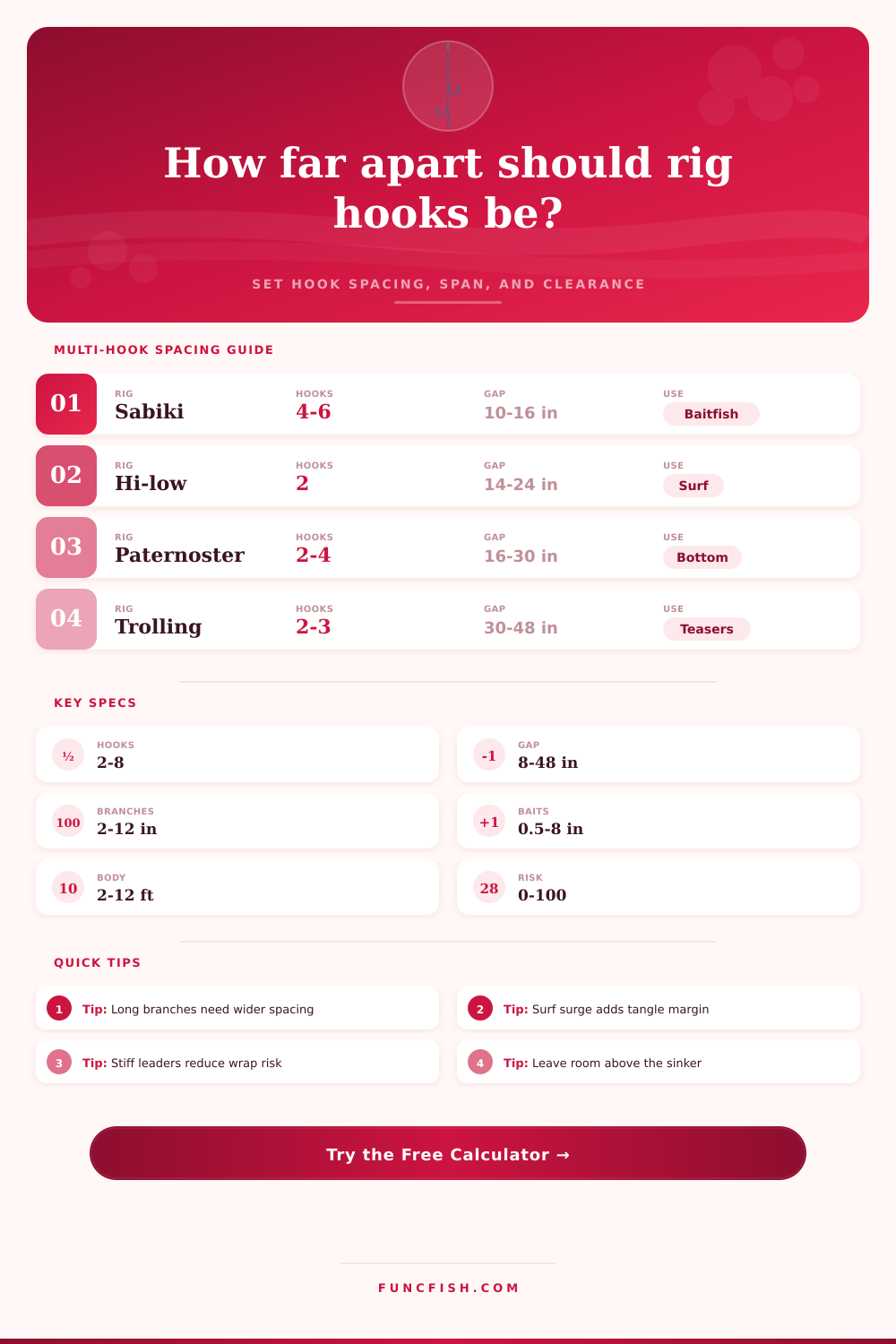
| Sabiki bait rig | 4 to 6 | 10 to 16 in / 25 to 41 cm | 6 to 10 in / 15 to 25 cm | Shorter branches keep tiny baits separated. |
| Hi-low surf rig | 2 | 14 to 24 in / 36 to 61 cm | 10 to 18 in / 25 to 46 cm | Increase spacing when bait tails are long. |
| Pompano double drop | 2 | 18 to 28 in / 46 to 71 cm | 12 to 20 in / 30 to 51 cm | Floats and beads add swing room around each hook. |
| Flapper or clipped rig | 2 | 20 to 34 in / 51 to 86 cm | 14 to 24 in / 36 to 61 cm | Long snoods need extra vertical separation. |
| Paternoster reef rig | 2 to 4 | 18 to 32 in / 46 to 81 cm | 12 to 24 in / 30 to 61 cm | Strong tide calls for stiffer branches. |
| Teaser or daisy chain | 2 to 3 | 30 to 48 in / 76 to 122 cm | 18 to 36 in / 46 to 91 cm | Keep trailing hooks behind the lure wash. |
| Species or target | Typical hook group | Minimum gap | Preferred material | Spacing note |
|---|---|---|---|---|
| Baitfish, herring, sardine | #8 to #14 | 8 to 12 in / 20 to 30 cm | Light mono | Small feathers and flies can sit closer. |
| Panfish and crappie | #4 to #10 | 10 to 16 in / 25 to 41 cm | Light mono | Keep baits apart when spider rigging. |
| Trout tandem nymphs | #10 to #18 | 10 to 20 in / 25 to 51 cm | Fluoro | Depth control matters more than many hooks. |
| Surfperch, whiting, pompano | #2 to 2/0 | 14 to 24 in / 36 to 61 cm | Mono or fluoro | Surf surge rewards wider hook separation. |
| Flounder and fluke | 1/0 to 4/0 | 16 to 28 in / 41 to 71 cm | Fluoro | Longer baits need more tail clearance. |
| Snapper and reef species | 1/0 to 6/0 | 20 to 32 in / 51 to 81 cm | Heavy mono | Stiffer droppers reduce current wrapping. |
| Catfish bottom rigs | 2/0 to 8/0 | 18 to 34 in / 46 to 86 cm | Heavy mono | Cut bait swing drives the spacing. |
| Trolled teaser baits | 4/0 to 9/0 | 30 to 48 in / 76 to 122 cm | Heavy mono or wire | Large baits need clear water behind each hook. |
| Leader material | Stiffness effect | Best branch length | Tangle behavior | Calculator factor |
|---|---|---|---|---|
| Light monofilament | Flexible | 2 to 6 in / 5 to 15 cm | Good for small hooks, wraps in heavy surge. | Neutral spacing |
| Heavy monofilament | Moderately stiff | 4 to 10 in / 10 to 25 cm | Good bottom-rig separation. | Slightly shorter gap |
| Fluorocarbon | Stiff and dense | 3 to 9 in / 8 to 23 cm | Sinks well and resists branch collapse. | Shorter gap allowed |
| Soft braid branch | Very flexible | 1 to 4 in / 3 to 10 cm | Needs short branches or wide hook spacing. | Wider gap needed |
| Single-strand wire | Very stiff | 3 to 8 in / 8 to 20 cm | Separates well but can kink. | Shorter gap allowed |
| Dropper loop | Medium stiffness | 2 to 5 in / 5 to 13 cm | Compact, clean, and easy to repeat. | Neutral spacing |
| Water condition | Spacing multiplier | Branch advice | Best rig style | Why it matters |
|---|---|---|---|---|
| Calm lake or dock | 0.95x | Normal branch length | Sabiki, pickerel | Little surge means controlled separation. |
| Light current | 1.00x | Use normal spacing | Hi-low, drop-shot | Branches drift but rarely cross. |
| Moderate current | 1.12x | Shorten soft branches | Paternoster | Tide pushes hooks into adjacent lanes. |
| Strong river or tide | 1.28x | Favor stiff leader | Paternoster, flapper | Drag angle increases wrap risk. |
| Surf surge | 1.45x | Widen spacing | Surf hi-low | Backwash swings baits vertically. |
| Trolling pull | 1.35x | Keep teaser gaps long | Teaser chain | Wake turbulence can foul trailing hooks. |
💡Spacing calculation tips
Branch clearance: The spacing formula adds bait length, dropper branch swing, hook-size clearance, and water movement. If you use very soft branches, shorten the branch or increase hook spacing before adding more hooks.
Leader fit: A multi-hook rig needs top swivel clearance and sinker clearance in addition to hook span. If the trim result is negative, either reduce hook count, shorten branches, or build a longer rig body.
By the time these rigs hit the water, they’re tangled. You feel confident stepping off that pier, then boom! Current come up and those three hooks twist around each other within seconds.” It’s almost never about “bad luck”, it’s typically an inferior geometry problem.
When we build multi-hook rigs, most of us estimate our line length and simply guess how far back we need to add next dropper. That might work when dropping one bait in flat water, but it do not work when stacking several baits end-to-end in a current. The calculator above does the math for you. By inputting your conditions and gear, it converts guesses into precise spacing information.
Stop Guessing Your Rig Spacing
The problem with spacing is that hooks don’t sit there and stay put, they’re swinging all over the place. Each branch on a paternoster rig or a sabiki chain cast independently. And when two branches gets to be too far apart, they start to catch in each others’ arcs (that’s where the tangle starts).
To account for that, the tool measures how stiff the material is and how long your dropper branch is. Stiffer stuff, like Amnesia or fluorocarbon, hold its shape better than soft stuff like braid. So you can pack your hooks tighter together without them flopping around and getting wrapped up in each other. Soft stuff need more room between the stops since it will easily flop from side to side.
The distance matters. A rig that works at a still dock might fail in the surf. Because the water pushes the bait one way and gravity pulls it back, the rig stretch up and down, which increases area each hook covers. Add space for the back-and-forth. When fishing a powerful river current or tidal flow, the angle of pull gets much steeper then the current starts to shove lower hooks up into contact with their higher counterparts.
To compensate, the calculator provides a multiplier to your starting distance depending if you’re fishing a slack tide or contending with a heavy surge. It reminds you that fifteen inches might seem like plenty of room in calm conditions, but it could of been dangerously close when the tide is rolling.
Another functional limitation is leader fit. You only have so much mainline. Stacking multiple hooks with extra space between them will leave you out of space before you reach your top swivel or sinker. The tool will tell you if you’ll be able to even fit your intended rig onto the body line you chose. It will take away the span of your hooks plus some safety clearance and then divide by remaining length to see if it’s a negative number. If yes, there simply isn’t enough room for all those elements; they’re going to crowd one another, which results in tangles. This means you avoid creating something that might look nice on paper but doesn’t work in real life.
Imagine having a small garage and you’re trying to park three cars in there. Three sedans? No problem. But if they’re all SUVs with the doors wide open, it’s a mess. The water acts like driver trying to close the doors (your hooks). If you allow each element ample room to work independently without coming into contact with one another, you’ve got the spacing down.
Leaving gaps in your rig feels counter-intuitive, but leaving that gap allows your baits to be presented cleanly. Once you know which materials bend more and less and how strong current affects those elements alongside branch length, you’ll no longer guess; you’ll engineer. Your rigs won’t get dirty, your baits will position as desired and the fish will have exactly what you wanted them to see. Every bit of space between your hooks is worth it for a clean presentation.