Bead Chain Swivel Weight Calculator
Estimate bead chain swivel mass, terminal hardware weight, total rig ballast, sink rate, drag angle, and working strength for trolling, casting, and bottom rigs.
🎯Fishing Presets
⚙Rig Inputs
Bead Chain Swivel Results
📊Current Rig Snapshot
🔗Bead Chain Size Reference
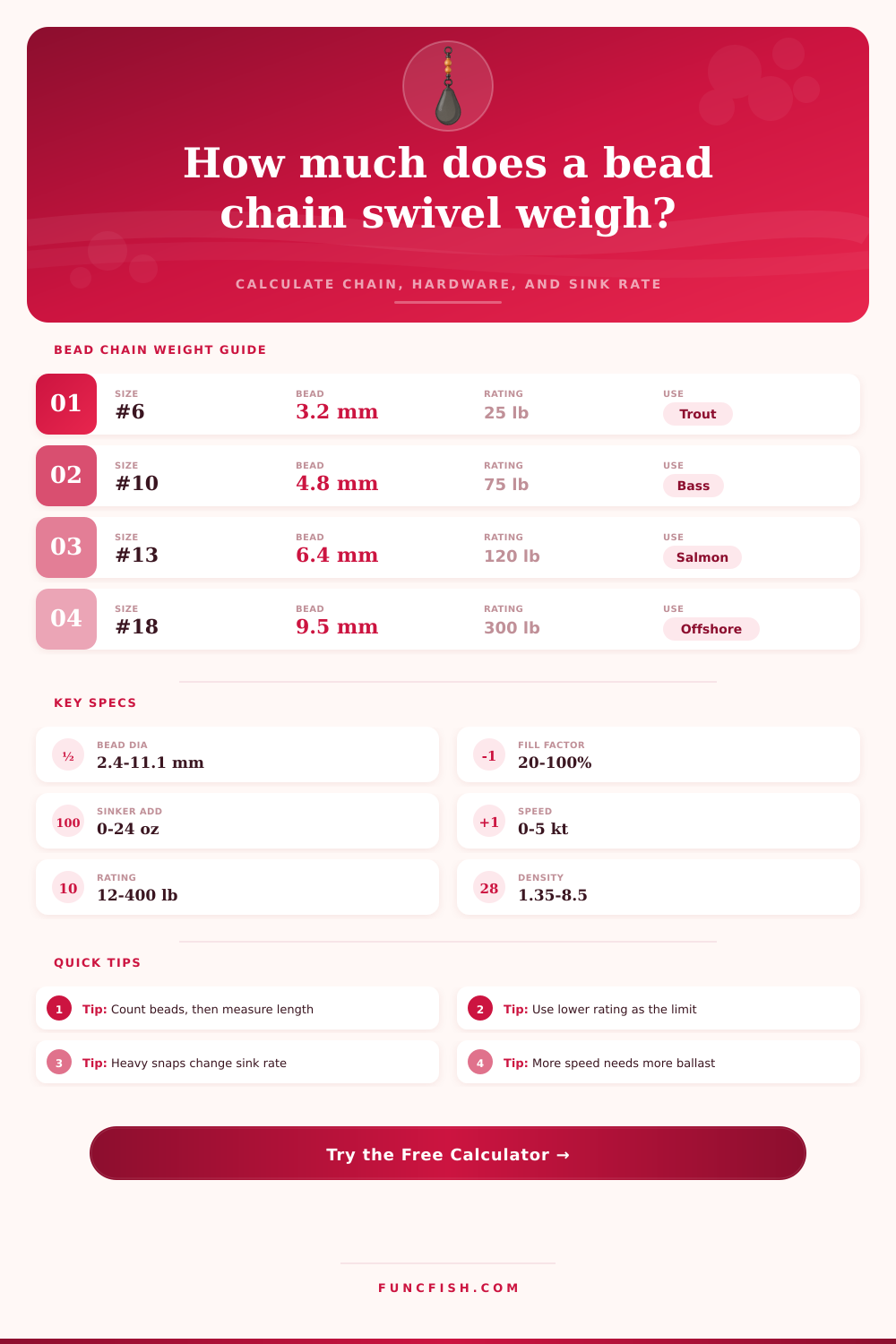
| Chain Size | Bead Diameter | Typical Rating | Fishing Use |
|---|---|---|---|
| Micro | 2.4 mm / 0.094 in | 12 lb / 5 kg | Small flies, ice jigs, tiny spoons |
| #6 | 3.2 mm / 0.126 in | 25 lb / 11 kg | Trout spoons, panfish spinners |
| #8 | 4.0 mm / 0.157 in | 40 lb / 18 kg | Bass spinners, light trolling |
| #10 | 4.8 mm / 0.189 in | 75 lb / 34 kg | Walleye rigs, inshore casting |
| #13 | 6.4 mm / 0.252 in | 120 lb / 54 kg | Dodgers, flashers, heavy spoons |
| #15 | 7.9 mm / 0.311 in | 200 lb / 91 kg | Salmon trolling, surf hardware |
| #18 | 9.5 mm / 0.374 in | 300 lb / 136 kg | Planers, teasers, offshore rigs |
| Heavy | 11.1 mm / 0.437 in | 400 lb / 181 kg | Large planer and shark leader gear |
⚖Material Density Reference
| Material | Density | Weight Behavior | Best Fit |
|---|---|---|---|
| Stainless steel | 7.90 g/cm³ | Durable, moderate corrosion resistance | General salt and freshwater rigs |
| Brass | 8.50 g/cm³ | Slightly heavier than steel | Small chains needing extra mass |
| Nickel plated brass | 8.40 g/cm³ | Heavy with smooth plated finish | Spoons, trolling attractors |
| Black nickel steel | 7.85 g/cm³ | Dark finish, similar mass to steel | Clear water and wary fish |
| Tin plated steel | 7.70 g/cm³ | Lightly lower density | Economy terminal assemblies |
| Titanium alloy | 4.51 g/cm³ | Light for its strength | Weight-sensitive casting leaders |
| Plastic float bead | 1.35 g/cm³ | Nearly neutral compared with metals | Buoyant attractor spacers |
🛠Terminal Hardware Reference
| Hardware | Approx Weight | Added Drag | Use Case |
|---|---|---|---|
| Loop ends only | 0.05 g / 0.002 oz | Very low | Direct crimp or light lure ties |
| Duo-lock snap | 0.40 g / 0.014 oz | Low | Fast lure changes on small rigs |
| Cross-lock snap | 0.80 g / 0.028 oz | Medium | Bass, pike, and inshore casting |
| Coastlock snap | 1.20 g / 0.042 oz | Medium | Salmon, surf, and trolling gear |
| Crane swivel plus snap | 0.90 g / 0.032 oz | Medium | Extra twist control before lures |
| Double snap ends | 1.60 g / 0.056 oz | High | Flashers, dodgers, and planer links |
🐟Species And Gear Comparison
| Target | Rig Style | Common Chain | Weight Range |
|---|---|---|---|
| Trout | Spoon anti-twist | Micro to #6 | 0.03-0.25 oz / 1-7 g |
| Panfish | Inline spinner | #6 to #8 | 0.05-0.38 oz / 1.5-11 g |
| Bass | Spinner or spoon | #8 to #10 | 0.25-0.75 oz / 7-21 g |
| Walleye | Bouncer or crawler rig | #10 to #13 | 0.5-2.0 oz / 14-57 g |
| Kokanee | Dodger trolling | #10 to #13 | 0.5-1.5 oz / 14-43 g |
| Salmon | Flasher trolling | #13 to #15 | 1.0-6.0 oz / 28-170 g |
| Surf fish | Spoon or plug leader | #13 to #18 | 1.0-5.0 oz / 28-142 g |
| Offshore | Planer or teaser link | #18 to Heavy | 4.0-24 oz / 113-680 g |
💡Calculation Tips
Formulas use bead sphere volume, material density, hollow fill percentage, terminal hardware allowance, underwater buoyancy, and a simplified drag equation. Always check actual tackle markings when fish size or heavy current makes failure costly.
If you’ve ever positioned the lure in the sweet spot only to see it float out of position, then I’m sure this rings true. Chances are it’s not due to bad luck. Most times, it’s due to physics and something you didn’t consider. Many anglers sees bead chain swivels as inexpensive line-twist protection devices or simply pieces of hardware. Not accounting for mass and drag can result in lost fish or money.
These two forces acts upon each other depending on how hard the current is running or how fast your boat is traveling. Every link adds more mass and drag to a rig. A plan is not a guess. Knowing why makes all the difference. Begin with information the calculator supplies. Material density matter.
Understanding Bead Chain Weight and Drag
Stainless steel does not rust. That’s why many folks opt for it. It is durable and predictable. Black Nickel Steel is almost as heavy, but this alternative look less scary than stainless in clear water. Brass is more dense and means each bead are heavier. Nickel plated brass or even solid brass will add more weight if you want to go deeper but dont want to extend the line. A simple change that impacts the rig’s behavior in water instantly.
It’s not just about size; it’s also about bead count. Because hollow chains aren’t what they seem, they’re lighter than expected, the program needs your true bead count. For example, an 8-bead #13 chain might feel heavy in your hand yet could have only half the weight of real lead due to thin walls and air inside. That’s why there’s the fill factor input which helps eliminate the illusion. Otherwise, you’ll guess wrong on your ballast. You will run too shallow and fail to account for it.
Manually counting the links is a drag. Measuring the finished length and putting that data back into software saves time while providing more accurate results. You do not need a micrometer. Another variable that baffles novices are hardware selection. While swivels and snaps aren’t free-floating connections. A little snap like a tiny duo-lock snap doesn’t seem like much on a trout spoon; however, on a bottom rig in heavy current, it’s enough difference in center of gravity to alter how the bait fishes.
Offshore guys fish gigantic links that alone weighs ounces per piece for heavy rigs out deep. Inshore fishermen should realize that even small clips adds up if you want to stay at a certain depth while minimizing drag. How does it run? Drag angle and sink rate Terminal weight determine how fast a rig runs. This seems great until you hear, “Drag goes up very fast with increasing speed.” Whoa! Many anglers are unaware of this fact.
As your bait speeds up from zero to three knots while sinking vertically, water begins to push up on its surface area and bends the bait upward. This is where calculator predicts that angle to tell you whether your rig will ride above waves, or stay down and be able to catch some fish. You also have the option to adjust your safety factor to help out. Remember, fishing isn’t a laboratory experiment; rods flex, hooks dig and fish hit hard. Having a larger safety factor means your terminal tackle won’t let go when the big one bites.
The presets get you started, but dialing in the inputs is what makes it personal. Whether you are trolling for salmon or casting for bass, the goal remains the same. It’s the same whether you’re casting for bass or trolling for salmon; match the speed to the drag and weight to depth. Get those numbers aligned and the rest falls into place naturaly. You have more time in the strike zone, less dead casts and more fish biting. The combination of action and mass lets you spend more time fishing.