
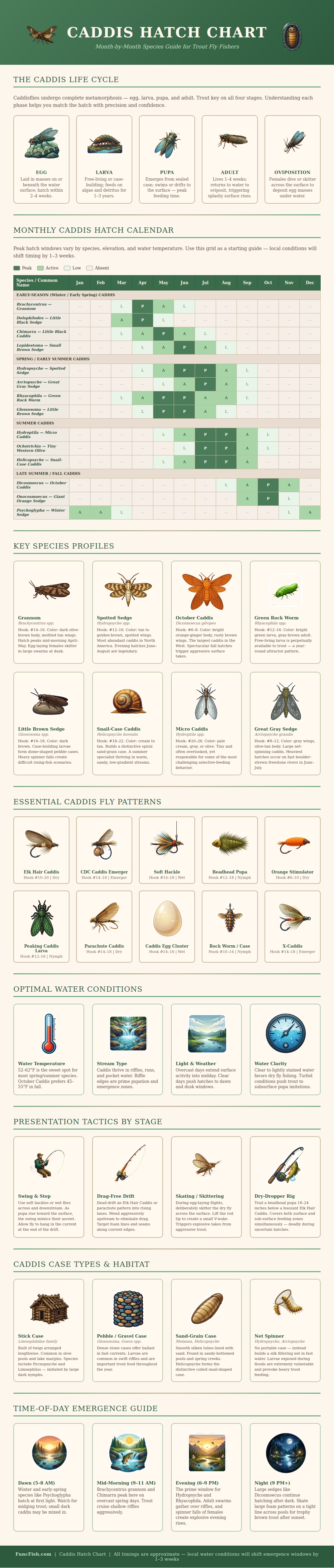
Caddisflies play an important role in the feeding patterns of trout, but many angler often overlook them due to the fact that caddisflies dont appear on the water as dramatic as mayflies. Caddisflies spend a large amount of time underwater, whereas they spend a relatively small amount of time in the air. Thus, trout is typically aware of the presence of caddisflies.
In order to effectively fish for caddisflies, an angler must understand the different life stage of the caddisflies, as well as what the trout are eating during each of those stage. One way to accomplish this is by understanding in which life stage the caddisflies are during each month of the year. The life cycle of a caddisfly consist of several different stages.
Caddisfly Life Stages and Trout Fishing
After the eggs are laid, the young caddisflies hatch and become larvae. These larvae can either wander freely in the water, or they can build protective cases out of materials found within the water. Eventually, these larvae will transform into pupae within their case.
These pupae will move towards the waters surface, where they will transform into adult caddisflies. The adult caddisflies will emerge from the water, mate, and the female caddisflies will return to the water to lay their egg. Each of these life stages corresponds to a certain feeding period for the trout.
Timing is important in that there are different types of caddisflies that appears at different times of the year. During the early seasons of the year, caddisflies will appear when the water temperature are relatively cold. Additionally, the young caddisflies will hatch during bursts of time during which the eggs lay.
As the seasons continue, different family of caddisflies will appear in different types of water. For instance, some types of caddisflies will prefer areas of water with fast-moving currents and boulders, while others will prefer to live in slow moving areas of water that contains sand. Additionally, large caddisflies will appear later in the year, and the large size of these caddisflies will alter the way that trout interact with these insect.
An angler can use a hatch chart to determine which type of caddisflies live in each of the different months of the year; however, other factor, such as the elevation of the area and the temperature of the water, can impact where and when the caddisflies emerge from their pupae stages by as many as several week. To catch caddisflies, anglers must understand the life stage of the caddisflies that are active at the time. For instance, during the emergence of caddisfly pupae, the young insects are vulnerable as they rise from the water towards the surface.
Trout may tend to ignore the adult caddisflies that over the water if they are focused upon the rising pupae. Alternatively, if the female caddisflies are laying their eggs, the movement of the caddisflies upon the water’s surface may become more unpredictably. Thus, instead of allowing a dry fly to sit still upon the water’s surface, anglers may have to twitch or skitter the dry fly to mimic the movement of the caddisflies.
Each of these strategies may be used during a single fishing afternoon, as the dominant stage of caddisflies may change throughout the day. In addition to understanding the life stage of the caddisflies, anglers can increase their chance of catching trout by understanding the conditions of the water in which the caddisflies live. The conditions of the water often have an impact upon the caddisflies more than the calendar does.
For instance, the larvae and pupae stages of caddisflies are active most in water temperature between fifty and fifty-five degrees. Additionally, most of the activity of the caddisflies occurs in riffles in the water, areas where the moving water help the caddisflies to reach the water’s surface. For instance, overcast weather will extend the activity of the caddisflies into the middle of the day, while bright sunlight will limit the activity of the caddisflies to the dawn and the dusk.
Additionally, the clarity of the water impact the way that trout can view the caddisflies. In clear waters, the trout can view the detail of a fly; in stained waters, however, the trout will rely upon the silhouette of the fly and its movement in the water. Additionally, there are specific tactic for presenting the fishing line that will allow anglers to mimic the life stages of caddisflies.
For instance, soft hackle flies mimic caddisfly pupae that are rising out of the water. In these case, anglers should swing the soft hackle flies across and down through the water. When the adult caddisflies are upon the water, using a drag-free drift will allow the fly to remain in the feeding lane of the trout.
When the female caddisflies are laying their eggs, anglers can skate a large dry fly across the water’s surface. Additionally, anglers can pair a buoyant dry fly with a pupa pattern, which will allow them to cover both life stages of caddisflies at once. Understanding the hatch chart for each type of river will allow anglers to understand the context of the water wherein they are fishing for caddisflies.
For instance, the hatch chart can help anglers to recognize which parts of the river contains which types of caddisflies. For instance, the riffles in the river may contain gravel upon which the larvae build their cases. Alternatively, other parts of the river may contain sand upon which other type of caddisflies build their cases.
If the trout are refusing an angler’s dry fly, the trout may have switched to feeding upon the caddisfly pupae for a period of time. Thus, understanding each of these life stages will allow anglers to have more success in fishing for trout. Regardless of the time of year in which anglers are fishing, trout anglers should always target caddisflies.
This is due to the fact that the larvae of caddisflies are always within the water. Thus, either nymph or larva imitations will produce fish; the larvae are always within the water. While the hatch chart will provide information regarding the times of year when large caddisflies will be upon the water, trout will be eating some form of caddisfly food.
Thus, if anglers understand that trout eat caddisflies, the river will make more sense to them.