🐟 Barracuda Weight Calculator
Estimate barracuda weight from length & girth measurements — imperial & metric results instantly
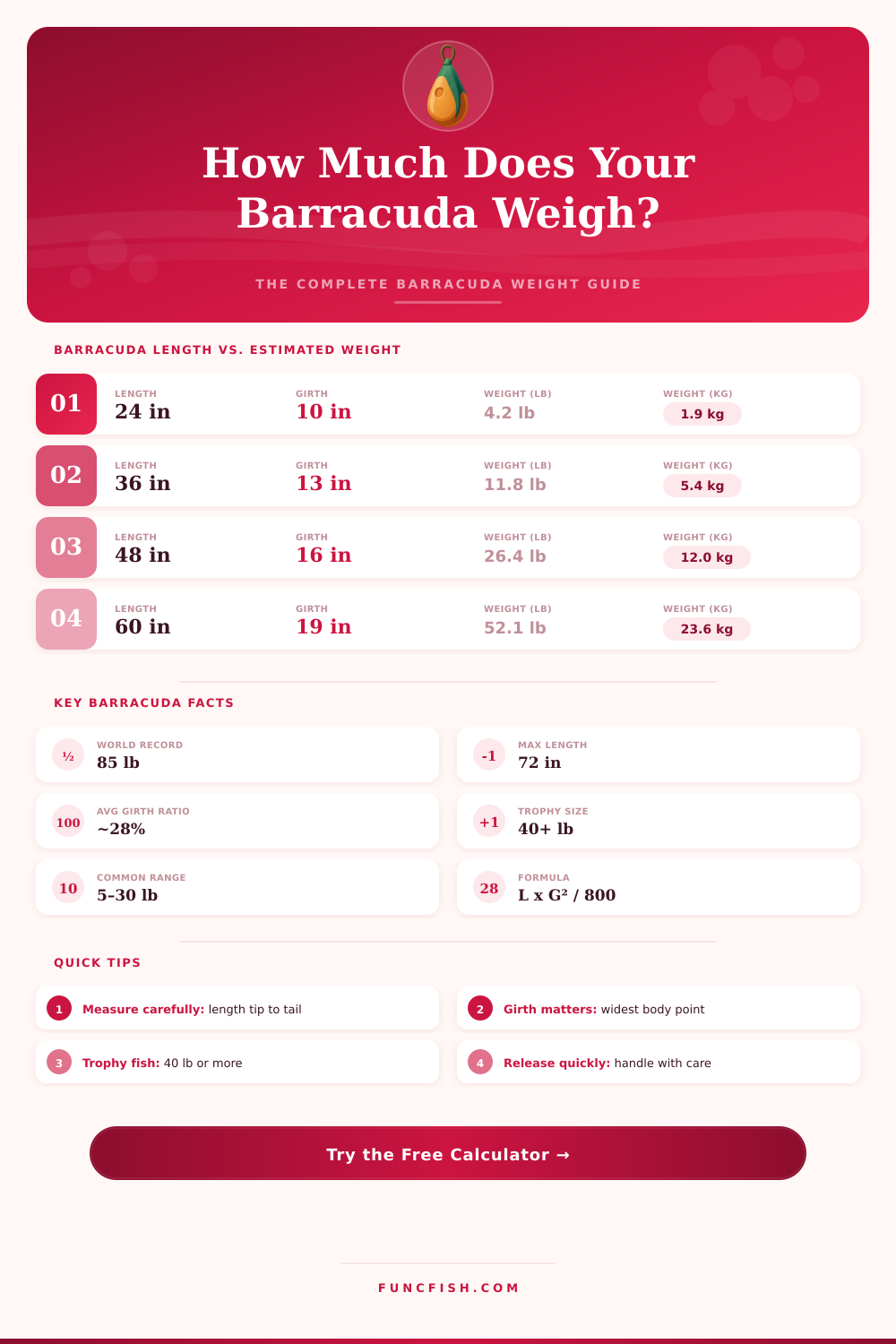
| Length (in) | Length (cm) | Est. Girth (in) | Est. Weight (lb) | Est. Weight (kg) | Size Class |
|---|---|---|---|---|---|
| 18 | 45.7 | 7.5 | 1.3 | 0.6 | Juvenile |
| 24 | 61.0 | 10.0 | 3.0 | 1.4 | Small |
| 30 | 76.2 | 11.5 | 4.9 | 2.2 | Small |
| 36 | 91.4 | 13.0 | 7.6 | 3.4 | Medium |
| 40 | 101.6 | 14.0 | 9.8 | 4.4 | Medium |
| 44 | 111.8 | 15.0 | 12.4 | 5.6 | Large |
| 48 | 121.9 | 16.0 | 15.4 | 7.0 | Large |
| 52 | 132.1 | 17.0 | 18.7 | 8.5 | Trophy |
| 56 | 142.2 | 18.0 | 22.7 | 10.3 | Trophy |
| 60 | 152.4 | 19.0 | 27.1 | 12.3 | Trophy |
| 66 | 167.6 | 20.5 | 34.6 | 15.7 | World-Class |
| 72 | 182.9 | 22.0 | 43.9 | 19.9 | World-Class |
| Species | Max Length | Max Weight | Habitat | Recommended Tackle |
|---|---|---|---|---|
| Great Barracuda | 72 in / 183 cm | 85 lb / 38.6 kg | Tropical Atlantic, Caribbean | 30–50 lb class |
| Pacific Barracuda | 48 in / 122 cm | 12 lb / 5.4 kg | Eastern Pacific | 10–17 lb class |
| Guaguanche | 24 in / 61 cm | 2 lb / 0.9 kg | West Atlantic | 6–10 lb class |
| Pelican Barracuda | 36 in / 91 cm | 5 lb / 2.3 kg | Indo-Pacific | 10–15 lb class |
| Sennet Barracuda | 18 in / 46 cm | 1.5 lb / 0.7 kg | Atlantic, Gulf | 6–8 lb class |
| Technique | Target Weight Range | Recommended Line | Leader Wire | Hook/Lure Size |
|---|---|---|---|---|
| Spinning / Casting | 5–20 lb / 2–9 kg | 20–30 lb braid | 18–30 lb wire | 3/0–5/0 |
| Topwater / Popper | 5–30 lb / 2–14 kg | 30 lb braid | 30 lb wire | 4/0–6/0 |
| Offshore Trolling | 20–60 lb / 9–27 kg | 50–80 lb mono | No. 4–7 wire | 7/0–9/0 |
| Vertical Jigging | 10–40 lb / 5–18 kg | 40–65 lb braid | 40–60 lb wire | 4/0–7/0 |
| Live Bait / Chunking | 20–70 lb / 9–32 kg | 50 lb mono | No. 5–7 wire | 6/0–9/0 |
| Fly Fishing | 2–15 lb / 1–7 kg | 9–12 wt line | 12–20 lb wire | 2/0–4/0 fly |
| Wire Leader Casting | 10–50 lb / 5–23 kg | 30–50 lb braid | No. 3–5 wire | 5/0–8/0 |
| Bottom / Anchor Rig | 5–30 lb / 2–14 kg | 20–40 lb mono | 20–30 lb wire | 3/0–6/0 |
To estimate weight of a barracuda, you will need to measure the length of the barracudas and the girth of the barracuda. Many people will struggle with estimate the weight of a barracuda due to the sleekly build of the fish. The length of a barracuda are not an accurat estimation of the weight of a barracuda due to it’s sleek body.
Therefore, you will need to use the girth of the barracuda to determine the weight of that individual barracuda. The girth of the barracuda is the measurement of the widest part of the fish, which is located just in front of a dorsal fin. Different species of barracudas has different formulas associated with them due to there different body makes.
How to Estimate a Barracuda’s Weight
For instance, the Great barracuda has a specific growth curve to its body that requires the use of a specific coefficient to calculate the weight of that barracuda. The coefficient to use with a formula that employs the length of the barracuda cubed is approximately 0.0000065. However, the Pacific barracuda is much slimmer than a Great barracuda so it require a different exponent in the mathematical equation used to calculate the weight of the barracuda.
Using a generic equation for all barracuda species will likely result in undershooting the actual weight of the barracuda by 20% or more. Another factor that can impact the weight of the barracuda is the body condition of that barracuda. Barracudas that have eaten a substantial amount of bait recently will have a greater girth and therefore, more weight than barracudas that have not eaten as much.
Additionally, barracudas that are in cooler water areas or that have just spawned will be lean and have less weight than those that are more muscular. Barracudas that live near wrecks have greater mass than those that live in the flat areas. The type of tools that you use to measure the weight of the barracuda will also impact the accuracy of the weight measurement.
A fiberglass tape measure will provide more accurate measurements of barracudas than other tape measure. The fiberglass tape measure will have a lower error rate (5%) than other tape measures. However, if you use lip grips to hold the barracuda in place those measurements may not be as accurate.
The use of lip grips may impact the muscle of the barracuda which will lead to a 12% error in the measurement of the weight of that barracuda. To get the most accurat measurement of the barracuda, you should use both the length and the girth of the barracuda. Using both of these measurements will provide a confidence band of the accuracy of the weight measurement of the barracuda.
To determine the length of the barracuda, use the fork length instead of the total length of the barracuda. The total length of the barracuda includes the tail of the barracuda. However, the fork length of the barracuda is only from the nose of the fish to the fork in the tail.
Using the total length of the barracuda can result in the length measurement of the barracuda being a few percent too high. Additionally, account for the curve of the tape measure when measuring the length of the barracuda. If the tape measure has a curve to it, it may add phantom inches to the length of the barracuda which make the barracuda appear longer then it actualy is.
Knowing the weight of a barracuda can allow you to determine the correct equipment to use when catching barracudas. Knowing the weight of the barracuda will allow you to determine the correct strength of the fishing line (leader class) needed to secure the barracuda without breaking the line. Additionally, if you know the weight of the barracuda, you can make certain that your scale is able to handle the weight of the barracuda.
Using the weight of the barracuda will allow you to correctly categorize the barracuda. If you can correctly categorize the barracuda, you can determine if it is a standard catch or a trophy catch for that individual fisherman.