Surf Casting Sinker Grip Wire Calculator
Estimate surf sinker grip-wire length, wire count, holding capacity, breakout pull, and shock leader strength from wave height, sweep, sand type, cast range, and rig drag.
🎯Surf Fishing Presets
⚙Grip Wire Inputs
Grip Wire Calculation
Calculation Breakdown
📊Selected Setup Data
🐟Gear and Species Comparison
Pompano
2-4 ozTwo to four short wires hold light double-drop rigs on firm sand without making retrieval too heavy.
Striped Bass
4-6 ozFour 2.5-3.5 inch wires work well with fish-finder rigs and moderate longshore sweep.
Red Drum
5-8 ozChunk baits and outer bars usually need longer grip wires plus a stronger shock leader.
Shark Bait
8-10 ozUse four to six long wires, but keep breakout manageable so the rig releases under steady rod pressure.
🔧Grip Wire Material Reference
| Wire type | Typical diameter | Base bite hold | Stiffness | Best surf use |
|---|---|---|---|---|
| 17 ga spring stainless | 1.15 mm / 0.045 in | 0.58 lb per in | High | Breakaway and Sputnik leads in rough sweep |
| 18 ga stainless wire | 1.02 mm / 0.040 in | 0.46 lb per in | Medium | General fixed-wire surf sinkers |
| 16 ga heavy stainless | 1.29 mm / 0.051 in | 0.68 lb per in | Very high | Heavy baits, shell, and strong current |
| 17 ga galvanized wire | 1.15 mm / 0.045 in | 0.50 lb per in | Medium | Everyday replacement wires |
| 18 ga piano wire | 1.02 mm / 0.040 in | 0.54 lb per in | Very high | Long casting where springback matters |
| 17 ga phosphor bronze | 1.15 mm / 0.045 in | 0.42 lb per in | Low-medium | Softer bite on clean sand and lighter leads |
| 18 ga titanium wire | 1.02 mm / 0.040 in | 0.39 lb per in | Medium-high | Kink-resistant experimental rigs |
| 16 ga soft copper test | 1.29 mm / 0.051 in | 0.30 lb per in | Low | Short testing only, bends out easily |
🌊Surf Load Reference
| Condition | Current range | Wave range | Load multiplier | Typical grip setup |
|---|---|---|---|---|
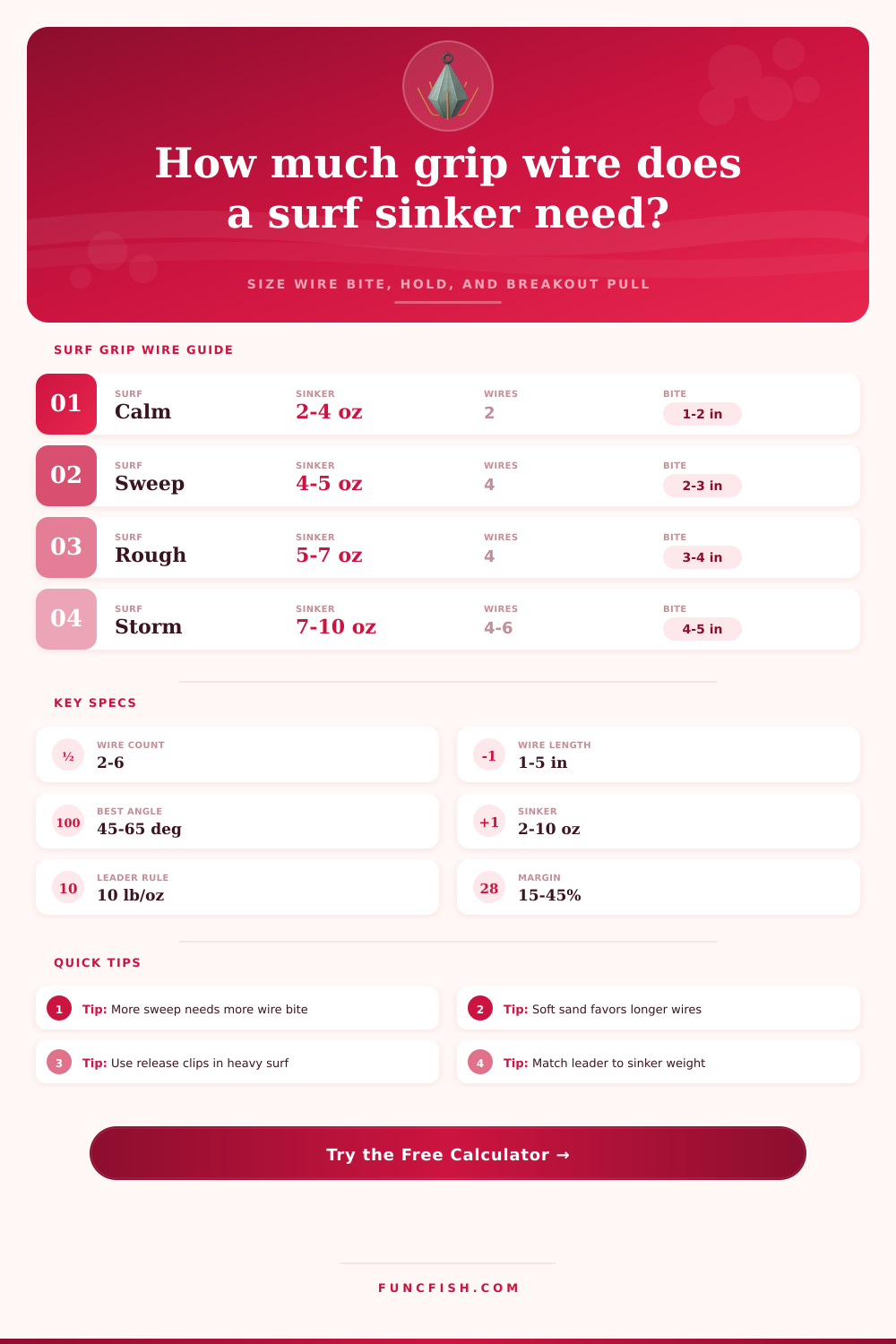
| Calm beach | 0-0.7 kt / 0-0.36 m/s | 0-2 ft / 0-0.6 m | 0.75x | 2 wires, 1-2 in bite, 2-4 oz |
| Moderate surf | 0.7-1.4 kt / 0.36-0.72 m/s | 2-4 ft / 0.6-1.2 m | 1.00x | 4 wires, 2-3 in bite, 4-5 oz |
| Rough sweep | 1.4-2.4 kt / 0.72-1.23 m/s | 4-7 ft / 1.2-2.1 m | 1.35x | 4 wires, 3-4 in bite, 5-7 oz |
| Storm swell | 2.4-3.5 kt / 1.23-1.80 m/s | 7-10 ft / 2.1-3.0 m | 1.70x | 4-6 wires, 4-5 in bite, 7-10 oz |
| Rip channel | 2.0-4.0 kt / 1.03-2.06 m/s | 3-8 ft / 0.9-2.4 m | 1.55x | Breakaway wires and high leader margin |
⚓Sinker Style Comparison
| Sinker style | Grip behavior | Release behavior | Best wire angle | Use case |
|---|---|---|---|---|
| Sputnik breakaway | High hold from locked arms | Trips easiest on retrieve | 50-65° | Long casts and rough surf |
| Breakout grip lead | Strong hold with resettable arms | Moderate release | 45-60° | General surf fishing |
| Fixed spider weight | Strong but less forgiving | Harder release | 45-55° | Soft sand and open beaches |
| Storm claw sinker | Maximum dig in soft bottom | Hard release under pressure | 55-70° | Big bait and storm surge |
| Pyramid with wires | Moderate hold plus body bite | Depends on wire bend | 40-55° | Moderate water and bait rigs |
| Plain pyramid | Body hold only | Easy release | Not applicable | Calm surf or short soaks |
| Flat grapnel | Good on firm sand and shingle | Medium-hard release | 45-60° | Europe-style distance surf rigs |
📏Wire Geometry and Leader Rules
| Measurement | Light surf | Moderate surf | Heavy surf | Why it matters |
|---|---|---|---|---|
| Exposed wire length | 1.0-2.0 in / 2.5-5.1 cm | 2.0-3.5 in / 5.1-8.9 cm | 3.5-5.0 in / 8.9-12.7 cm | Longer arms give more sand bite but increase breakout pull |
| Spread angle | 35-50° | 45-65° | 55-70° | Higher angles increase vertical bite and reduce skating |
| Shock leader | 8-10 lb per oz | 10 lb per oz | 10-12 lb per oz | Leader absorbs casting acceleration from heavy leads |
| Safe breakout pull | 2-5 lb / 0.9-2.3 kg | 5-9 lb / 2.3-4.1 kg | 9-16 lb / 4.1-7.3 kg | Too much grip can bury the rig or overload tackle |
| Working margin | 15% | 25% | 35-45% | Margin covers wave pulses and bait roll |
💡Grip Wire Calculation Notes
Wire bite: The calculator treats usable bite as exposed length multiplied by the sine of the wire angle, then adjusts it for bottom type, wire stiffness, and sinker style. This rewards wires that dig down rather than skate sideways.
Breakout balance: A rig that holds perfectly can still be wrong if it will not trip free. If breakout pull is near or above the rod pressure you can apply, reduce wire length, lower the angle, or switch to a release-style sinker.
The bottom line is that grip wire is a planned connection between dynamic hydraulic force and static mass. How much wire bites into the bottom material can be the difference between catching dinner or sending your gear back with the last wave to break over the beach. It’s not about choosing the heaviest lead, its about getting the geometry right.
Plug in your current speed, your wave height, and sand type, and the calculator figures out the rest for you. It spares you having to guess at conversions and coefficients.
How to Choose the Right Grip Wire for Fishing
Most anglers believe that heavier is better when it comes to holding power, failing to take drag into account. Short, soft wires can’t hold as well as big lead, so a heavy sinker will wash out of a rip channel if the wire pulls first while the lead hasn’t had time to dig in. The tool helps you visualize that tradeoff. It causes you to realize a steady set up becomes a changing load issue as wave height increases, increasing pull forces during surge cycles.
The bigger part that few people consider are the effect of wire gauge. Stiffer wires like stainless steel resist shear from current better then softer ones like copper and phosphor bronze. When soft wire is swept moderately through firm sand, it flattens out instead of digging down. Base hold per inch vary dramatically by material as seen in the table below. At equal lengths, a heavy 16 gauge stainless wire may have almost twice the bite of a soft copper test wire. This translates directly to vertical penetration because of the stiffness.
Breakout pull or the force required to trip the rig when you’re ready to get it up is affected too. It’s a fine line. You need enough wire to keep weight on the bottom during a bite, but not so much that you cannot pull the weight off without breaking your rod tip. And when the calculator tells you that you should of a 40% margin for safety in storms that means all the random waves surging up will still give you that space. Go outside that and you’re washing your rigs. But go inside that in calm water and you’ve got all this excess wire out there fighting every retrieve to keep from burying metal. After an hour of fishing and not being able to trip a sinker, you’ll get frustrated quick.
The type of sand does matter. Wire length is determined by how much soft sand you expose. When selecting “soft” sand, the calculator will set the length accordingly because soft sand require longer exposed wire lengths. Shell grit or firm packed sand typically has more resistance, which means you’re able to get away with using shorter lengths while maintaining their holding power. Selecting different types of sand will cause the calculator to adjust its results to match, it understands that a pyramid weight won’t behave the same way on a mud flat as it would on shingle.
For common fish like pompano and striped bass, you can use preset scenarios to find a starting point. These help you determine the right rig and expected bottom conditions. That leads back to shock leader strength. Casting runs get heavy sinkers moving fast and they will load up suddenly, snapping lightweight leaders like elastic if not matched appropriately. Ten pounds of leader for each ounce of sinker is one rule of thumb; but longer casts or rough water call for even higher ratings. This tool will check whether your leader matches these rules so you’re not suddenly losing the battle to a weak link that’s upstream from the knot nearest the sinker. That’s a waste of an otherwise great fight or an expensive lost rig before even wetting the line.
Adapting fast is everything in surf casting and it begins by learning to read the bottom. Tides, wind, and conditions changes every hour. Sizing your grip wire is all about system. Once you get it dialed in, trial and error with loose sinkers ends, and engineering rigs for the specific situation becomes second nature. Knowing the interaction between length, angle of wire, and materials puts you in control of the bottom contact whether you’re targeting whiting from shore or red drum out on the bars. And that’s what keeps your bait where the fish are swimming.