Slider Float Depth Calculator
Calculate slip float stop distance, true bait depth, shot placement, and float loading for slider float rigs in lakes, rivers, harbors, and inshore water.
🎯Slider Float Presets
⚙Depth And Rig Inputs
Slider Float Setup Results
Formula Breakdown
📏Slider Float Payload Grid
Finesse Pencil
Panfish Slip
Walleye Bobber
Live Bait Slider
🐟Gear And Species Comparison
Crappie / Bluegill
1-2 ft highSmall jigs and minnows usually fish just above brush, weed tops, or suspended schools with a 1.5-2.5 g float.
Walleye / Perch
1-3 ft highLeech and minnow rigs often need added stop depth because long casts and wind bow pull the bait upward.
Trout / Salmon
mid-depthEggs, beads, and small baitfish drift better when the shot carries the rig but the float is not overloaded.
Pike / Catfish
2-5 ft highLarge bait and stronger line need more payload, a wider hook-to-shot gap, and a bigger bottom clearance buffer.
📊Float Size Reference Table
| Float style | Payload rating | Comfort load | Typical depth | Best use |
|---|---|---|---|---|
| Fine pencil slider | 0.8-1.5 g | 0.5-1.2 g | 2-8 ft / 0.6-2.4 m | trout, bluegill, canal roach style rigs |
| Round panfish slip float | 2-3 g | 1.3-2.5 g | 5-18 ft / 1.5-5.5 m | crappie brush, perch, weed edge bluegill |
| Walleye slip bobber | 3.5-5 g | 2.4-4.2 g | 10-30 ft / 3.0-9.1 m | leeches, minnows, reef tops, saddles |
| River slider float | 5-7 g | 3.5-6 g | 4-20 ft / 1.2-6.1 m | current seams, salmon eggs, deeper drifts |
| Live bait slider | 6-10 g | 4.5-8.5 g | 5-25 ft / 1.5-7.6 m | pike, catfish, large shiners, suckers |
🌊Depth Adjustment Reference
| Condition | Estimated line angle | Stop depth addition | Chop allowance | When to use it |
|---|---|---|---|---|
| Calm vertical presentation | 3 degrees | about 0.1% | 0-1 in / 0-3 cm | boat fishing straight down or very short pitch |
| Light breeze or slow drift | 6 degrees | about 0.6% | 1-2 in / 3-5 cm | normal lake slip float fishing |
| Moderate wind or current | 10 degrees | about 1.5% | 2-4 in / 5-10 cm | float drifts with visible line bow |
| Strong current seam | 14 degrees | about 3.1% | 3-5 in / 8-13 cm | river slider rigs and controlled drifts |
| Wind bow on long cast | 18 degrees | about 5.1% | 4-6 in / 10-15 cm | bank fishing or big open-water casts |
🛠Shot Placement Table
| Rig type | Hook-to-shot gap | Shot pattern | Bait control | Depth note |
|---|---|---|---|---|
| Tiny jig under slider | 6-10 in / 15-25 cm | one small shot if needed | fastest contact | best near brush or docks |
| Minnow or leech rig | 12-20 in / 30-51 cm | main shot plus trim shot | natural swim room | common walleye setup |
| Egg or bead drift | 16-28 in / 41-71 cm | shirt-button shot spread | soft bottom tick | avoid dragging below target |
| Large live bait | 24-40 in / 61-102 cm | heavier main sinker | wider bait circle | keep bait above weeds |
📘Common Species Depth Targets
| Species or target | Typical slider depth | Bottom clearance | Float payload | Notes for calculator inputs |
|---|---|---|---|---|
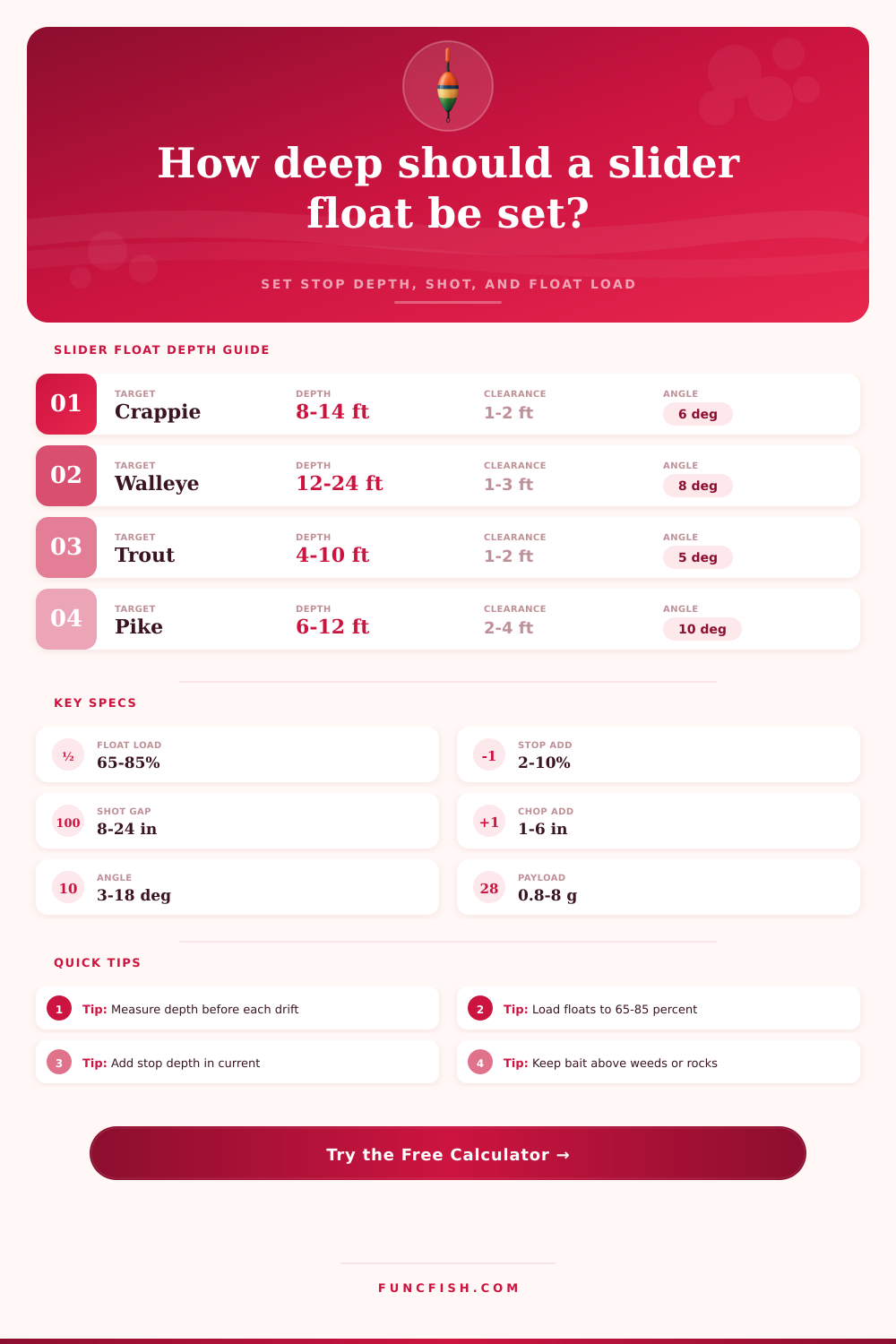
| Crappie over brush | 8-16 ft / 2.4-4.9 m | 1-2 ft / 0.3-0.6 m | 1.5-2.5 g | use surface depth when fish are suspended on sonar |
| Walleye reef edge | 12-26 ft / 3.7-7.9 m | 1-3 ft / 0.3-0.9 m | 3.5-5 g | add chop allowance for long casts and wind bow |
| Trout cove or pond | 3-10 ft / 0.9-3.0 m | mid-depth | 0.8-2.5 g | keep total load light for soft takes |
| Catfish channel edge | 5-18 ft / 1.5-5.5 m | 1-4 ft / 0.3-1.2 m | 5-8 g | avoid setting below bottom on slope changes |
| Pike live bait | 6-14 ft / 1.8-4.3 m | 2-5 ft / 0.6-1.5 m | 6-10 g | give bait room with longer hook-to-shot distance |
💡Slider Float Calculation Tips
Depth tip: In wind or current, the float stop usually needs to be set deeper than the vertical target because the line runs at an angle from the float to the bait. This calculator uses cosine correction plus your chop allowance.
Load tip: A slider float is most responsive when the combined hook, bait, shot, and line-drag load is roughly 65-85% of the rated payload. Below that it rides high; above that it can sink or false-trip.
People often confuse stop distance with vertical depth. The most frustrating aspect of slip float fishing is how easy an angler mixes up vertical depth with stop distance. It doesn’t make sense to watch a bobber pass over some structure and then strip the rod, only to find your bait is either swimming high above suspended fish or resting on the bottom.
But the problem isn’t the stop. It’s the current and wind changing the geometry of your line. Instead of dropping in a straight line, the line from your bait to your bobber form a diagonal. This means the amount of line between your stop and your rod tip cause your bait to sit deeper then expected. So if there’s a 10 degree wind bow off a reef edge where you’re targeting walleye, a stop set precisely twelve-feet out will probably result in a leech six-inches higher than fish want to come and get it.
How to Set Your Bait at the Right Depth
By entering your estimated line angle based off the drift conditions, raw target depth will be adjusted upwards or downwards to account for the cosine of this line angle. The same as the calculator above does automatically. In other words, do these fish have to turn away from food to get it?
You should also note how to properly load the float. This is where many rig go wrong. With a slider, you want just enough left on the float to register a slight bite but not so much that it interferes with natural swimming action of the bait. For this, load the float between sixty-five and eighty-five percent full. If you overload it, it will sink down into the water some, adding drag to your rig and obscuring the bite. Too little loading mean the float rides up too high. It becomes unstable in choppy conditions and sensitive to turbulence not caused by fish.
Input your hook weight, bait size, float rating, and split shot into tool. It will tell you if you are in the right range, or if you need to go heavier for thick cover or lighter for delicate work.
The behavior of the bait is driven by shot placement. Where the bait goes in the water is determined by where you place the main sinker. Too tight to the hook and you kill the presentation. For most walleye rigs, a fifteen to twenty inch gap between the main sinker and the hook give the bait space to swim freely while keeping it close to the bottom. Tighter spaces might be ok with panfish setups. But generally the more room you give a minnow to live, the better strike rate.
The tables below break down the suggested gap distances based off rig type and species. When you find yourself on a slow stretch not sure if you should loosen up your spread or tighten things down a bit, they makes good references.
Inexperienced anglers don’t always consider how weather affects depth accuracy. Wave action will lift your bait off the target depth as weight remains stationary and float rides higher on choppy water. A small safety margin of an additional inch or two of stop depth would of take into account the effect of the waves. This is just enough to keep your bait down at that perfect strike zone regardless of what’s happening on top.
Heavier winds will increase the angle error by adding more line bow. Knowing when to apply this allowance help you avoid the depth reset with each minor change in conditions.
Slider floats take more than throwing a bobber in lake. It takes some finesse, close attention, and patience. You have to know what is going on with the line, the current, and the wind. This helps you position your offering exactly where fish are holding. Getting the stop distance correct makes you spend more time hooking fish and less time guessing.
You can’t see all of the variables, but the math does that for you. So you concentrate on the actualy bite indicator that matters.