Sliding Ledger Stop Position Calculator
Calculate where to set the stop bead or stop knot on a sliding ledger rig so the lead can run freely, the hooklink clears the weight, and the fish meets the right resistance.
📌Ledger rig presets
⚙Stop position inputs
Sliding ledger stop estimate
Calculation breakdown
🛠Stop hardware data grid
Run Ring
Fish-Finder Slide
Boom Slider
Stop Knot
🎯Gear and species comparison grid
Wary Carp
18-30 inBest with low-friction ring sliders, soft beads, and enough stop distance for the fish to straighten the hooklink before feeling the lead.
River Barbel
24-42 inCurrent pulls line belly into the slider, so add travel for flow but avoid long stops near roots, rocks, and bridge debris.
Surf Bass
30-60 inFish-finder slides usually need longer travel because waves lift and drop the sinker while the bait moves in the wash.
Pike Deadbait
12-36 inUse enough run for a clean pickup, then set a positive stop so indication starts before the bait is carried into cover.
📊Recommended stop travel table
| Ledger situation | Starting stop distance | Hooklink ratio | Lead range | Adjustment note |
|---|---|---|---|---|
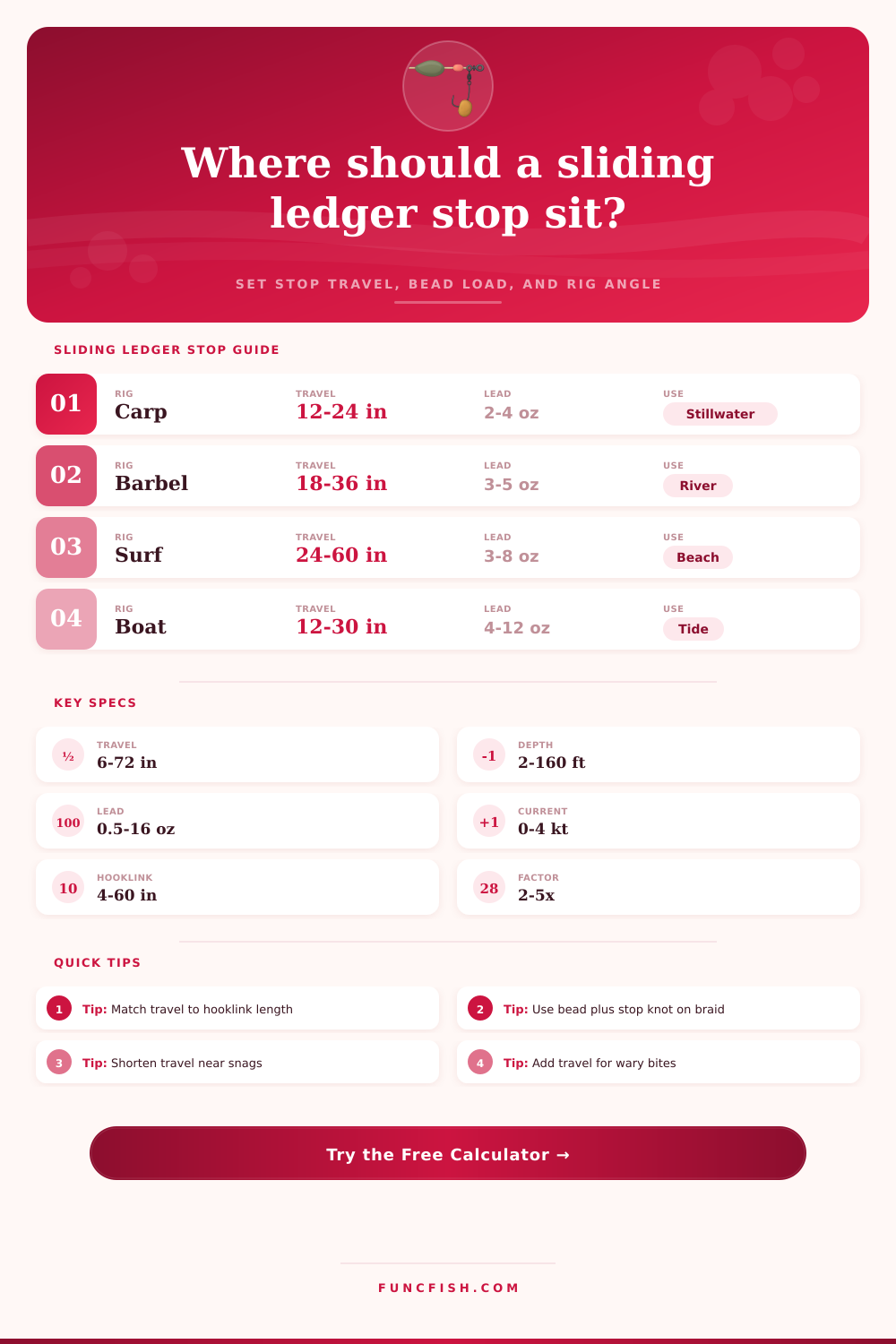
| Stillwater carp on clean gravel | 14-28 in / 36-71 cm | 1.0x to 1.5x | 2-4 oz / 57-113 g | Longer for shy bites, shorter for bolt-style indication. |
| Tench or bream over silt | 18-36 in / 46-91 cm | 1.2x to 1.8x | 1-3 oz / 28-85 g | Add clearance so the slider does not bury into soft bottom. |
| River barbel in moderate current | 24-42 in / 61-107 cm | 1.3x to 2.0x | 3-6 oz / 85-170 g | Current belly adds resistance before the fish reaches the stop. |
| Surf fish-finder with rolling wash | 30-60 in / 76-152 cm | 1.5x to 2.5x | 3-8 oz / 85-227 g | Use longer travel for wave surge and bait movement. |
| Anchored boat ledger in tide | 16-36 in / 41-91 cm | 1.0x to 1.8x | 4-12 oz / 113-340 g | Stop load rises quickly when tide pressure hits the main line. |
| Rough ground cod or ray rig | 12-30 in / 30-76 cm | 0.8x to 1.5x | 5-12 oz / 142-340 g | Keep travel controlled so the sinker cannot lodge far from the bait. |
🧵Main line and stop compatibility
| Line or leader | Typical diameter | Stop method | Load caution | Ledger use |
|---|---|---|---|---|
| 10-15 lb mono | 0.30-0.37 mm | Rubber stop plus bead | Use soft beads to protect knots | Light stillwater, perch, bream |
| 20-25 lb mono or fluoro | 0.45-0.50 mm | Bead against swivel eye | Check stop after hard casting | Carp, pike, inshore ledger |
| 20-30 lb braid | 0.23-0.28 mm | Stop knot plus hard bead | Braid can cut soft stops | Distance casting, river touch ledger |
| 50-60 lb shock leader | 0.36-0.80 mm | Heavy bead and crimp sleeve | Match bead bore to leader | Surf, boat, rough ground |
| 80 lb mono leader | 1.00 mm | Large bead or crimped stop | High lead shock needs 5x margin | Catfish, rays, heavy tide |
📐Formula reference table
| Calculated item | Core formula | What increases it | What reduces it |
|---|---|---|---|
| Stop position | Hooklink clearance + angle allowance + condition correction | Long hooklinks, current, surf wash | Bolt mode, snags, heavy leads |
| Free-run travel | Stop distance - slider length + planned slack | Low-friction slides, cautious fish | Inline sleeves, high friction sliders |
| Stop load rating | (Lead load + line drag + strike impulse) x safety factor | Large leads, thick line, strong current | Light line, calm water, soft rods |
| Rig angle | atan(horizontal span / vertical span) + current sweep | Long casts, shallow water, tide | Deep drops, close ledgering |
| Clearance margin | Stop distance / hooklink length | Long stop, short hooklink | Long hooklink, short stop |
🐟Species stop-position reference
| Species group | Typical hooklink | Stop travel target | Lead response | Practical note |
|---|---|---|---|---|
| Carp and tench | 8-18 in / 20-46 cm | 12-36 in / 30-91 cm | Free run to semi-fixed | Give shy fish enough travel before resistance. |
| Barbel and chub | 18-36 in / 46-91 cm | 24-42 in / 61-107 cm | Positive stop | Balance current pressure against snag risk. |
| Catfish and rays | 24-60 in / 61-152 cm | 30-72 in / 76-183 cm | Heavy stop load | Use high-rated beads, links, and stop knots. |
| Surf bass and redfish | 18-48 in / 46-122 cm | 30-60 in / 76-152 cm | Long sliding run | Wave surge usually needs extra free-run distance. |
| Pike deadbait | 18-36 in / 46-91 cm | 12-36 in / 30-91 cm | Prompt indication | Keep the stop close enough to detect pickup direction. |
| Cod rough ground | 18-30 in / 46-76 cm | 12-30 in / 30-76 cm | Short controlled run | Shorter stops help keep the lead from wedging. |
💡Stop setting tips
Clearance tip: If the calculated clearance ratio is below 1.0x, the hooklink can fold around the lead before the fish reaches the stop. Shorten the hooklink or move the stop farther from the slider.
Hardware tip: Thin braid and heavy leads can pull through soft rubber stops. Use a stop knot backed by a bead when the required stop rating is near the line class.
These estimates model rig geometry and load for stop placement. Fine-tune by watching bite indication, weed pickup, and whether the slider still runs freely after casting.
Placing your stop bead wrong can be frustrating as you often end up with no line once a carp grabs bait and begins running. It give them enough room to straighten out, unhook themselves and swim free without any lead touching their lip. That’s the beauty of having that friction point for a sliding ledger rig.
With the calculator above, we eliminate the guessing game about where to position that small bit of rubber on your main line. In theory, a sliding ledger sounds like a no brainer but in practice, it’s not quite as easy. Basically, you need weight to allow the line to slide up until the fish pulls hard enough to tighten hook link. At that point, you hope it stops dead to show you there is a bite and let you set the hook.
How to Place Your Stop Bead Correctly
Too near the end of the lead and the fish notice straight away and spits out the bait. If it is too far down the line, you will either wrap the line around the weight or the fish will have time to run into weed before you can set the hook. This page calculates the ‘sweet spot‘. Where the distance from the weight combined with the depth of water and angle of the cast make it likely to work best for you.
Whether you’ve got the tide against you for bass or you’re fishing shy carp on a gravel bar makes a huge difference, these factors all affect how the line sit up. The stop position is not meant to be a fixed setting; rather, it should adjust depending on conditions. First thing to think about is how much friction you have between your run ring and rest of the rig.
If you have a low-friction run ring (i.e., a slide that has little resistance so the lead slides freely), then you can have a greater distance of free run before the stop engages. That’s good if the fish is wary and won’t tolerate any abrupt movement. But if your rig has more resistance, such as a boom slider or fish-finder rig with some drag in the system, that resistance shorten the effective free-run distance by adding friction.
So the calculator factors out those effects of hardware. It accounts for physical size of the bead and the friction coefficient of the line passing through it. Then there’s another wrinkle: the current and the tide. Water flow also pushes your main line up off bottom and changes the angle at which the hooklink connects to slider. So even with a perfectly set slider on that line, it’s angled different as it connects back to the hooklink.
That belly in your line becomes a kind of shock absorber that delays when you’re going to get the bite signal. That means you need additional stop travel to prevent fish from feeling the lead until bait is all the way gone. And that’s where the tool comes into play. It asks how high you hold the rod and how fast current is running. Then, it calculates the angle the rig will have between slider and stop at end of its travel. Too much of an angle, you’ll lack sensitivity. Too little, you risk tangling.
Don’t underestimate line selection When a big fish loads up on the initial bite, or loads up on the hookset or during the fight, thin braid will slice right through those soft rubber stops like a hot knife through butter and delete your stop system in one violent instant. Similarly, thicker monofilament require larger bore beads or else it will heat-up from friction and weaken your line.
The calculator comes with tables of reference that detail safe combinations between line diameters and stop methods. Hard knot stops on fine fluorocarbon can lead to break-offs whereas soft beads on a heavy shock leader could of been a recipe for disaster. Match your hardware to the line strength and know that the stop will hold when you need it most.
So really, where do you put your stop? It’s all about the story you want to tell from the moment the fish takes the bait until she gets away. When does the fish know there is something at the business end of her line? How do you make sure he knows there is a player in the game before he turns toward the boat? Right. If you get it right, the fight takes care of itself; the resistance sets the hook, and the fish doesn’t even realize what has happened. Wrong answer and you’re simply dangling some free bait attached to a length of string.
The formula provides a baseline rooted in both the physics and the geometry of your rig, but your feel and your eyes will refine the final placement. Watch for local hang-ups and how the fish bite on the tip of your rod. Keep in mind that one thing never changes. You want the fish to run just long enough to show what he’s doing then stop him cold before he comes off the reel. That balance of freedom and control is what transforms a close call into a keepable fish.