Spod Rocket Fill Calculator
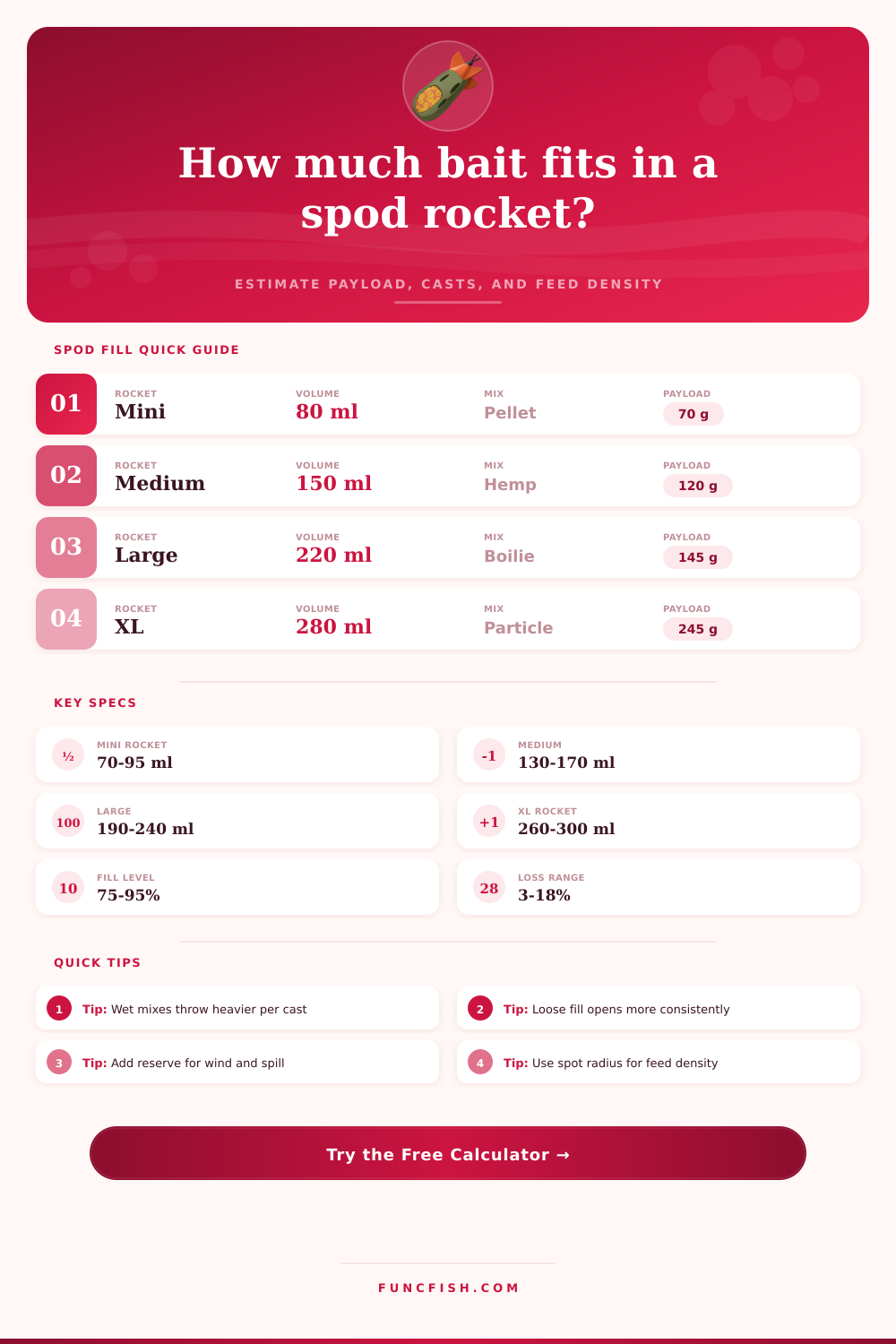
Estimate spod rocket payload, bait to prepare, casts needed, and spot feed density from rocket size, bait mix density, fill level, packing pressure, and casting loss.
🎯Session Presets
⚙Fill Inputs
Spod Fill Results
📊Rocket Capacity Grid
📋Rocket Size Reference
| Rocket type | Typical volume | Best fill range | Use case |
|---|---|---|---|
| Mini rocket | 70-95 ml / 4.3-5.8 cu in | 80-95% | Canal, close range, low feed |
| Small rocket | 100-125 ml / 6.1-7.6 cu in | 80-92% | Margin spots and short range carp |
| Medium rocket | 140-175 ml / 8.5-10.7 cu in | 78-90% | General spod rod baiting |
| Large rocket | 200-245 ml / 12.2-14.9 cu in | 75-88% | Open water particle or crumb beds |
| XL rocket | 260-300 ml / 15.9-18.3 cu in | 72-85% | Heavy feed when rod and range allow |
🌱Bait Mix Density Reference
| Bait mix | Wet bulk density | Release character | Calculator note |
|---|---|---|---|
| Cooked hemp and small seed | 0.82 g/ml / 13.4 oz/pint | Fast scatter | Good density for repeated carp baiting |
| Damp micro pellet | 0.70 g/ml / 11.5 oz/pint | Medium breakdown | Swells slightly after soaking |
| Damp groundbait crumb | 0.55 g/ml / 9.0 oz/pint | Cloud and crumb | Compresses more than particles |
| Crushed boilie and crumb | 0.62 g/ml / 10.2 oz/pint | Patchy food signals | Variable by crumb size |
| Sweetcorn particle blend | 0.88 g/ml / 14.4 oz/pint | Visible food items | Heavy wet load in large rockets |
| Cloudy zig soup mix | 0.46 g/ml / 7.5 oz/pint | High leakage cloud | Light payload, higher splash loss |
🐟Species And Feed Comparison
| Target | Typical starting feed | Rocket choice | Spot density cue |
|---|---|---|---|
| Carp on open gravel | 1.5-4.0 kg / 3.3-8.8 lb | Medium to large | 120-350 g/m² for a defined patch |
| Bream shoal | 2.0-5.0 kg / 4.4-11.0 lb | Large groundbait rocket | Broader cloud, lower precision needed |
| Tench near weed | 0.6-2.0 kg / 1.3-4.4 lb | Small to medium | Keep radius tight along the weed line |
| Chub on river glide | 0.3-1.2 kg / 0.7-2.6 lb | Mini or small | Account for drift before it settles |
| Winter carp | 0.25-1.0 kg / 0.6-2.2 lb | Mini to medium | Low casts, low loss, high accuracy |
⚖Fill Method Matching Table
| Fill style | Capacity factor | Release reliability | Best bait types |
|---|---|---|---|
| Loose fill | 0.94x mass | Very high | Groundbait, zig cloud, chopped boilie |
| Normal thumb level | 1.00x mass | High | Hemp, pellet, corn, mixed particle |
| Firm packed | 1.08x mass | Medium | Groundbait, damp pellet, sticky crumb |
| Over-wet loose | Use wet drain state | Medium | Cloud mix, soup, fine crumb |
| Particle heavy | Use wet density | High if drained | Hemp, maize, tiger nut, corn |
💡Calculation Tips
The calculator uses bulk wet densities and practical fill factors. Actual payload varies with rocket shape, bait cut size, water retention, and how consistently each rocket is filled.
How precise is your spod? Do you make the carp scatter all over a weed bed or focus on a small area for feeding? Is your rocket packed to tightly? Does that affect its aerodynamic properties and weight distribution? That will alter trajectory and what lands there won’t be near where you want.
One mate uses wet groundbait and another uses dry pellets, but both has the same volume despite having different densities. It is about having right amount of bait where fish need it, not how full your spods look. After selecting type of bait and size of rocket, the calculator spits out the rest.
Why Bait Weight Matters More Than Volume
Most people will estimate volume simply by seeing how far they can fill cylinder before it appears full. But this isn’t an accurate way to measure weight if you’re mixing multiple types of baits. One hundred milliliters of soaked corn is heavier then one-hundred milliliters of crushed boilie. Not only will this affect the rocket’s flight but also how much food gets down to bottom. When trying to create a dense bait bed, knowing payload in grams instead of just visually estimating are important.
It takes into account bulk density of your particular mix to arrive at that number. The air space at the top of the rocket isn’t due to being lazy, it’s necessary for the mechanics of how the rocket works. When filled to capacity with wet crumb it will build pressure as you cast. Pressure can forces a bait to open prematurely or release unevenly.
According to chart, ideal filling limits are between 75-90% full leaving room for a buffer that helps the bait flow nicely through the chute. With no cushion, the bait adheres to side like wet sand and leaves a messy trail rather than a nice deposit.
The rocket does not deliver one hundred percent of the loaded-in bait. A few particle stick to inside walls of tube, a few others splash on the water’s surface. The wind in air stream also carries away light particles. By entering an expected loss percentage into calculator, you can compensate for all those things.
The loss rate increases dramatically on a windy winter day. You intend to deliver two kilos, however due to wind and splash, you actualy lose ten percent. That leaves your fish with just eighteen hundred grams, and that shortfall accumulates over several sessions. This results in lost bites, since targeted feeding quantity was never reached.
In most fishing situations, it’s not how much you feed the fish; rather, it’s how dense the feeding zone is. If you spread out five kilograms over a wide range, the fish has to search to find food. If you pack two kilograms in a small space, they get a feeding frenzy going. This concept is what the spot radius input helps you visualize. When you double the radius of an area, you quadruple the area covered. This greatly decreases concentration of baits.
You can be thinking you’re loading up on them while your bucket runs dry. But all the fish see are a few scattered crumbs. Keeping your radius tight focuses the food signal in one place and makes the signal strong.
Winter fishing is not the same as summer sessions. Slow metabolism, cold water and over feeding could of been a huge mistake. Tempting the wary carp is often done better with a light pellet mix on a mini rocket. Heavy-feeding in four degree water with an XL rocket typically repel fish instead of attracting them.
The tools preset will quickly adjust to those conditions. It helps you transition to cold water efficiency or flip a switch to go full-on high volume feed for your summer bream sessions.
The physics of spodding are simple. The current and the wind aren’t going to be controllable factors. What you put in tube is something that you will have to control. If you know your mix’s release characteristics, as well as weight of your bait, it becomes less guess work and more strategy.
How much bait did you buy at the store? That doesn’t matter to carp. All they care about is what ends up on the bottom. This is the most critical element of this process, mastering the payload.