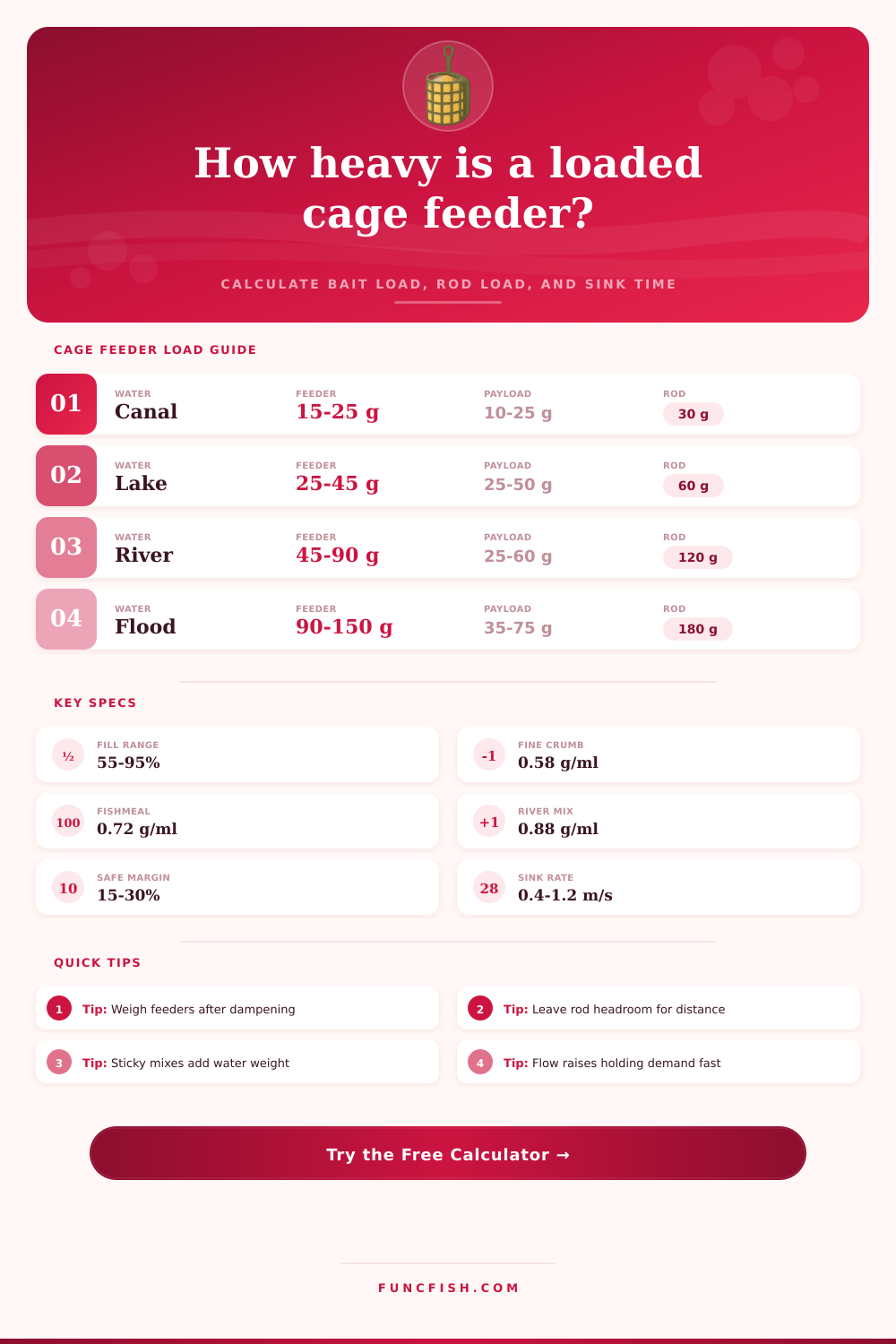
Cage Feeder Load Calculator
Estimate the real loaded weight of a cage feeder, bait payload, rod casting load, flow-holding demand, and sink time before you clip up and cast.
🐟Feeder Fishing Presets
⚙Load Inputs
Use the printed weight stamped on the feeder for empty feeder weight, then estimate volume from the cage capacity or by filling it with water and measuring the water poured out.
Cage Feeder Load Results
📊Current Setup Snapshot
📏Cage Feeder Style Reference
| Feeder type | Typical empty weight | Volume range | Best load use |
|---|---|---|---|
| Micro open cage | 10-20 g | 15-30 ml | short finesse casts |
| Small open cage | 15-30 g | 25-45 ml | canal and light lake work |
| Medium open cage | 30-45 g | 45-75 ml | bream, skimmers, F1s |
| Large river cage | 60-120 g | 55-95 ml | flow holding and big payloads |
| Window cage feeder | 20-60 g | 35-70 ml | controlled release at range |
| Distance bullet cage | 45-90 g | 40-80 ml | long casts with less air drag |
🧪Bait Density And Water Uptake
| Bait mix | Load density | Water uptake | Release pattern |
|---|---|---|---|
| Fine brown crumb | 0.58 g/ml | 12% | fast cloud, light payload |
| Fishmeal groundbait | 0.72 g/ml | 16% | medium bind, steady feed |
| Hemp and caster blend | 0.64 g/ml | 10% | broken feed trail |
| Crushed pellet mix | 0.80 g/ml | 18% | heavy damp payload |
| Sticky river groundbait | 0.88 g/ml | 22% | firm plug for flow |
| Leam and joker carrier | 0.95 g/ml | 20% | dense, slow release |
🎣Species And Gear Comparison Grid
| Target | Normal loaded feeder | Rod rating | Line and tip match |
|---|---|---|---|
| Roach and dace | 20-45 g | 30-45 g | 3-5 lb line, 0.5-1 oz tip |
| Skimmer bream | 45-80 g | 45-75 g | 4-6 lb line, 1-1.5 oz tip |
| Bream shoals | 70-120 g | 60-100 g | 5-8 lb line, 1.5-2 oz tip |
| Commercial carp | 60-110 g | 60-90 g | 6-10 lb line, 1.5-2.5 oz tip |
| Chub in flow | 80-145 g | 90-150 g | 6-10 lb line, 2-4 oz tip |
| Barbel in push | 130-230 g | 120-180 g | 10-15 lb line, 3-5 oz tip |
🌊Flow And Casting Load Reference
| Condition | Flow speed | Load adjustment | Practical cue |
|---|---|---|---|
| Still or canal | 0-0.10 m/s | base load | feeder settles almost vertical |
| Gentle tow | 0.10-0.25 m/s | add 5-10% | line slowly bows downstream |
| Steady river | 0.25-0.45 m/s | add 15-25% | tip pulls into a firm curve |
| Pushy river | 0.45-0.70 m/s | add 25-45% | feeder skips if underweighted |
| Floodwater push | 0.70 m/s plus | add 45% plus | large feeders need heavy rods |
💡Calculation Tips
You’re fishing a current seam, casting out with your swim, and your feeder lands on the water, yet never sinks. Instead, it hangs there in current before drifting downstream. The rod tip’s twitching, but not from fish; instead, it’s the water pulling at the bait. That’s what happens when you guess wrong about your weighting. And the calculator up top do the math for you. If you understand why the numbers move, then you’ll know when to make an adjustment if condition change.
For both presentation and payload, this can be critical for feeder fishing. How much weight do I require to make a accurate cast? But how much is too much? Will it overload my rod or spook the fish? The printed weight of empty feeder (i.e. What’s written on packet) isn’t as useful as most anglers think. When packed full of damp groundbait, some feeders that weigh only 30g in their unweighted state could end up weighing 45g once you include the hooklength! This makes a big difference to how rig moves in the water and how well the rod loads at casting time.
Why Feeder Weight Matters
How much do you want it full? How dense do you pack it? Light, fluffy, fine brown crumb create a cloud in the water that the fish follow, but it doesn’t add much weight to the feeder. A stickier river blend with high water absorption can double effective payload. When you choose the bait type you use, the tool compensates for that variation. It knows if you packed pellets heavy, they’ll sink slower and stay put longer then an airy mix of crumb would.
That’s why sometimes you can drift away on a slow moving river and catch them all in still water. You might do this while using same feeder and rod.
Another place where casual fishermen blow big bucks is in rod rating. When you’re throwing a 45-gram feeder on a medium rod rated for sixty, it feels right at thirty meters. But if a gust of wind helps, push that weight out to fifty and you’ll bend the tip beyond recovery. Your rod load percentage is calculated, and you can see if you’re operating inside reasonable safety margins. It factors in increased strain of distance casting that so many anglers forget about until they hear that “snap” sound. Having headroom protects your investment and helps precision as the rod flexes evenly within power zone.
Speed of flow make all the difference. Even a lightweight feeder can hold its position vertically when it’s still. But if you want to add a little tow, then you need just enough to hold your line tight. When flow gets up, the holding power go through the roof. A pushy river may ask for fifty percent more than a canal does to keep from drifting. And that’s not linear. A few inches per second can mean several times heavier feeders and lots more bait to hold them down.
If you miss out, they’ll tire of chasing moving meal. You will miss all those bites while you are constantly tweaking your drift. How long your hooks take to sink is important, but often overlooked. With a rig that has to get 40 seconds on the bottom, there you sit, 40 seconds before you can able to set the hook. Busy swims with wary fish means fast presentations win. The heavier load sinks faster but not when mix is so aerated and/or buoyant. Pressing down on the bait compresses it, making it denser and with fewer air pockets. The feeder then cuts through water more quickly.
“The key is equipping yourself for the conditions. There’s no point taking a light kit to fish for barbel in floodwater. Similarly, there is no point taking heavy tackle on a quiet canal to fish for roach. It all works together; the variables are continually changing. A heavier rod allow larger feeders, which carry more bait, which sinks faster and holds better. If you change one thing and don’t think about the rest of the system, it wouldn’t of worked. Find that sweet spot by working with the tool before you’ve left the bank. Knowing what rig weighs and how it performs helps you spend more time fishing and less time wondering what to do. And that translates into confidence when the bite arrives.”