Olivette Loading Calculator
Balance a float rig by splitting its carrying capacity between the inline olivette, dropper shot, bait allowance, and final antenna trim.
📌Scenario presets
⚙Float loading inputs
Calculated olivette loading
Formula breakdown
🔧Olivette material grid
Lead
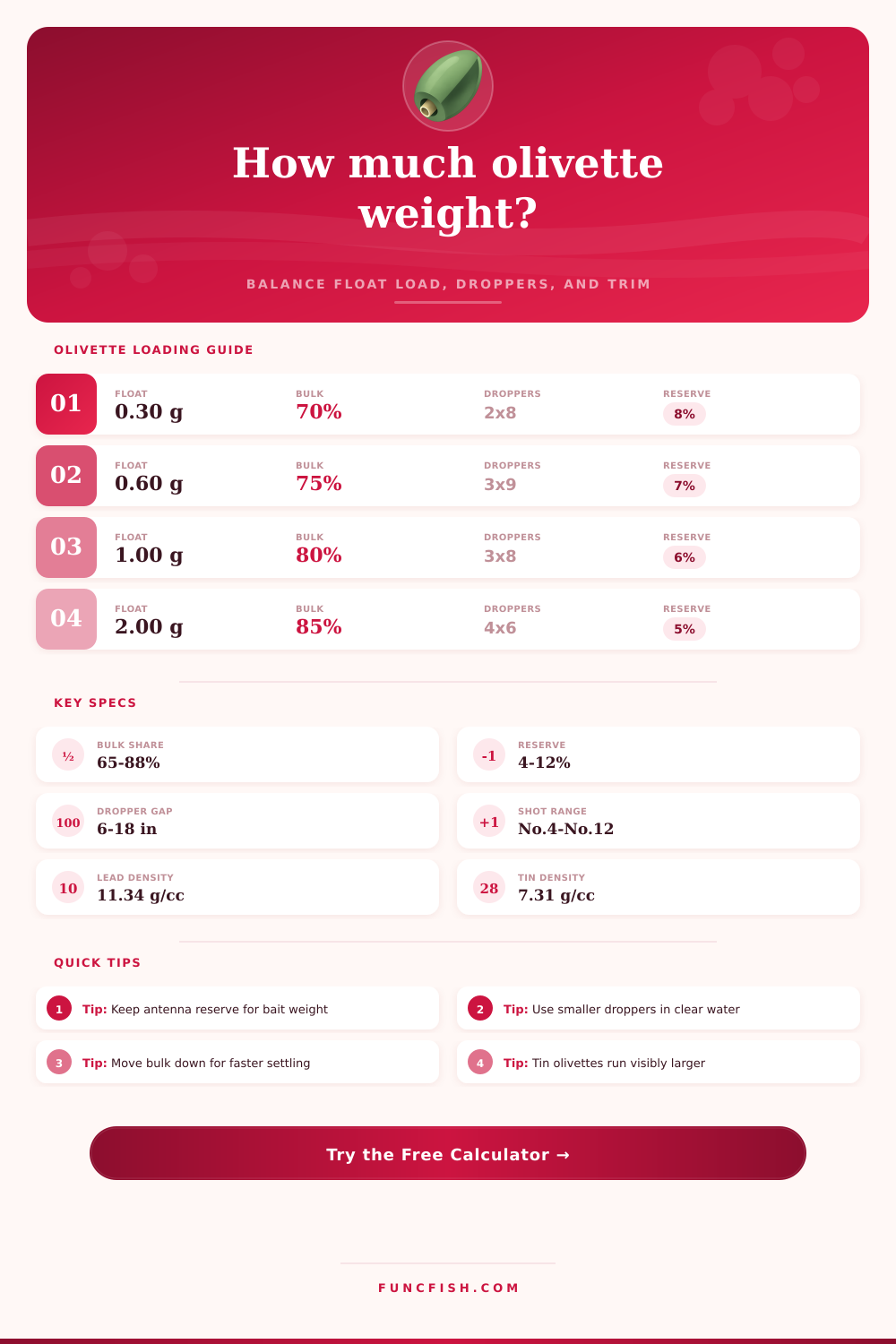
11.34g/cc density. Most compact common olivette; easy to pinch soft shot around the same rig.
Tungsten
17.60g/cc effective density for compact putty or dense sleeves; smallest profile for deep and clear venues.
Tin
7.31g/cc density. Non-toxic choice that needs more length for the same grams and falls slightly softer.
Brass
8.50g/cc average. Durable sliding olivettes, larger than lead but smaller than glass at equal weight.
🎣Gear and species comparison
Canal Roach
0.25-0.60 gUse 65-75% olivette loading with two or three fine droppers for delicate lift and sail-away bites.
Lake Bream
0.80-1.50 gUse 75-85% bulk loading and leave enough trim reserve for larger baits and a settled float tip.
River Roach
1.00-2.50 gUse a positive compact bulk with heavier droppers when flow needs the hook bait to reach depth cleanly.
Margin Carp
0.40-1.00 gKeep a stronger reserve and fewer droppers so the rig stays stable around paste, corn, or pellet.
📊Reference tables
| UK shot size | Approx weight | Ounces | Best use near olivette |
|---|---|---|---|
| No.13 | 0.010 g | 0.00035 oz | Final antenna trim on tiny floats |
| No.12 | 0.015 g | 0.00053 oz | Very fine spread droppers |
| No.11 | 0.025 g | 0.00088 oz | Canal dropper and micro adjustment |
| No.10 | 0.040 g | 0.00141 oz | Light droppers below a small olivette |
| No.9 | 0.055 g | 0.00194 oz | Standard skimmer and roach droppers |
| No.8 | 0.070 g | 0.00247 oz | Positive dropper for bream and F1 rigs |
| No.7 | 0.090 g | 0.00317 oz | Deep water or towing presentation |
| No.6 | 0.120 g | 0.00423 oz | Strong droppers under a large bulk |
| No.4 | 0.200 g | 0.00705 oz | Heavy trimming and fast river rigs |
| Float capacity | Typical olivette share | Dropper plan | Reserve target |
|---|---|---|---|
| 0.20-0.35 g | 55-70% | 2-4 x No.11-No.13 | 8-12% |
| 0.40-0.75 g | 65-78% | 2-4 x No.9-No.11 | 6-10% |
| 0.80-1.25 g | 72-84% | 3-5 x No.7-No.10 | 5-8% |
| 1.50-2.50 g | 78-88% | 3-6 x No.4-No.8 | 4-7% |
| 3.00 g plus | 82-90% | 4-8 larger droppers | 4-6% |
| Presentation | Bulk above hook | Line diameter | Loading note |
|---|---|---|---|
| Strung out shallow | 45-90 cm | 0.08-0.12 mm | Reduce olivette share and use more small droppers |
| Canal deck rig | 25-45 cm | 0.10-0.14 mm | Keep a modest reserve for tow and fine bites |
| Lake skimmer | 20-40 cm | 0.12-0.16 mm | Use compact bulk with two tell-tale droppers |
| Deep bream | 15-35 cm | 0.14-0.18 mm | Increase olivette share to speed the rig down |
| River running line | 10-30 cm | 0.14-0.20 mm | Use positive loading and heavier droppers |
| Material | Density | Volume for 1 g | Practical effect |
|---|---|---|---|
| Tungsten | 17.60 g/cc | 0.057 cc | Shortest, most compact bulk profile |
| Lead | 11.34 g/cc | 0.088 cc | Compact, common, easy to fine tune |
| Brass | 8.50 g/cc | 0.118 cc | Medium profile and durable sliding body |
| Tin | 7.31 g/cc | 0.137 cc | Larger non-toxic option for the same load |
| Glass | 2.50 g/cc | 0.400 cc | Very large, slow, visual sliding weight |
💡Practical loading notes
Trim reserve: A small reserve is not wasted capacity. It keeps the antenna from vanishing when a wet bait, tow pressure, or surface film adds extra downward force.
Dropper matching: When the calculated per-dropper weight sits between shot sizes, use the lighter size and finish the float with one micro trimming shot above the olivette.
The biggest errors in float fishing aren’t made out on the water; they are made at the shoreline as we try to adjust our line with shot. The line is too light so it floats away in the breeze or it’s too heavy so it crashes down onto surface and startle fish. The trick is finding a balance between how much bulk weight you have on your hook and how much extra you have for adjustment.
Once you know what style of presentation you are using and how big a float you’re running, the olivette loading calculator does all the math for you. That means no more guessing whether to use weight inline or spread out between little shot. Because rigging weight up front alter how it behaves in the water.
How to Get Your Fishing Line Weight Right
If you want the bait to dive fast and land on its nose with a clean presentation like in a strong current or fishing deep bream, use a compact bulk near the hook. For a more natural slow fall and drift that lures wary roach in still water, spread weight down to small droppers.
This is where the antenna reserve comes in. And no, it’s not wasting space. Instead, it is your reserve to deal with things like surface tension and wet baits. If you don’t have some of this reserve, then your float get wonky and will end up going into the water too much. You need enough so that you can visibly see what that reserved piece of antenna looks like on your float while still having something to visually reference. Keep that in mind when trimming your floats. The calculator suggest a range between four and 12 percent. So there is margin left for sensitivity but not fragility.
Action also comes from material selection. The standard is lead due to its density and malleability. If fishing in clearer water you may consider tungsten, which provides the same weight in a smaller package. As it falls, the smaller profile are less threatening. Olivettes made of tin are bigger for equivalent weight. This means they sink slower with added drag. Drag can be enough to keep a bait in strike zone longer on a slow drift. The density decide volume and visual impact as seen in the reference table.
Take for instance fishing for roach in a canal. With that light float and many tiny shot sizes you are going for something dainty. Should you use winter time skimmers on a lake? The calculator might tell you more olivetts would of be better. That will concentrate weight and get the rig down fast. Then it will match the inertia of the rig to the resistance of the environment to keep the bait buried on bottom before the current drives it up.
The other key output is settling time. A rig that settles in two seconds may appear unnatural and draw some suspicion while a rig that take ten seconds to get to depth will cost you missed bites as the fish have dropped the slow-moving bait. This is estimated by where bulk is placed and what line diameter is used. A compact bulk makes the bait fall faster. Heavier line drags more water, which slows things down too. Fine mainline affects both your sensitivity and how your terminal tackle act.
Load up precisely. Precision leads to confidence in the bite. Knowing exactly how much weight loads the float let you read every twitch without guesswork. No more thinking “was that a fish or did I just load it wrong?” Dial in the bulk first, and then perfect the droppers for the last few inches. Leave some slack for the bait and let the rig do the work.
Often, the difference between filling the boat and coming home empty-handed is decided based off before you even cast your line.