Hair Length By Bait Calculator
Calculate finished hair length from bait size, bait stack, hook gape, stop allowance, rig style, material stretch, and pressure so the hook point has room to turn.
📌Hair Rig Presets
⚙Bait, Hook, And Hair Inputs
Hair Length Results
🎣Hair Rig Reference Grid
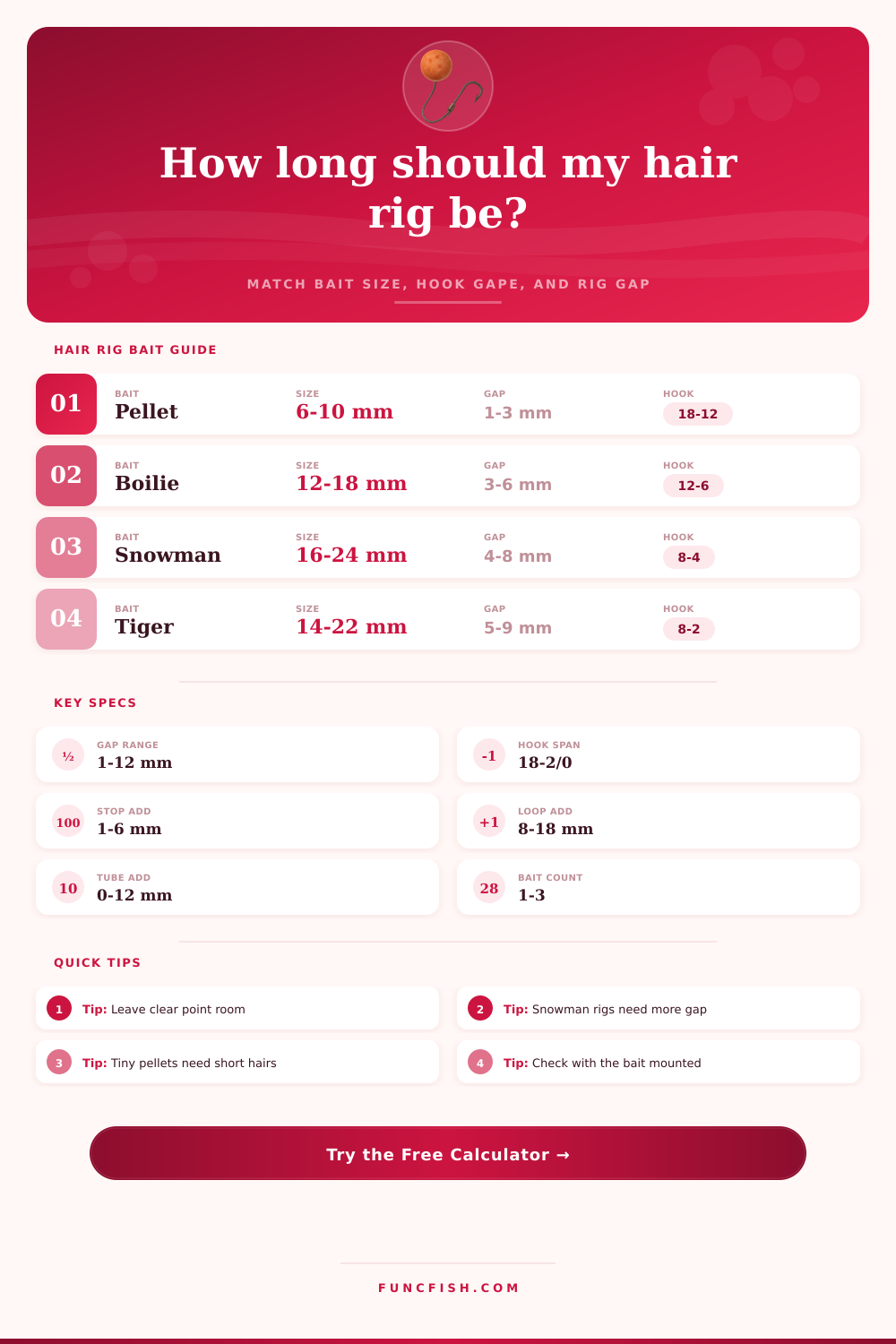
📏Bait Size To Hair Gap Table
| Bait presentation | Typical bait size | Starting hair gap | Common hook range | Adjustment note |
|---|---|---|---|---|
| Micro pellet on band | 4-6 mm | 1-2 mm | #20 to #16 | Keep it short so the pellet stays tight to the bend. |
| Banded hard pellet | 6-10 mm | 1.5-3 mm | #18 to #12 | Increase gap only if the point is masked. |
| Single bottom boilie | 12-18 mm | 3-6 mm | #10 to #6 | Match gap to hook gape and bait hardness. |
| Wafter or balanced bait | 10-18 mm | 2.5-6 mm | #10 to #6 | Use a moderate gap to keep the bait close but mobile. |
| Snowman stack | 16-24 mm | 4-8 mm | #8 to #4 | Allow more room because the stack is taller. |
| Tiger nut or maize stack | 14-24 mm | 5-9 mm | #8 to #2 | Hard particles often need a wider turning gap. |
| Chod or hinged pop-up | 12-20 mm | 5-12 mm | #8 to #4 | Stiff sections need space to reset and rotate. |
⚓Hook Gape And Bait Clearance Table
| Hook size | Typical gape | Best bait width | Hair exit zone | Rig use |
|---|---|---|---|---|
| #18 | 4.5 mm | 4-6 mm | Near bend | Small pellet, corn skin, F1 work |
| #16 | 5.5 mm | 5-8 mm | Near bend | Pellet, maggot clip, tiny wafter |
| #14 | 6.8 mm | 7-10 mm | Bend to low shank | Commercial pellet and small method bait |
| #12 | 8.2 mm | 9-12 mm | Low shank | Feeder pellet, corn pair, mini boilie |
| #10 | 10.0 mm | 10-14 mm | Low shank | Method feeder and 12 mm boilie |
| #8 | 12.5 mm | 12-16 mm | Shank or ring | Standard carp bottom bait |
| #6 | 15.5 mm | 15-20 mm | Shank or blowback ring | Carp boilie, wafter, snowman |
| #4 | 19.0 mm | 18-24 mm | Ring or D-rig | Big carp, tiger nut, large snowman |
| #2 | 24.0 mm | 22-32 mm | Ring or swivel | Large particle stacks and heavy bait |
🧵Hair Material Comparison
| Material | Stretch allowance | Stiffness effect | Best use | Calculator behavior |
|---|---|---|---|---|
| Soft braid | Low | Very supple | Bottom bait, pellet, snowman | Uses natural gap and minimal cut correction. |
| Coated braid stripped hair | Low-medium | Controlled hinge | Method and carp rigs | Adds small allowance for coating transition. |
| Fluorocarbon hair | Low | Stiff | Clear water, D-rig, pop-up | Adds clearance so the bait does not lock the hook. |
| Nylon mono hair | Medium | Springy | Light feeder, corn, particle | Adds stretch and stop-knot allowance. |
| Stiff boom or chod filament | Very low | Very stiff | Chod, hinged stiff, pop-up | Raises the suggested gap and cut tag. |
| Latex bait band | High | Elastic | Pellet and dumbbell hookbaits | Subtracts loaded stretch from finished length. |
| Silicone or bait floss | Medium | Soft but grippy | Pop-ups, tiger nuts, flossed bait | Adds tag allowance for trimming and stop security. |
💡Calculation Tips
Formula notes: finished hair length equals bait stack length plus stop allowance plus target gap, adjusted by hair exit offset. Cut tag adds loop, knotless-knot, tube, and material allowances, then compensates for stretch or stiffness.
Missing a fish is the costliest error in carp fishing. But that’s not why we’re here. Catching one, only to feel the hook come off backwards before it ever gets set; now that’s a heartbreaker, and more often than not it stems from one seemingly random variable: hair length. Is yours a tangle of rubber and braid? Or is it a finely tuned surgical tool?
This calculator do all the complex math of material stretch, gape and stack height so you don’t have to do slide-rule calculus on the bank. Enter bait size, hook gape, pressure variables, and it calculates an estimated final hair length for a starting point based off reality, not assumptions.
How to Pick the Right Hair Length
There is a gap. That’s the deal with the gap; give the hook room to turn over. Too near the bend, the bait hides the point as the fish inhales. Too far and the hair becomes a lever, which straightens prior to engagement of the hook. The gap should of be just enough so that the shank pivots on the hook.
The tool accounts for loop knots and stop allowances that will eat up millimeters you’d otherwise disregard. Tight floss tags can gobble up three to five millimeters of effective length. Dumbbell stops can do likewise. Don’t account for that and you’re rigging something shorter then you believe.
The other half of the equation is that different line materials acts differently under tension. Stiff filament-style booms needs more room to hinge correctly than softer braids do; soft braids hang nicely and take up less space without locking into place. Stretchy nylon like some fishing lines (i.e. Unlike Fluorocarbon can stretch a lot when pulled hard by a surging fish, which effectively makes it longer during the critical moment. Fluorocarbon) can expand substantialy when pulled hard by a surging fish; which in effect gives it longer hair during the critical moment. Fluorocarbon doesn’t bend around small baits well but holds position.
The calculator adds to its suggestions depending upon what material you choose. Do you pick a soft braid? It will add more allowance for lockup. A stiffer boom section? It will add allowance for lack of flexibility. A perfect rig made with soft braid may be a miserable failure if you don’t factor in the diminished flexibility.
And then there are multiple baits; stacking them adds another complication. Two boilies stacked side-by-side do not constitute a snowman presentation. It is actualy a longer bait with a larger diameter. It is also taller, hangs higher off the bottom, and needs more room to the sides to spin freely without snagging on the shank. Because round baits sort-of nest one inside the other, the tool considers both bait count and overlap, which results in a smaller overall stack than if you simply added their individual diameters. And that little difference makes a big difference when you need to fit a double snowman onto a size eight hook and don’t want to choke it down on the point.
The rest is dictated by pressure conditions. Shorter hairs works best on clear water, keeping your bait tight to the hook bend. Long hair are needed on weedy lakes where you need to give the rig a bit of room to come free and reset after coming over heavy cover. The last adjustment is the fish pressure setting to move the final recommendation out to the safety margins in rough cover. This little tweak help prevent the snag that leads to losing the hook instead of the fish.
Most anglers typically begin with a pre-set and tweak the setup accordingly. Something like a tiger nut stack require significant space, but a micro pellet on a fine hook requires hardly any at all. For such situations, the reference tables offers a starting point to plot bait size against recommended gap. Think of them as anchors rather than hard-and-fast rules.
Remember that each hook model is shaped a little different. Each bait is also different, as its shape and density vary. Rig ’em up on terra firma first. Before casting, insert a finger into the mouth of the bait and press down. A free-turning hook should happen in two seconds or less. Shorten the hair if not, or go back to your stop bulk adjustment.
No amount of math can replicate this sense of touch. The math is your starting point. Your eyes and fingertips are the proofreaders for the final product. Right here matter because landing the fish makes the difference between a lost opportunity and a good catch.