Balanced Wafter Weight Calculator
Estimate how much hook, putty, shot, or extra buoyancy is needed to make a carp wafter sit neutral, slow-sinking, or slightly positive.
🎯Rig presets
⚙Wafter balance inputs
Balanced wafter result
Calculation breakdown
📊Hook and trim reference
🧪Bait buoyancy comparison
Factory wafter
0.78-0.92Estimated density range in grams per cubic centimeter after a short soak.
Corkball pop-up
0.25-0.45Very buoyant; usually needs hook weight plus extra putty or shot.
Dense boilie
1.05-1.18Often sinks without extra trim unless paired with cork or foam.
Plastic corn
0.35-0.70Depends heavily on foam content, air cavity, and hook attachment.
📐Balanced wafter sizing table
| Bait setup | Typical hook | Starting trim | Balance target | Best use |
|---|---|---|---|---|
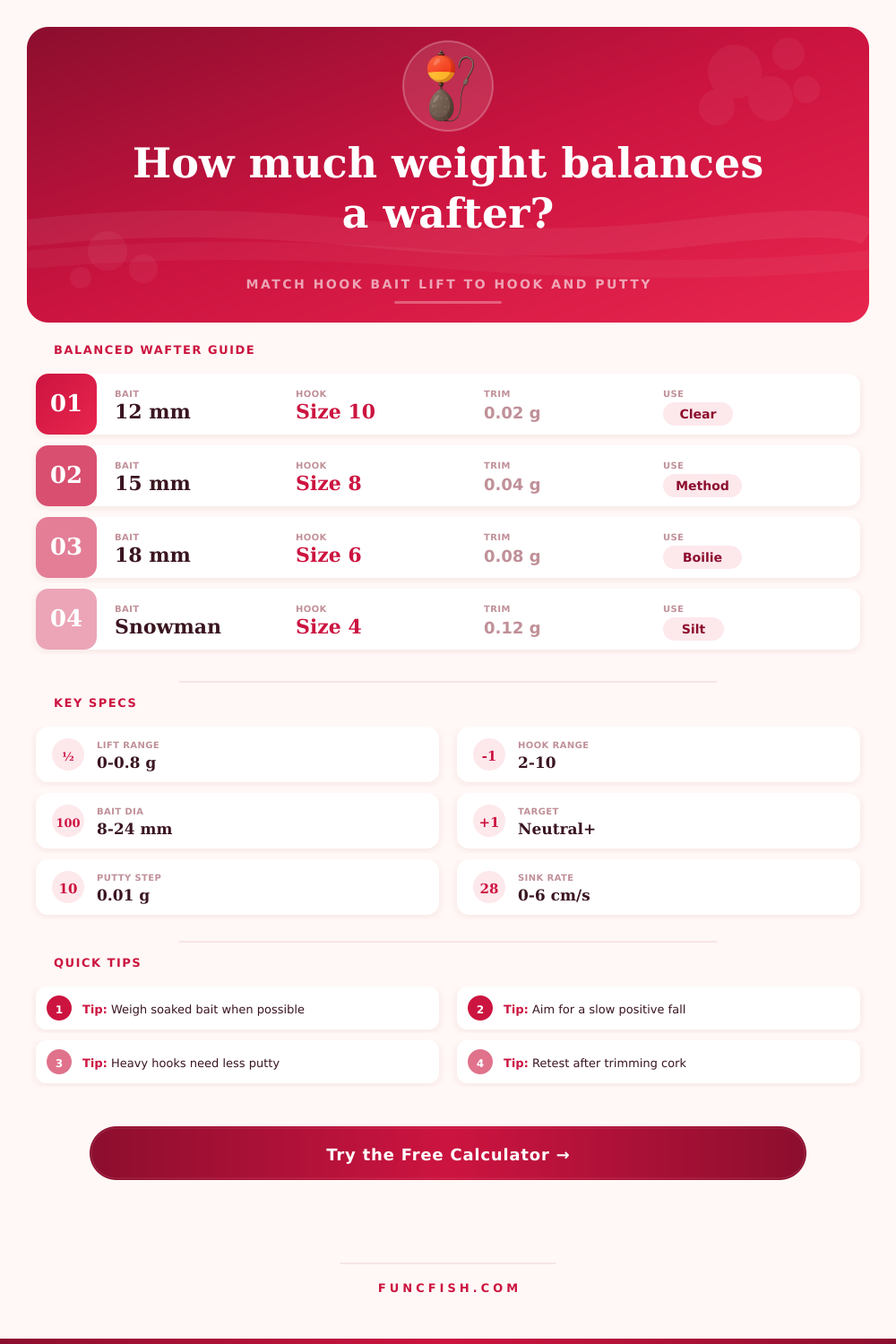
| 10-12 mm mini wafter | Size 10 fine to medium wire | 0.00-0.03 g putty | Neutral to feather fall | Clear water, pressured carp, winter bites |
| 12-15 mm standard wafter | Size 8 medium wire | 0.02-0.06 g putty | Slow sink with hook reset | Method feeder, lead clip, short braided hair |
| 15-18 mm barrel or boilie | Size 6 medium to heavy wire | 0.04-0.12 g putty | Positive slow sink | Bottom bait look with easier inhalation |
| Snowman with pop-up topper | Size 4 or 6 heavy wire | 0.08-0.20 g putty | Slightly positive bottom contact | Silt, debris, or larger carp presentations |
| Chod or hinge pop-up | Size 4 to 6 chod hook | 0.12-0.35 g putty | Pop-up pinned above swivel | Weed, silt, and helicopter arrangements |
🐟Species and rig matching
| Target | Hook bait | Hook range | Trim style | Balance note |
|---|---|---|---|---|
| Pressured carp | 10-15 mm wafter | Size 8-10 | Neutral or feather fall | Use just enough downforce for hook to settle. |
| Big lake carp | 15-20 mm boilie wafter | Size 4-6 | Positive slow sink | Heavier hook usually supplies most trim. |
| Method feeder carp | Dumbbell or pellet wafter | Size 8-10 | Standard slow sink | Short hair and bait band add small weight. |
| Silty venue carp | Snowman or cork-dust bait | Size 4-6 | Lightly positive | Avoid burying the bait by over-weighting it. |
| River carp | Dense wafter or tiger stack | Size 4-6 | Firm bottom pin-down | Undertow needs extra positive downforce. |
🔧Trim material equivalents
| Trim material | Approx weight | Adjustment step | When to use | Testing note |
|---|---|---|---|---|
| Tungsten putty smear | 0.01-0.04 g | Very fine | Final tuning around the hooklink knot | Roll thin and retest after it cools. |
| Small putty blob | 0.05-0.12 g | Fine | Wafter or snowman balancing | Pinch off tiny pieces rather than overloading. |
| No. 10 split shot | About 0.04 g | Fixed step | Repeatable trim on supple braid | Use soft shot to avoid damaging hooklink. |
| No. 8 split shot | About 0.06 g | Fixed step | Small wafters needing positive reset | Check that the shot cannot slide to the hook. |
| Trimmed cork plug | Removes lift | Variable | Pop-ups that are far too buoyant | Cut less than planned and retest in water. |
💡Calculation notes
Tank-test the final rig: the calculator estimates volume, displacement, and component weight, but soaked bait, trapped air, and putty shape can move the real balance point.
Use positive downforce sparingly: a balanced wafter normally needs only enough extra weight to turn the hook and settle slowly, not enough to behave like a dense bottom bait.
There’s an element of carp fishing that is closer to engineering than fishing. To get them to bite, you’re playing with their biological instinct, but you also has to understand the way they taste everything you throw to them. This leads us to the wafer bait.
This balanced bait that exists between those two concepts. Biologically speaking, it need to be designed to appear as though it’s resting on the bottom, yet mechanically, it must remain buoyant enough so fish can suck it in without resistance. If you don’t do this perfectly right, one side leaves your bait hovering above substrate while the other buries your hook in silt. This do not help catch fish.
How to Balance Your Bait
To understand the problem, you have to look at mass vs. It is displacement. What’s cool about a wafer is that it’s lighter (less dense) than water so it floats upward to offset weight of hook and whatever extra stuff you add. That’s why balancing scales on the calculator gives you an answer. It calculates what it takes to be balanced (in other words), in equilibrium.
Why does the calculator want to know the size of bait and whether it’s soaked? Because that alters the density. You may think a dried wafer feels lightweight in your fingers, but once it get wet, it’ll pick up water and increase its density when under water. If you don’t account for this difference, your bait will ride too high or sink too deep. And then you break the spell, making it no longer look like a real piece of food floating slowly downward.
Another issue with hooks is weight. Most anglers think an 8 is just an 8. In other words they have no idea that different patterns and wire diameter can make a big difference in how heavy a hook will be. A heavy gauge chod hook can weighs more than a fine wire wafer hook. If you’re looking at getting a slow fall this is important. You want enough weight to pull the hook point down in the body of the bait. So if the carp sneaks up and takes a timid sip he pulls on something not his teeth. Not enough weight can mean the hook doesn’t seat. Too much weight means dragging like a rock, this again makes the fish alarmed.
By toggling options through the different sinking rates up to neutral hover, you can calculate correct balance. If fishing in clear water with good visibility, then a standard slow-sink rate may be your call. Conversely, if you’re in an area of weedy cover or soft silt, you’ll likely need something a bit more positive than zero to help the rig dig into small bits of debris while avoiding hang-ups.
The tool comes equipped with reference tables that offer a place to start. Using a minimum amount of putty, you could pair a size ten hook with a dozen-millimeter wafer, for instance. This will give you a starting point but it’s no hard rule. Each body of water have its own quirks.
The last part is the water conditions. The warmer the water, the less buoyant it is compared to cold water. So for the same volume of bait, the cold water will provide a little bit more lift. This means if you dial in your rig perfectly on a summer day, that same setup may suspend higher and sink slower in colder water. That’s all due to fluid density changing. Trimming material adjusts for changes in environment. Tungsten putty allows you to fine tune the weight without bulking out your trim at all. It is enough to alter how it finally drops but light enough to get super specific with your trims.
You have to test your rig in a tank or bucket first. That’s why we do the math. It will give you a good guess, but things can go wrong. You might put uneven amounts of putty on or get air bubbles caught in your hair rig when you tie the hook. You need to see what happens with your bait settled out in still water.
“You’re looking for it to slowly float down and sit at the depth you desire. If it spins around randomly, then it’s not balanced. With that knowledge, you are able to make adjustments that no computer program can teach you.
So the takeaway is to keep it subtle. And the best is when they don’t notice your presentation until it’s too late. That’s why knowing about water density, buoyancy and weight helps put you back into the driver’s seat on your presentation. It begins with a number. Double check it in the bucket and then let the fish tell you if you nailed it.