Pop Up Buoyancy Offset Calculator
Balance a carp pop-up, snowman, or critically balanced hookbait by estimating bait lift, hook and rig weight, counterweight size, offset position, and sink behavior.
📌Scenario presets
⚙Rig and buoyancy inputs
Pop-up balance result
Enter the rig details to estimate lift, counterweight, offset position, and sink behavior.
Calculation breakdown
📊Pop-up material reference
Standard Pop-Up
Cork Dust
Corkball
Wafter
📋Hook and shot sizing tables
| Hook pattern | Estimated dry weight | Typical pop-up match | Balance note |
|---|---|---|---|
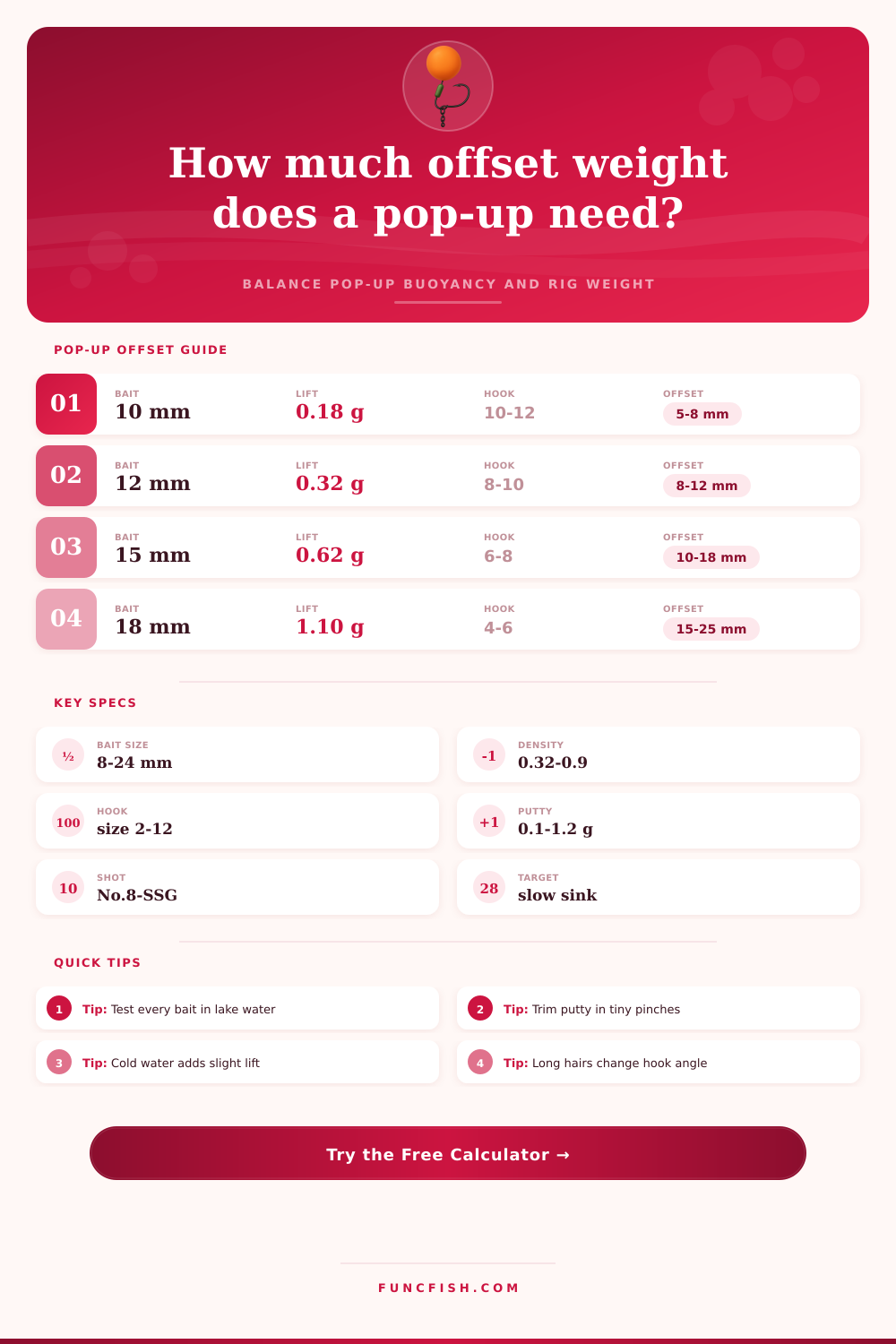
| Size 12 fine wire | 0.035 g / 0.0012 oz | 8-10 mm wafters | Needs very small putty pinches |
| Size 10 fine wire | 0.050 g / 0.0018 oz | 10-12 mm mini pop-ups | Good for winter fine tuning |
| Size 8 curve shank | 0.085 g / 0.0030 oz | 12-14 mm pop-ups | Often balances light wafters alone |
| Size 6 wide gape | 0.125 g / 0.0044 oz | 14-16 mm pop-ups | Common carp pop-up starting point |
| Size 4 wide gape | 0.180 g / 0.0063 oz | 16-18 mm pop-ups | Needs stronger bait lift |
| Size 2 heavy carp | 0.260 g / 0.0092 oz | 18-22 mm corkball baits | Can overpower low-lift baits |
| Counterweight | Nominal weight | Best adjustment use | Practical comment |
|---|---|---|---|
| Tungsten putty pinch | 0.05-1.20 g / 0.002-0.042 oz | Exact balance | Trim in tiny pieces after dunk testing |
| No. 8 split shot | 0.06 g / 0.002 oz | Fine mini rigs | Useful for small wafters and zigs |
| No. 6 split shot | 0.10 g / 0.004 oz | Light pop-ups | Often one or two sizes below BB |
| No. 4 split shot | 0.20 g / 0.007 oz | Standard carp rigs | Good first step for 14-16 mm baits |
| BB split shot | 0.40 g / 0.014 oz | High-lift baits | May be too heavy for critical balance |
| SSG split shot | 1.60 g / 0.056 oz | Oversize buoyant baits | Usually a pinned-down choice |
| Presentation | Target net balance | Offset starting point | When to use |
|---|---|---|---|
| Critically balanced | 0.02-0.08 g sink | 5-12 mm from hook | Clean bottom, cautious carp, close inspection |
| Slow sinking | 0.08-0.18 g sink | 8-18 mm from hook | General pop-up and snowman rigs |
| Hovering above hook | 0.00-0.04 g lift | 12-25 mm from hook | Chod, hinge, low weed, and soft silt |
| Pinned down firmly | 0.20-0.45 g sink | 5-15 mm from hook | Flow, nuisance fish, solid bags, long casts |
| Still slightly buoyant | 0.04-0.12 g lift | 20-60 mm from hook | Zig foam and suspended presentations |
💡Practical balance notes
Dunk test the full rig: The hookbait alone is only half the story. Hook coating, bait floss, swivel rings, shrink tube, putty shape, and soaked bait mass all change the final pop-up offset.
Adjust the smallest part first: If the bait drops too fast, shave putty or move to a smaller shot. If it rises too aggressively, add a tiny putty smear before changing the hook.
So there you are standing at the bank with your hook bait dressed and ready. You drop it in the water and now the pop up is below the bottom bait. It’s going to sit on the bottom, the fish isn’t going to see it. And this is why the whole system needs to work against gravity. Buoyancy shouldn’t be a factor of just foam.
A little change can make big difference. This matters most when making more subtle presentations in pressured waters. When adding counterweight, you can’t ignore the fact that something’s pulling down on hook and you don’t want the pop-up floating by itself. Adding putty or a split shot will try to pin it to bottom, but hair rig doesn’t add much weight. Also, if you add counterweight without taking into consideration where it is in relation to bend in the hook, you’ve created a lever effect that’ll twist the bait sideways.
## Balance Your Bait with This Tool
This calculator will take into account the offset distance between the hook bend and the weight so you won’t have to guess if the way you put your putty down there help or hurts the presentation. It uses the raw diameter of your boilie and then subtracts out any volume from trimming. After that, it figures the rest of the lift based off the drag of the type of hook you’re using.
Now you know why a pop-up has a density of roughly.52 grams per milliliter. This gives your bait a moderate amount of lift, which is about right for most situations. The catch is that you have to be careful when choosing heavier hooks, such as a size six wide gauge hook. Pure cork balls or even cork dust used for high lift pop ups displace much more water than the same amount of weight. This makes them very good at lifting your bait out of the water.
The issue arises that now you want to add much heavier counterweights than before to make sure the bait stays positioned next to hook eye. Adding that counterweight brings back the old balance point, which usually means you’ll have to move your shot further from the hook so the rig doesn’t sit flat when you cast.
Brackish or salt water adds buoyancy because those dissolved minerals make it more dense; cold water is denser than warm, and we have all seen how temperature also adds variables that simple tables don’t totally account for. In other words, your bait will float up a bit more in winter weather, and although that doesn’t seem like much, it’s incredibly important in terms of key balance. Your bait will only hover a couple millimeters off the hook, and a fraction of a gram makes a world of difference than. That perfectly balanced rig for your midsummer lake may be downright loose by fall. However, the tool accounts for that change in environment, so you can adjust your expectations accordingly without ever having to hit water.
Bait stops and swivels add to the sinkdown force but many anglers fall into the trap of only checking the hookbait and not the rest of the hardware weight. On a scale, a size twelve fine wire hook is hardly noticeable. However, at around 0.035 grams, this tiny amount may be enough to tip a critically balanced rig over the edge and see it sink completely.
The reference tables in the tool help you understand how various shot sizes matches certain bait diameters. For example, a ten millimeter wafted boilie might use a number eight split shot, whereas a standard carp pop-up may need a heavier adjustment to stop the bait floating up during the retrieve. The tool gives you a base line for these adjustments.
Calculating provides a starting place from static physics, but the true test comes in water. Lake conditions add dynamic factors. Trapped air within porous baits creates temporary buoyancy, which goes away when the bait absorbs water. Adding hook coatings and flossing introduces additional mass below eye that alters the leverage point, thus we find it helpful to use the calculator output as a guideline not a last word decree.
Take the rig out, trim the putty in small pinchers, dip it in the tank and watch it fall. Does it sink too quickly? Shave some weight off. Does it climb up aggressively? Apply a small dab of putty near eye. This isn’t rocket science. It is not about memorizing equations or weighing gear on a scale. Instead, it is about learning how weight, buoyancy, and distance work together.
If you position the bait exactly where you want it… Centered so that your cast goes straight through to where the hook meets the line; then you’ll know when it’s time to stop tinkering because you trust the system. And you trust the system because you understand the math involved in keeping the bait floating high. You should of known this earlier. So now you don’t waste time wondering if the fish will see it. Instead, you’re spending more time studying the lake and less time re-rigging at the bank.