Ice Fishing Leader Length Calculator
Estimate an ice-fishing leader length, bite clearance, knot allowance, cut length, and material match from species, water clarity, depth, bait size, rig style, current, cover, and line strength.
📌Leader presets
⚙Leader inputs
Leader length plan
Calculated from the current rig settings.
Calculation breakdown
🧵Material data
Fluorocarbon
Mono
Wire
Heavy fluoro
📊Leader length reference
| Ice target | Common leader range | Material starting point | When to lengthen | When to shorten |
|---|---|---|---|---|
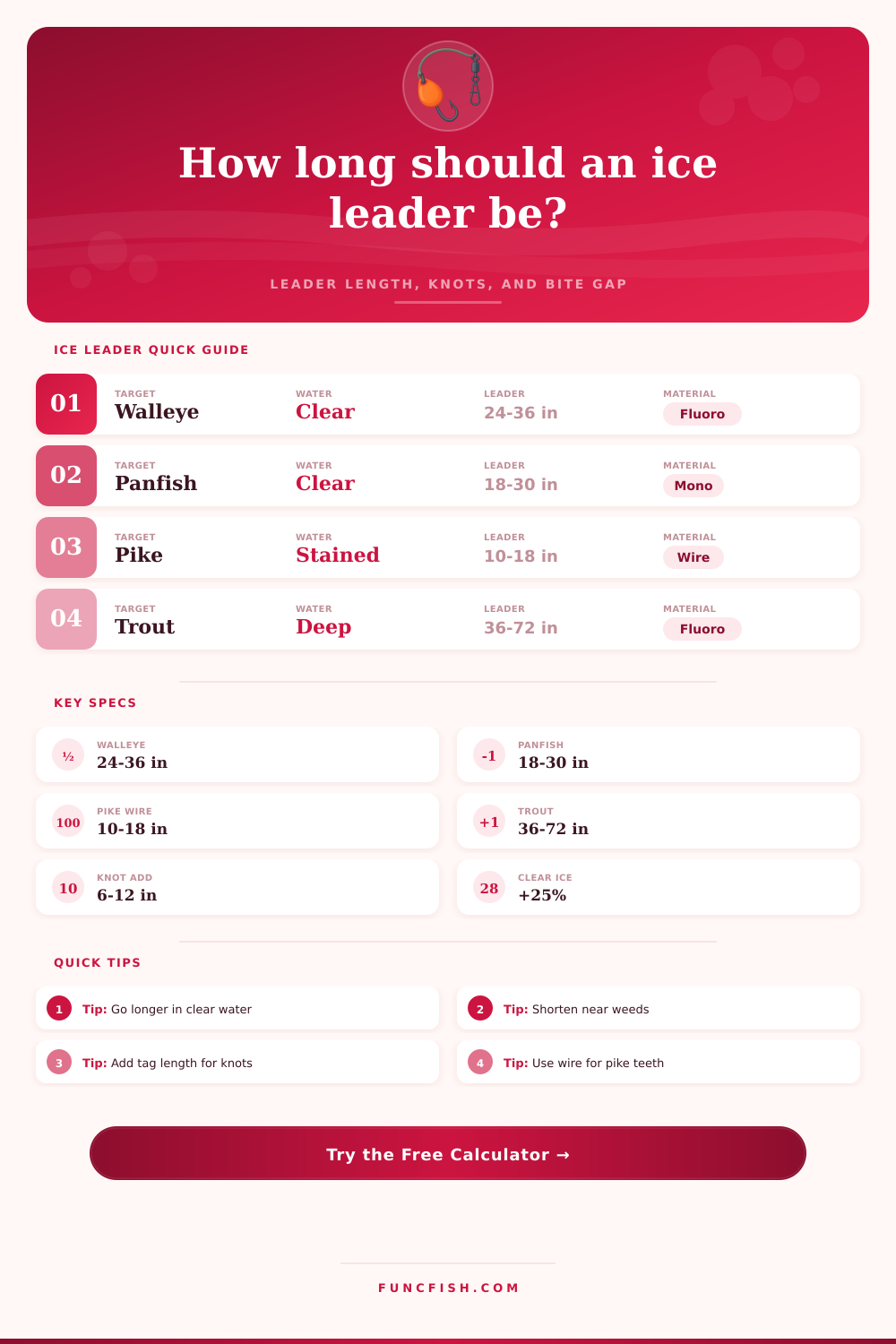
| Walleye jigging | 18-36 in / 46-91 cm | 6-10 lb fluorocarbon | Clear water, braid main line, pressured fish | Rock contact, current, stained water |
| Crappie or perch | 18-42 in / 46-107 cm | 2-5 lb mono, fluoro, or micro tippet | Bright basin fish or tiny tungsten jigs | Weeds, tight shelter, quick rebaiting |
| Pike tip-up | 10-24 in / 25-61 cm | Wire, titanium, or 30-50 lb fluoro | Clear water with heavy fluoro | Quick-strike rigs and big lively suckers |
| Lake trout | 36-84 in / 91-213 cm | 10-20 lb fluorocarbon | Deep clear basins and braid main line | Heavy current, tube jigs near rock |
| Whitefish | 30-72 in / 76-183 cm | 4-8 lb fluorocarbon | Sight-fishing and clear bottom flats | Snaggy mussels or compact dropper rigs |
⚖Rig comparison
| Rig style | Leader role | Typical knot allowance | Bite clearance focus | Calculation note |
|---|---|---|---|---|
| Jig or spoon | Stealth and lure freedom | 6-9 in / 15-23 cm | Separates lure from visible main line | Depth and clarity drive most length changes. |
| Dead-stick minnow | Natural movement below swivel | 8-12 in / 20-30 cm | Keeps bait swimming outside swivel shadow | Bait size and mood add extra leader. |
| Tip-up set | Tooth or stealth section | 9-14 in / 23-36 cm | Protects against teeth and handline visibility | Species reserve and material stiffness matter. |
| Dropper rig | Controls bait branch length | 5-8 in / 13-20 cm | Prevents tangles around spoon or sinker | Current and bait drag shorten the safe branch. |
| Current seam | Reduces line angle and abrasion | 8-12 in / 20-30 cm | Keeps terminal gear away from braid belly | Current factor adds abrasion but caps length. |
| Target and mood | Leader range | Material bias | Hook gap cue | Adjustment priority |
|---|---|---|---|---|
| Negative panfish | 18-30 in | Fine fluoro | #14-#10 | Stealth first |
| Neutral walleye | 24-40 in | 6-10 lb fluoro | #8-#4 | Bait freedom |
| Aggressive trout | 20-36 in | Fluoro or mono | #8-#2 | Fall rate |
| Pike on bait | 12-24 in | Wire or heavy fluoro | #2-2/0 | Tooth margin |
| Deep perch school | 16-28 in | Fine fluoro | #12-#8 | Tangle control |
Leader estimates are planning values. Recheck for nicks, ice abrasion, and lure fouling after fish, snags, or hole-edge contact.
💡Calculation notes
Clear water, braid main line, bright ice, and cautious fish all increase the leader because the terminal connection should sit farther from the bait.
Current, weeds, rock, wire stiffness, and quick-strike rigs shorten the recommendation because long leaders tangle or rub faster under ice.
In January, you punch a hole in thick ice and drop a jig down until it goes slack or taut. When the rod tip tap subtly, you’ve got a bite, but careless knots or braid visibility can spook walleye on clear, sunny days. Because you’re concealing the link between your heavy main line and dainty bait, leader length is not just about strength; it is about stealth. And no need to crouch in a snow-sled shelter guessing numbers; just enter your water clarity, depth and species into the calculator and let it handle the math.
A twenty-four inch fluorocarbon leader for walleye is typical, but most guys just use this because it’s a normal length and has never really thought about how or why it might work. It is long enough that the fish doesn’t really notice your main line, but it is not too long so you can still feel very slight bites. In reality, heavy runoff from snow melt makes water somewhat stained and decreases line visibility. In these conditions, a long leader is just more bulk that can tangle up around weed tops. Also if it’s dark out the fish don’t see your line till it’s in their mouth so you can get away with making your leader much shorter and still have confidence you are getting bit.
How to Choose the Right Leader Length for Ice Fishing
Folks just think of leader length like it’s a fixed thing but it needs to change. Fluorocarbons has a refractive index equal to water, so they are invisible and sink. Monofilament floats. It will stretch to help absorb sudden runs. It may dull bite detection on a sensitive ice rod. • Wire: Trade off = Stealth vs Survival (P.S. Pike have teeth sharp enough to cut through any synthetic fiber. Fluorocarbon sinks, has a refractive index like water, is almost invisible, and is stiff. Monofilament stretches, floats, dulls bite detection, and absorbs sudden runs. It is stiffer than fluorocarbon. The wire whips in the current and sinks fast. Consider turbulence when choosing a length, and make sure the bait’s action is close to its natural fall rate.
When tying a knot, you always want some extra line from where you stop for the final desired length because knots weaken the line at their connection point and also add bulk there. You’ll typically only need an inch or two for an improved clinch or uni knot, but with other knots like a braid-to-fluoro FG knot, it’s a bit tougher and you really need a bunch of working length to get it right. The calculator will give you a cut length based off how much line you think you might need after reties and whatever allowance you want to leave yourself for tying. And it prevents the frustration of going out fishing and finding you’re two inches too short once you’ve hooked into a fish and have to sit there tied up in freezing weather trying to re-tie. Every inch counts when your fingertips is numb.
Surprisingly, leader length is also important due to depth as leaders that are too long can catch on shallow cover like weeds and rocks. Longer leaders may be needed when fishing deeper waters for fish like whitefish or trout. In these spots, it is key to let your bait hit the bottom and sink on its own without being dragged by the mainline above it. The leader’s weight becomes critical there with heavy fluoro adding a large sink rate, great in many scenarios when wanting a fast fall vertically in deep, clear basins. Lighter tippet sinks slower and may spook suspended fish, but can also not get down as fast as desired between short feed windows.
The other dynamic variable static graphs don’t account for is the pull of moving water, which creates an angle between the rod tip and the bait in a V-shape. A longer leader tends to keep terminal gear more vertical near the point where most of the fall occurs. This prevents current from shoving it off to one side, which could cause a snag or pull it away from fish. But heavy current does increase the abrasion factor against structure and rock, sometimes requiring shortening your leader and beefing up to a higher test line for durability purposes. You’re constantly negotiating being able to protect equipment and still have the bait in the strike zone.
In addition to water clarity, weather conditions influence visibility. Clear ice lets in more sunlight, which casts shadows from your lines and lights up any other bits of litter. Snow on top of the hole, or an overcast sky scatters that light, making it darker and providing cover for the fish to safely check things out. That’s why the calculators’ settings adjust according to your chosen clarity, and why you need to go with longer, thinner leaders on a sunny day for greater stealth. On a cloudy day you can get away with going a bit shorter and stouter while still getting plenty of bites.
The key to an ice fishing leader system is adaptation. You have some experience or a good guide to give you a solid base, but you are constantly making changes based off how conditions change during the day. Maybe you lost three fish in an hour because your leader was a little too rigid and didn’t allow for enough lure action. Or maybe you caught two nice fish but snapped them both off on rock bottom because you failed to consider abrasion risk factors. But each lesson perfects the next, and consistency is more important then perfection.
You want a leader setup that allows the fish to find the bait, take the hook set cleanly and hold well enough until it’s through the ice. When those details become second nature, that cold morning will be a productive one and we’ll learn that sometimes, the smallest adjustment would of brought the biggest rewards on a frozen lake.