
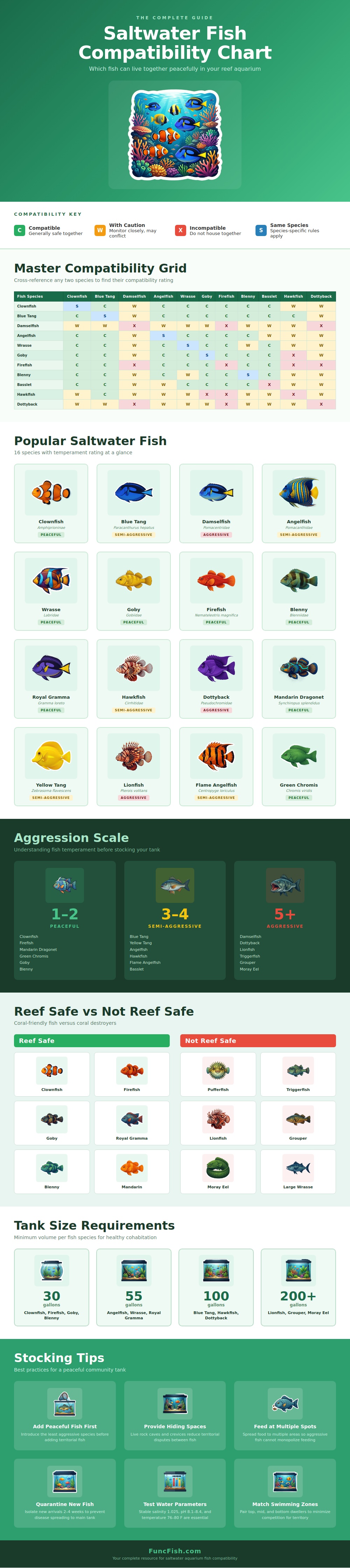
Setting up a saltwater tank involves a balancing act between various fish that has their own personalities and territories. For instance, you want colorful tangs and happy clowns to live in the same tank together without fighting. To prevent stress and/or aggression-related loss of fish, check a compatibility chart to determine which species can lives together in peace.
But it’s more than just preventing confrontations between two species. It’s also making sure everyone feels secure. This way, they feel comfortabley coming out and showing their natural colors instead of hiding in terror. The first point of understanding compatibility is realizing that not all peaceful fish are created equal. Some species is naturally docile. Others may be fairly passive but only up to a point; they’re pretty darn tolerant unless pushed around. This difference is emphasized nicely in an infographic.
How to Choose Fish That Get Along
Clownfish, for instance, are flagged as generally getting along well with most tankmates because once settled in, these guys tend to be on the mellow side. Damselfish, on the other hand, is infamous for being bullies who fiercely protect their rocks. Because of this, they are accompanied by a cautionary red X in the chart. Avoid those red X’s or you risk bringing trouble into your tank from day one. So use the chart to help resist the urge to mix any ol’ colorful thingy with any other colorful thingy. It’ll be a reality check.
Whether an animal is aggressive or not also matter a lot. For example, one fish listed as being semi-aggressive may appear peaceful alone, but can be a problem when combined with other species that is weak swimmers or which share the same swim zone. That’s why I find it useful to look at temperament ratings because they allow me to get a heads up on how certain combinations of tank mates will behave before I buy any one of them.
Blennies and gobies, for instance, tend to hang out along the bottom while leaving middle of water free for mid-dwellers. By mixing the areas up, you’re less likely to create competition for resources and space since each species was naturaly designed to inhabit different portions of the reef. You’re just mimicking this natural segregation in your living room.
There’s also a level of reef safety I’d be careless not to mention so we don’t all forget about it too late. There are some beautiful looking fish that will go into your tank and decimate everything overnight. If you want to keep a mixed species aquarium and still have soft corals in your tank, knowing which ones is going to strip polyps off your corals is important. Triggerfish and puffers has powerful jaws designed specifically for breaking open bivalves. These are horrible tankmates for fragile zoanthids and anemones. The solution? Reef safe fish like royal grammahs or firefish will let you appreciate their beauty while maintaining the ecosystem you’ve worked hard to create. That balance is what makes a healthy tank truly sustainable.
Harmony is also surprisingly related to tank size. Stress leads to aggression. Overcrowding lead to stress, and stress triggers aggression. Even if you keep two species that seem compatible together, a lack of enough space can force them both to claim territory which causes fighting. Larger tanks provides benefits like more room to escape when fish fight and more water to dilute waste. A 30g tank provides far less buffering space different than a 100g tank. This means even semi aggressive angelfish or semi aggressive tangs can roam around without running into one another all the time. Space = cheap insurance against future behavioral problems that could derail your hobby.
Last but not least, order of stock makes all the difference. Introducing most aggressive fish first gives them time to claim tank “ownership” before any other occupants. Later fish adjusts to the pecking order instead of trying to challenge it outright. It’s a very easy approach that reduces resident chasing/bullying due to perceived threat to their “territory”. Provide appropriate hiding places in your rock work and several feeding locations so they don’t have to guard resources, and you’re well on your way to setting up a stable environment over the long term.
If you are patient during the first few weeks, their personalities will settle on their own without interference. If you take the time to learn about these dynamics beforehand, then you’ll have an aquarium that reflects your understanding. You’ll plan for what works and avoid mixing things that don’t. You’ll get an environment that isn’t fighting with itself. Instead, the colors come alive and there is activity everywhere. You can sit back and enjoy the calmness as you watch it all unfold each day.