
A lot of times you put some nice healthy fish into a tank full of clean water, and everything is fine for several weeks. Suddenly you observe your betta’s fins clamped down, his color dulled, and he gasping at the surface. You test the temp, perfect! You test the ammonia, zero. What happened? The answer is often something you can’t see. Your pH changed.
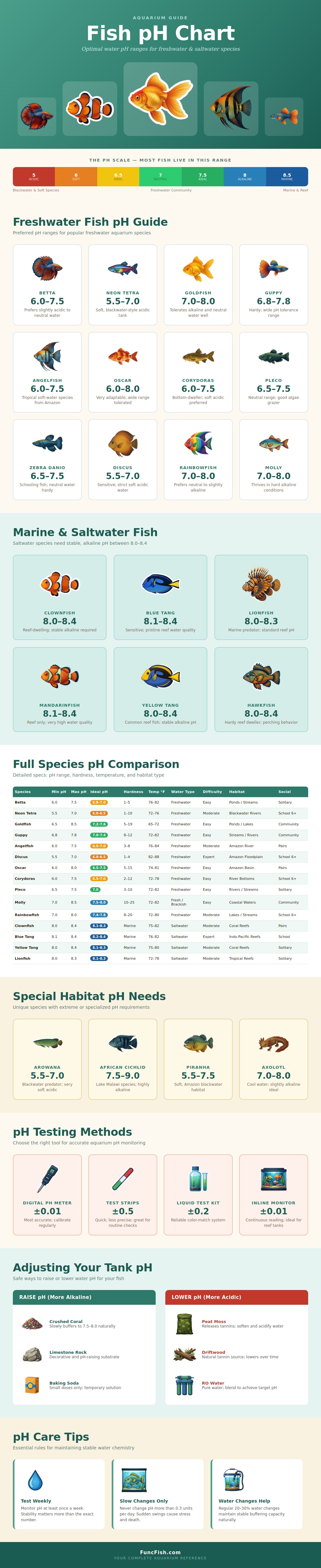
Clarity is a major concern for most new aquarists, and while that’s half the battle, chemistry is the other half. And pH is the headline act. It determine the behavior of all the other chemical parameters in your tank. As you can see in the breakdown of popular species in the chart above, there is a range within a range. And that’s usually a surprise to newbies. There’s no such thing as one-size-fits-all when it comes to freshwater fish. Each species come from very different natural surroundings.
Why Stable Water is Better Than Perfect Water
Some come from soft, acidic blackwater rivers whose substrates and decaying organic matter lower the pH further and turn the water tea colored. Others originate in hard, alkaline lakes with calcium-rich substrates that push the pH upward. This distinction is made clear in infographic. For example, if you’re keeping cichlids like discus or neon tetras, you’re effectively attempting to mimic an acidic soft swamp. Placing those species in hard tap water is not only uncomfortable for them but also actualy stressful on their immune systems over time.
By contrast, guppies and goldfish are known generalists. Their evolutionary history was in variable temperature waters so they have a broader tolerance spectrum. While that make them good starter fish, it can give the novice a false sense of confidence. Because guppies and goldfish fare better in more varied conditions, many beginners assume that all community tank are similarly accommodating. Far from it.
Testing methodology, Why accuracy and consistency matter In this area, how you do things is key. If you don’t know how to test with accuracy, you can’t control it. While test strips are easy, they’re not very precise. For color matching reliability, liquid tests are best. For exact readings (assuming proper calibration), digital meters is best.
Consistency is the name of the game. Most aquatic life is healthier when water parameters remain consistent. A pH that’s all over the place (e.g., swings from 7.0 to 6.5 one day then goes up to 7.8 the next) isn’t healthy at all, especially for most freshwater fish. It’s sudden fluctuations that kill. Why? Because fish maintain an internal balance against their surrounding environment. When that surrounding environment suddenly fluctuates, their bodies cannot quickly catch up. They become stressed which can cause death or disease in just a few hours. So again, it’s all about consistency and not necessarily perfection when it comes to water chemistry.
For adjustments. Avoid using commercial pH-lowering agents unless you’re an expert, as they can cause sudden crashes. It takes time (patience) and nature. To lower pH, use natural products like driftwood and peat moss. These will leech tannins into your water over time to soften the water. Also, these organics create a similar environment found in most tropical fishs native habitats. For increasing pH, limestone or crushed coral can be used as a buffer which will dissolve slowly releasing minerals in the water column over time. The infographic recommends using these safe solutions since they work with water chemistry not against it.
Unless you’re an expert and facing a particular emergency situation, don’t use any commercial pH-lowering agent. They tend to drop the pH without warning and rob your water of its necessary buffering capacity. It’s a race… one that no one wins.
Some tanks have special needs. Certain factors make some tanks more challenging than others, whether it’s a freshwater tank (high Alk levels for Africans) or a marine tank (reefs need tight regulation of pH… Usually 8.1-8.4). In the marine environment, where reefs thrive on very small fluctuations in water chemistry, having an inline monitor is priceless. It can’t be stressed enough how important this is… If you have a saltwater tank, you don’t want blind spots. As you move further from neutral freshwater conditions, your margin of error decreases significantly.
The bottom line is that there’s no magical number for success; rather it’s realizing what your specific occupants requires. Before purchasing any new fish, know their natural history. Adjust water conditions to their place of origin, not necessarily what comes from your tap. Regularly test and change things gradually. Most of the secret lies in planning ahead. If you match your tank’s water chemistry to the needs of the fish living in it, everything else seems to take care of itself. Colors will be brilliant, your fish will live long lives, and you’ll feel that first sense of confidence return. Maintain stability, respect the pH, and let nature work the magic.