
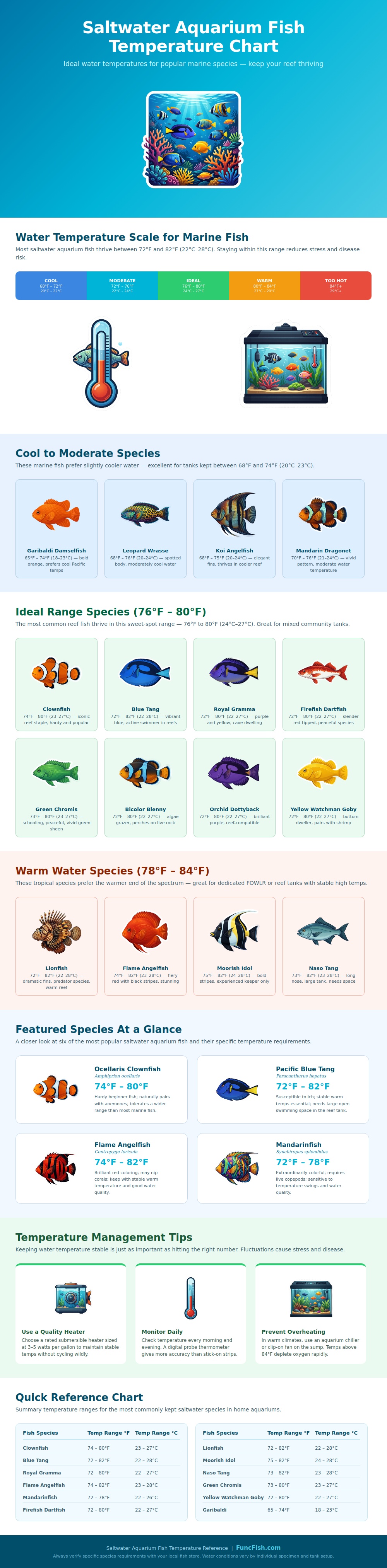
When you notice the fish are laying low and even appearing listless, hiding in the rock work, it could be a sign of bad water chemistry or even disease. But many times, the problem isnt so complex. While most saltwater hobbyists understand that their fish like to swim in warm water, few understands exactly how small that range really is for each type of fish.
To that end, visual guide breaks out those requirements into distinct areas based off warm tropical highs and cool Pacific lows. It can make sense of why a Clownfish would be happier around eight degrees warmer then a Garibaldi Damselfish. And it can help avoid the universal pitfall of thinking every marine creature is the same commodity.
Keeping Fish Happy with Right Water Temperature
In fact, keeping your tank in the comfortabley zone between 72-76 degrees Fahrenheit will put you right in the happy place for lots of favorite species. This middle ground also minimize stress hormone generation in the aquarium and maintains healthy immune responses. Let’s take the Clownfish (the classic orange-and-white fish of all reef tanks) as an example. It’s tolerant of a wider range than many species and thus is forgiving for the novice. That said, even they appreciates consistency; a rapid shift of only a couple-three degrees can be physically shocking.
In this instance, precision isnt as important as monitoring. No, you dont have to keep the temp precisely at 78.0 degrees all the time, but you should keeps it in a narrow range so the fish dont waste energy trying to regulate their own body temperature. Another key element frequently forgotten is that warmer water has lower levels of dissolved oxygen. Oxygen begins to diminish quite quickly as temperatures rises past eighty-four degrees or more. Fish dont just get unhappy with the temperature, they also start gasping at the surface. They arent just unhappy; they’re suffocating. That’s why the chart paints the dangerous range in red.
In most configurations, the risk of overheating will kill your livestock before undercoating will. Investing in some sort of little chiller or even just clipping a fan onto your sump can make all the difference when heatwave hits. Other species, such as Mandarin Dragonets, are cool-water species that relies on live food (like copepods) and do well in more stable temperature conditions. When water temps rise, however, it can result in the demise of these small prey item or drive them down into substrate beyond the reach of the fish. That’s when you run into a situation of ecological collapse-in-miniature, where your fish starve regardless of whether you feed him regularly. Maintaining the water just slightly cooler will help preserve natural food web within your tank.
To maintain these conditions, you will need certain equipment. You’ll need a proper sized submersible heater that wont cause the crazy cycling that stresses fish. The heater should provides gentle, continuous heat, not aggressive spurts of energy. Combine this with a digital probe thermometer rather than a stick-on strip. Stick-on strips is notorious for being way off or moving around. A probe gives you actualy numbers to rely upon as you make adjustments.
However, it’s all for naught unless you do what should of been obvious; watch the fish. Look for their body language around feedings. Do they just sit there? Or do they dart from one side of the tank to another? What are they doing? The answers to those questions is going to tell you far more about what is happening than any device ever will. If you match the tools to the needs of the species, eventually the tank run itself. It stabilizes and becomes the norm instead of constantly fighting against it. Your parameters become routine and your fish come out from behind cover and begin exploring. They swim again and color returns. They know they’re safe.
Then you look at that dial… but pay closer attention to your eyes. You will see that a peaceful tank is a happy tank. Temperature is the key to peace.