
All of sudden you’re in the water and it’s all happening. It is a glorios mess of shapes and colors. Even if you’ve dived many times before it’s overwhelming. Chances are good you’ll be looking at a blur of fish and never notice anything for what it realy is. Recognizing reef fish makes such a difference. It transforms your view from seeing “fish” to seeing each one as an individual creature. Each fish has its own history, its own role in the ecosystem and its own behavior.
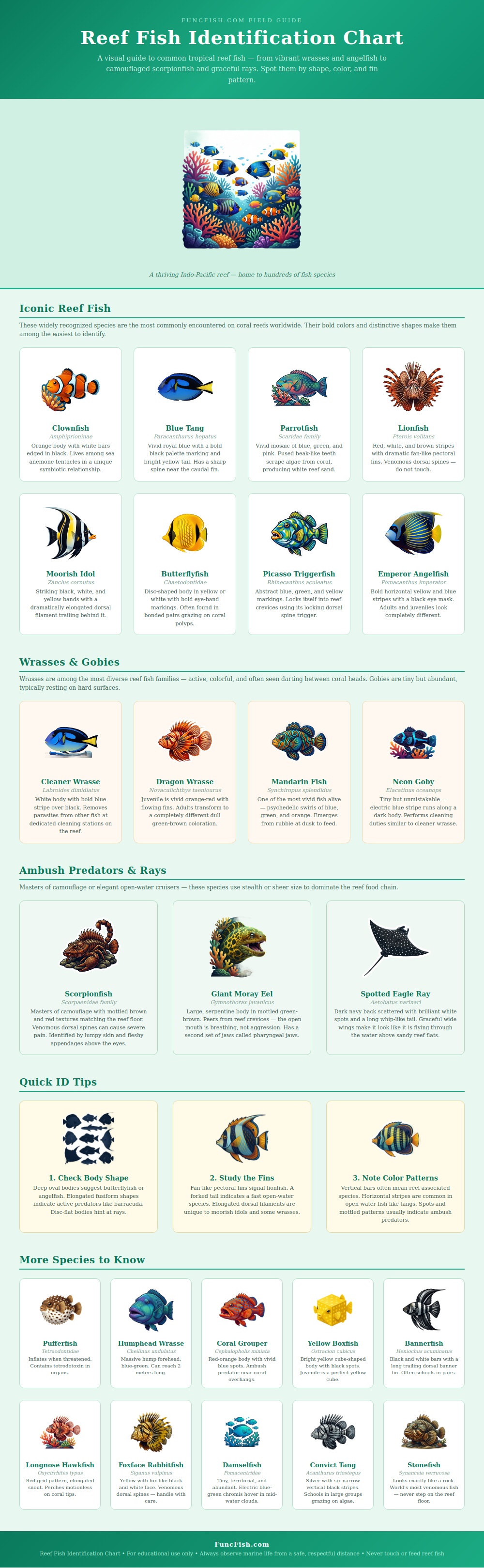
The visual reference above organize the most common residents into easy-to-manage categories that teach your eye to look for patterns instead of guessing randomly. We start with well-known icons of the reef: clownfish, which we all know about, but it is their relationship with sea anemones that gets all the credit. These fish actualy live amidst the paralyzing stinging tentacles, in exchange for protection against predators, they’ll clean the tentacles and eat whatever bits of leftovers fall from their mouths.
How to Identify Reef Fish
Another key part of the reef ecosystem are the herbivorous parrotfish and blue tang. Dory). Their tooth structure is designed more like beaks than teeth, which enables them to rasp away at corals’ surface to strip off algae. In turn, this creates enormous quantities of sand, so the beaches you visit was probably formed by parrotfish grinding down coral skeletons. Most tourists overlook how useful this is.
Body shape tell you almost everything about how a fish survives. Angelfish and butterflyfish has deep, oval bodies because they dart into and out of narrow crevices. Those bodies let them rapidly twist and turn amid the branches of corals. Conversely, if a fish have a streamlined, torpedo-shaped body, it’s a fast swimmer made for open water. This contrast is obvious from the chart above which shows that form follows function in a literal way.
See those dramatic pectoral fins splayed out wide? That’s probably an ambush predator like a lionfish, who uses stealth instead of speed. Its great fins help it sneak up on prey then corner it so it can strike. Don’t forget about the reef’s cleaners too. Tiny but necessary workers like neon gobies and cleaner wrasses establishes a station at which larger fish queue up for parasite removal. It’s a quiet moment in what is otherwise a competitive world. That bright blue band running down their body are a signal saying to the bigger predators, don’t worry, I’m a helper, not lunch.
By decreasing the load of parasites and diseases on all organisms in the reef, this teamwork make the reef healthy. Imagine how hard it would of be for the bigger guys without those little helpers. Another clue to identifying this group is that many species are camouflaged. Bottom dwellers such as stonefish and scorpionfish mimic their surroundings so well they appear as part of the rocks different than a living thing.
Because these species can’t outpace danger, they rely on defense mechanisms which include being toxic. In other words, venom means business, and it’s easy to see why these fish has it. When divers accidentally walk on one, it is usually because it is hard to see clearly in low light; they cannot tell a lump of rock from a dangerous object. So how do we solve that problem? Lesson learned: keep your hands and fins off ’em. If you don’t respect the camouflage then you don’t respect the animal’s survival strategy.
Last but not least, most reef fishes changes drastically in appearance from juvenile to adult forms. Dragon wrasses and emperor angelfish is examples that dramatically change colors with age. Many people mistake this polymorphism (occurrence of multiple distinct forms of one species) for two species instead of realizing it’s simply one species in various life stages. Knowing this about biology will help avoid misidentifications and make you appreciate their life cycle even more.
When you’re diving next, pay attention to the patterns. Notice the shapes. Recognize how each fish contribute to its particular role. The reef isn’t just a blur anymore; it’s a functional community made up of all these living pieces, each doing something important.