
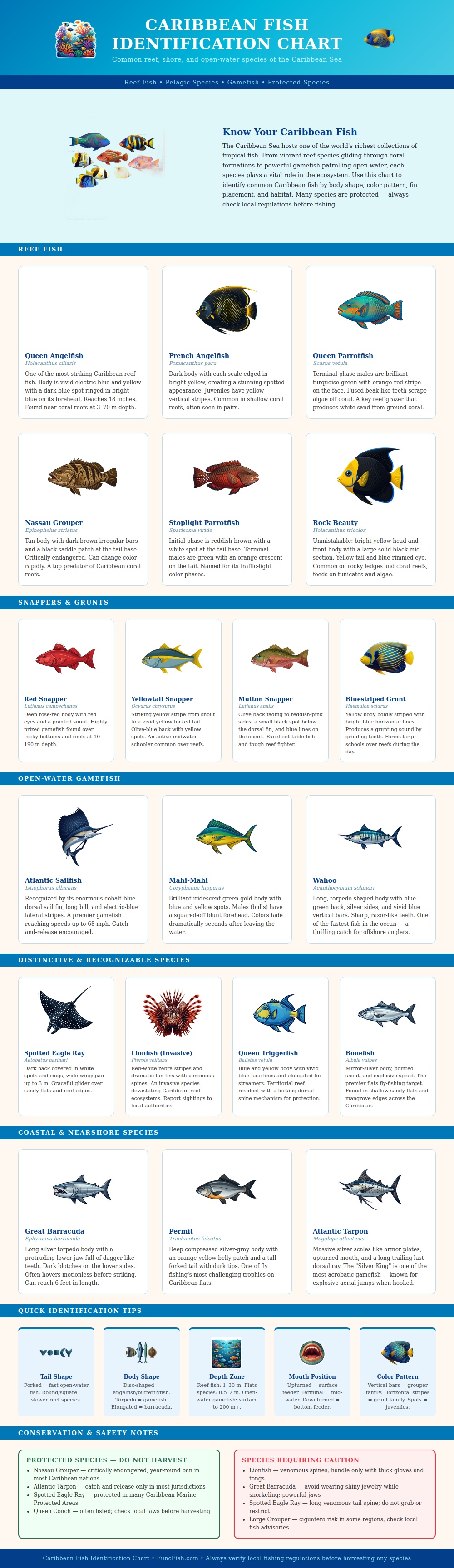
When you’re anchored off some coral head in the Bahamas, looking down at turquoise water that might as well be air, you see the reef: alive and moving. But it’s a blur of color unless you know what you’re looking at. Then there’s a green flash darting behind a brain coral, and a silver streak vanishes back out into the deep. Unless you have a frame of reference, one fish looks like all the others; identifying them becomes theoretical then essential. It changes what you leave alone, what you keep, how you interact with water.
The chart above groups them not just by name but by habitat, by their physical habits. That makes them easier to spot before they dissapears.
How to Identify Different Fish Types
You start with the reef dwellers. You are likely to spot them while snorkeling or fishing from a boat. Reef dwellers tend to be colorful for a reason. That’s because bright colors tell predators, “I’m not good to eat,” or, “I’m toxic.” Think of the angelfish, for example. They are stunning but prickly. The Rock Beauty is split starkly in two, with yellow on the front and black on the back, while the Queen Angelfish are all electric blue and yellow.
They stick close to the structure because they eat algae and tunicates that grow directly on the rock. This means you won’t spot them floating around out in open water. And their disc-shaped bodies allows them to fit snugly into crevices, protecting themselves from predator chases. It is armor by another name.
And then there are the grazers. The parrotfish have fused teeth that make them look ridiculous like a beak. They scrape away algae from the coral so it doesn’t get smothered. They also grind up dead coral to make white sand you’ll play in later. The Stoplight Parrotfish changes color like a traffic signal and the Queen Parrotfish is turquoise-green when male. Let them eat if you see them; they’re hard at work doing some serious ecological lifting.
Away from the edge of the reef, the water opens up, and this is where you find those schools of snappers and grunts. These are not as colorful as their reef cousins but also far more dangerous to catch. The classic prize is the Red Snapper, a fish with a pointed snout designed for speed and a deep rose-red color. The Yellowtail Snapper has that same bright stripe, even if it runs all the way back to its forked tail, a dead giveaway at a distance. Generally speaking, if it has a round tail, it means it can maneuver in tight spaces; if it’s got a forked tail, it means it’ll be fast. This is a simple rule of thumb that will help you guess behavior before you even get close.
The game is totally different if you head offshore. Species that live in open waters is designed for speed and endurance. The Atlantic Sailfish cuts through current with a huge dorsal fin raised high like a sail. Mahi-mahi flash iridescent gold and green but lose all color the moment they are out of the water. Wahoo have a true torpedo form with razor teeth. They don’t hang around. They cover miles of ocean. So it takes a patient angler with lots of respect for their power. Catching one requires respect.
Catch-and-release is becoming more common among many anglers as populations recover slow from overfishing. Identification goes beyond just naming species; it’s actualy essential. It’s also important to be safe. It’s also important to be safe. Certain fish appear harmless yet can spoil your dive. Take lionfish, an invasive species that proliferates without any natural protection from native species in local environments. They’re venomous and have spines. Then there’s the Spotted Eagle Ray that gracefully cruises the sandy bottom, with a razor-sharp, poisonous tail spine you never touch. There’s the Great Barracuda, hovering ominously in the shadows and watching shiny jewelry like it’s bait. Remove your rings before diving because it’s not only a matter of being bitten but of showing respect for a superior predator on his turf.
Even more important are the protected species. In most Caribbean countries, taking the Nassau Grouper is prohibited. This species had a population crash from overfishing and is now considered critically endangered. They take decades to reach maturity and spawn rarely; also, tarpon is protected throughout their range. Take a single one and you hurt the stock for years. Rules exist for a reason, so check them locally before you fish.
But to identify is more than that (it’s to identify the system as well). If you can recognize what fish hunts, who guards, and who grazes, then the reef will no longer appear random. Instead it’ll appear as a machine. And you’ll begin to read the water, see how the groupers hovers by the ledge waiting to ambush prey, or how the parrotfish open up space for new coral polyps.
The next time you are on vacation in the Caribbean, before you go casting or diving, spend some time looking around. Notice what the fish hang out by, what shape they have and what color. A beautiful view turns into a livig story. Once you see how the fish pattern, you would of never looked at the ocean the same again.