
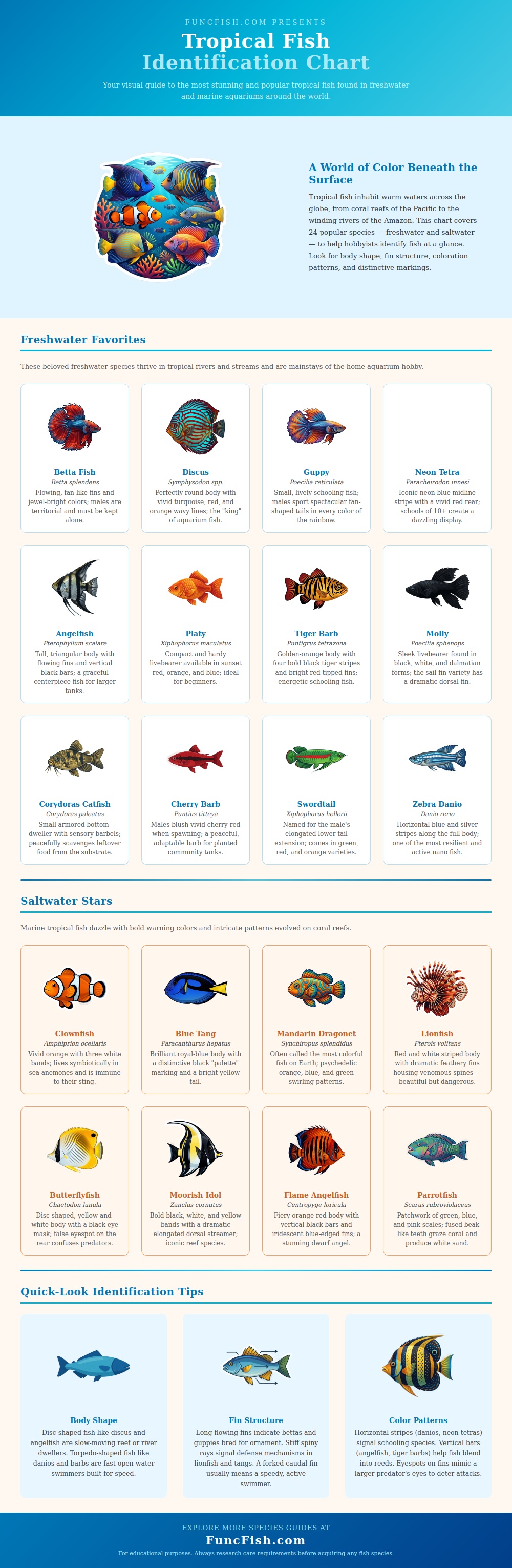
A flash of electric blue zips past a driftwood root in the glow of your tank. Maybe a neon tetra? Oh, no! The fish need to be identified, cardinal tetras is double the price and have more demanding water requirements. Correctly identifying your fish isn’t just embarrassing for you, the hobbyist. It could result in buying the wrong food, acquiring the wrong tank mate, or possibly introducing a pest species that’ll ruin your ecosystem. Identifying fish are aquarium keeping‘s first line of defense.
To narrow things down for you, I’ve put together a visual reference (above) of two dozen popular species and divided it into saltwater and freshwater. What you’ll immediately notice here is that the chart do not group them by color, but instead by where each species come from naturaly. A fish is defined more by its origins different than by its appearance.
Why You Must Know Your Fish Types
Take the Guppy vs. The Betta Splendens, which share a similar flashiness but opposite social requirements. The Guppy prefer to be kept in schools while the Betta require being left alone. It is a very common misstep for beginners to mix species based solely on size, resulting in damaged fish. The Betta species, which share a similar flashiness but opposite social requirements. The Guppy prefers to be kept in school while the Betta requires being left alone. It is a very common misstep for beginners to mix species based solely on size, resulting in damaged fish.
Take a look at body shape when viewing the freshwater side. If the fish are disc shaped, like an Angelfish or a Discus, you have a species of slow moving fish from the rivers. These fish prefers open swimming space close to the surface and calm currents. If the fish are torpedo shaped, like a Tiger Barb or a Zebra Danio, then this is a fast swimmer who require horizontal space to cruise. Confine him in a narrow tank and he’ll bounce off the glass. This is why it’s not just about number of gallons. It’s also about the relationship between tank shape and body type. You can’t put a fast swimmer in a lane that’s too short.
Beyond aesthetics, color is a practical hint too. For example, neon tetra or danio use horizontal stripes when schooling up to blend into each other. This makes the school look like a mirror which throws off a predator. Tiger barbs or angelfish uses vertical stripes to hide against vertical structures, like reeds, in the rivers where they comes from. That’s why knowing about it helps you select the right aquascaping. If your tank contains nothing but smooth rocks and vertically stripy fish, those fish will be feeling uncomfortabley. In short, nature designed things to look good but also function well. That’s what the chart demonstrates nicely… Form follows function in nature.
Not all aquatic life is equal; salties can be more finicky as marine fish tend to be more prone to fluctuations in water conditions. Two popular reef creatures (and perhaps the most famous) includes the Blue Tang and Clownfish. Both prefer regular salinity levels and hiding places. For the Tang, that means grazing areas while the Clown relies on anemones for shelter.
We also included the Lionfish. It is pretty but potentially deadly. Just know it’s not just trying to look cute when those spines gets up! It’s a defense mechanism. Handle with care…and respect.
But more than knowing the name of a fish is knowing its nature. You should of know whether it’s a grazer in the middle of the water column or a scavenger on the bottom, like the Corydoras catfish. And the chart clearly divides that function. See the Corydorus have those whisker-like sensory barbels that probe the substrate? The Parrotfish has teeth that are fused together for scraping coral. So you know right away where they fits into your tank’s food chain. Why waste money by feeding floating pellets to a bottom feeder? That’s an inefficient use of resources.
Start with the obvious: fins. Fins that is long and flowy usually tell me these fish are ornamental breeds (e.g., Bettas, Guppies). Ornamentals tend to be delicate and sensitive to improper water flow. Spiky, stiff fin rays typically is a sign of defensive behavior. Tangs or even Lionfish has this. An active fish will usually have a forked tail. Knowing their diet and activity level will help determine the rest of their care.
Next time you’re at the store, don’t focus only on color. Focus on the structure. Sure, the fish won’t speak to you but its body will scream at you what it needs to stay alive.